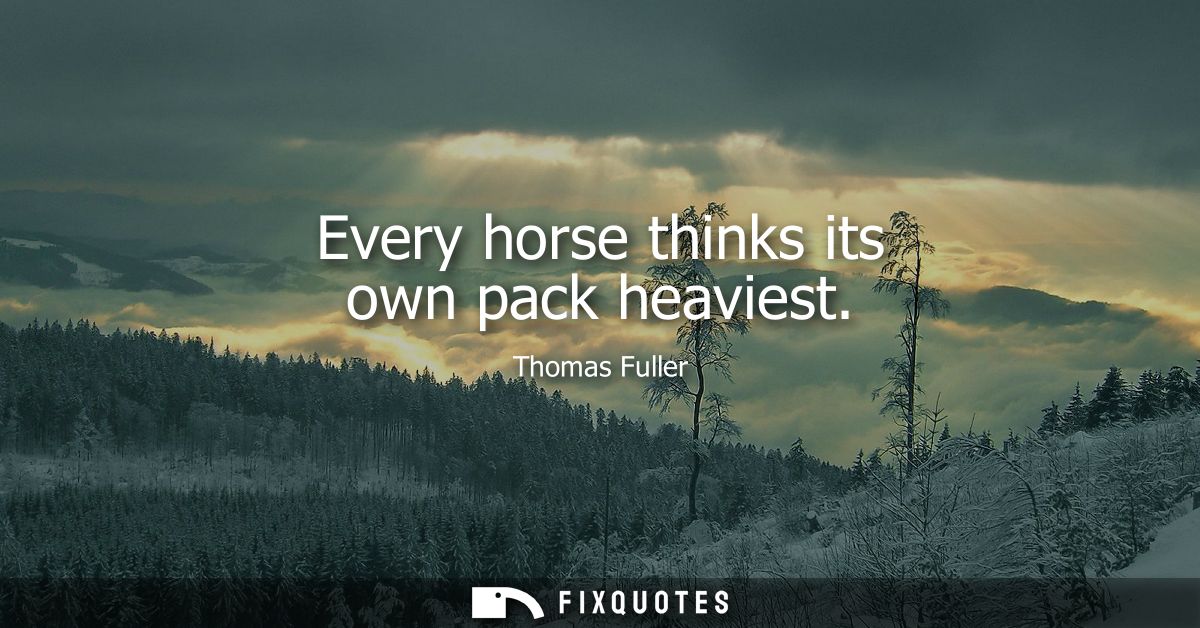
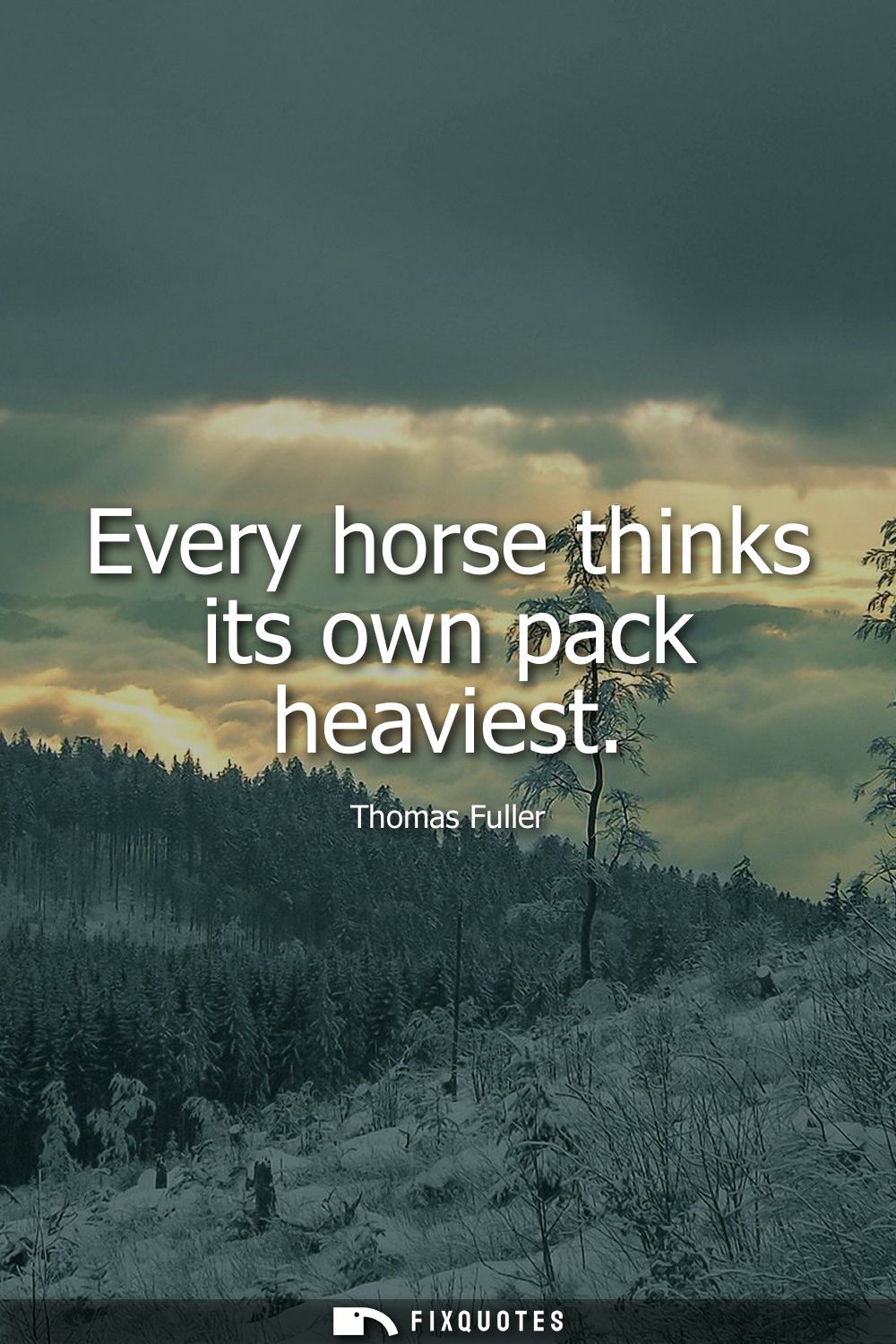
"Every horse thinks its own pack heaviest"
About this Quote
Self-pity loves a proverb because it can hide behind barnyard common sense. “Every horse thinks its own pack heaviest” is Fuller’s compact diagnosis of a stubborn human reflex: we experience our burdens from the inside, so they feel uniquely crushing, even when they’re ordinary, shared, or objectively lighter than someone else’s load.
Fuller, a seventeenth-century English clergyman, worked in a culture steeped in moral instruction and public upheaval (civil war, religious conflict, political whiplash). In that setting, complaint isn’t just annoying; it’s spiritually risky. The line nudges the listener away from a self-centered narration of suffering and toward humility, patience, and a more charitable reading of other people’s struggles. The horse is a shrewd choice: not a tragic hero, not a sinner, just a working animal doing what it’s built to do. That framing makes the point less accusatory and more inevitable. Of course the horse thinks its pack is heaviest. That’s how perception works when your ribs are the ones under the straps.
The subtext is a warning against the moral inflation of inconvenience. Fuller isn’t denying pain; he’s challenging the performance of pain as evidence of specialness. The proverb quietly reorders status: your hardship doesn’t automatically make you exceptional, and someone else’s silence doesn’t mean their pack is light. It’s pastoral counsel with teeth, aimed at a community tempted to turn grievance into identity.
Fuller, a seventeenth-century English clergyman, worked in a culture steeped in moral instruction and public upheaval (civil war, religious conflict, political whiplash). In that setting, complaint isn’t just annoying; it’s spiritually risky. The line nudges the listener away from a self-centered narration of suffering and toward humility, patience, and a more charitable reading of other people’s struggles. The horse is a shrewd choice: not a tragic hero, not a sinner, just a working animal doing what it’s built to do. That framing makes the point less accusatory and more inevitable. Of course the horse thinks its pack is heaviest. That’s how perception works when your ribs are the ones under the straps.
The subtext is a warning against the moral inflation of inconvenience. Fuller isn’t denying pain; he’s challenging the performance of pain as evidence of specialness. The proverb quietly reorders status: your hardship doesn’t automatically make you exceptional, and someone else’s silence doesn’t mean their pack is light. It’s pastoral counsel with teeth, aimed at a community tempted to turn grievance into identity.
Quote Details
| Topic | Wisdom |
|---|---|
| Source | Help us find the source |
| Cite |
Citation Formats
APA Style (7th ed.)
Fuller, Thomas. (2026, January 15). Every horse thinks its own pack heaviest. FixQuotes. https://fixquotes.com/quotes/every-horse-thinks-its-own-pack-heaviest-10310/
Chicago Style
Fuller, Thomas. "Every horse thinks its own pack heaviest." FixQuotes. January 15, 2026. https://fixquotes.com/quotes/every-horse-thinks-its-own-pack-heaviest-10310/.
MLA Style (9th ed.)
"Every horse thinks its own pack heaviest." FixQuotes, 15 Jan. 2026, https://fixquotes.com/quotes/every-horse-thinks-its-own-pack-heaviest-10310/. Accessed 22 Mar. 2026.
More Quotes by Thomas
Add to List