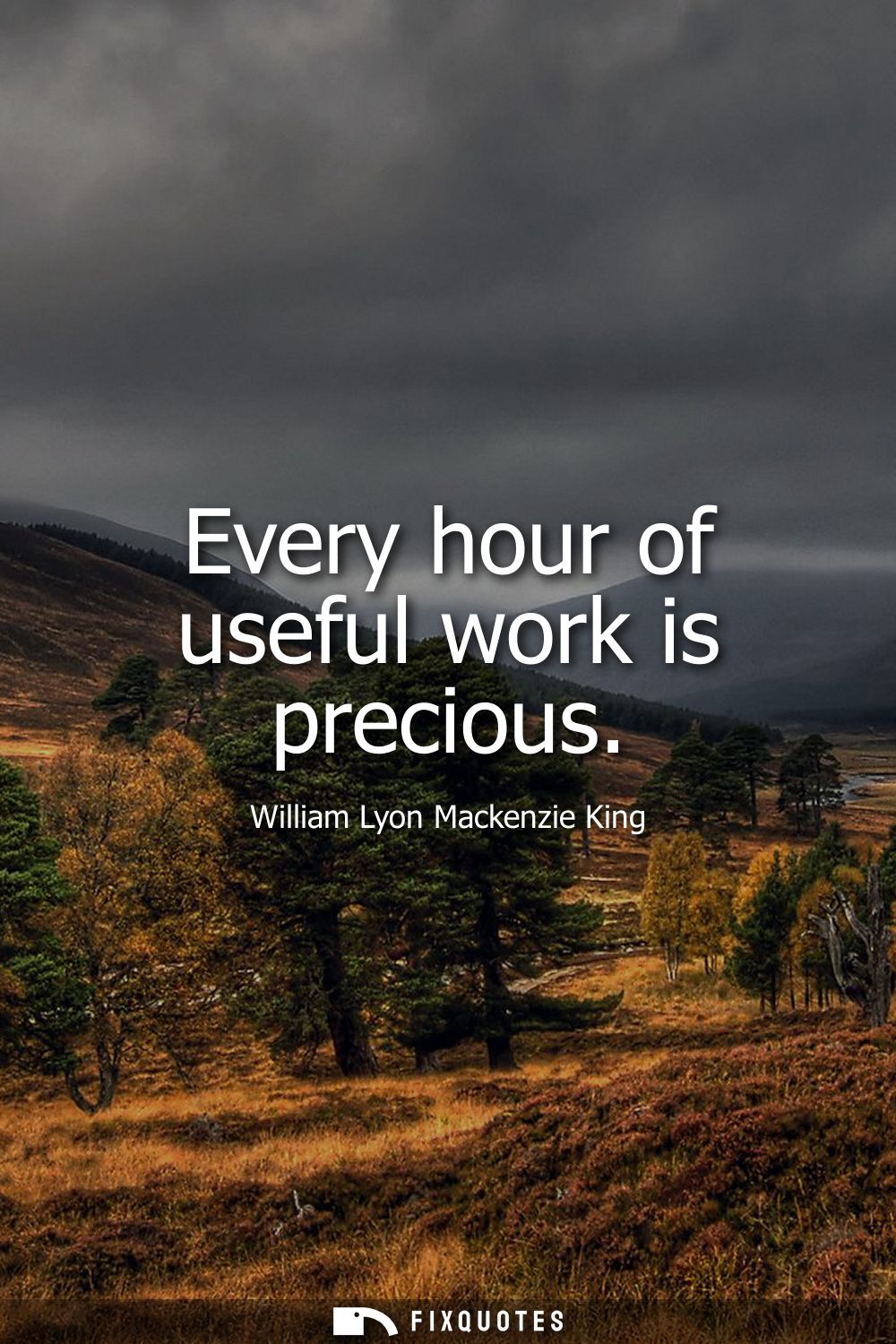
"Every hour of useful work is precious"
About this Quote
"Every hour of useful work is precious" lands with the cool austerity of a politician who made a career out of patience, incrementalism, and staying in power. Mackenzie King wasn’t selling romance about labor; he was selling legitimacy. "Useful" is the tell. It draws a hard line between effort that flatters the ego and effort that moves the state. In four words, he makes productivity a moral category, then quietly reserves the right to define what counts.
The phrasing also signals a particular kind of governance: time as an administrative resource. King’s Canada, especially through the Depression and World War II, ran on rationing, mobilization, and careful coalition management. In that world, wasted hours aren’t just a personal failing; they’re a leak in the national vessel. "Precious" borrows the language of scarcity usually reserved for money or materials, turning labor time into a commodity that must be stewarded. It’s Protestant work ethic stripped of hymn and replaced with a ledger.
The subtext is disciplining, but it’s also protective. By praising "useful work" rather than sheer toil, King implies a social contract: citizens contribute; the government ensures the contribution matters. It’s an argument against both idle entitlement and performative busyness. Coming from a leader known for bureaucratic mastery and cautious pragmatism, the line doubles as self-justification: steady, practical labor - not dramatic gestures - is how a country survives crisis and earns its future one hour at a time.
The phrasing also signals a particular kind of governance: time as an administrative resource. King’s Canada, especially through the Depression and World War II, ran on rationing, mobilization, and careful coalition management. In that world, wasted hours aren’t just a personal failing; they’re a leak in the national vessel. "Precious" borrows the language of scarcity usually reserved for money or materials, turning labor time into a commodity that must be stewarded. It’s Protestant work ethic stripped of hymn and replaced with a ledger.
The subtext is disciplining, but it’s also protective. By praising "useful work" rather than sheer toil, King implies a social contract: citizens contribute; the government ensures the contribution matters. It’s an argument against both idle entitlement and performative busyness. Coming from a leader known for bureaucratic mastery and cautious pragmatism, the line doubles as self-justification: steady, practical labor - not dramatic gestures - is how a country survives crisis and earns its future one hour at a time.
Quote Details
| Topic | Work Ethic |
|---|---|
| Source | Help us find the source |
| Cite |
Citation Formats
APA Style (7th ed.)
King, William Lyon Mackenzie. (2026, January 15). Every hour of useful work is precious. FixQuotes. https://fixquotes.com/quotes/every-hour-of-useful-work-is-precious-157594/
Chicago Style
King, William Lyon Mackenzie. "Every hour of useful work is precious." FixQuotes. January 15, 2026. https://fixquotes.com/quotes/every-hour-of-useful-work-is-precious-157594/.
MLA Style (9th ed.)
"Every hour of useful work is precious." FixQuotes, 15 Jan. 2026, https://fixquotes.com/quotes/every-hour-of-useful-work-is-precious-157594/. Accessed 23 Mar. 2026.
More Quotes by William
Add to List