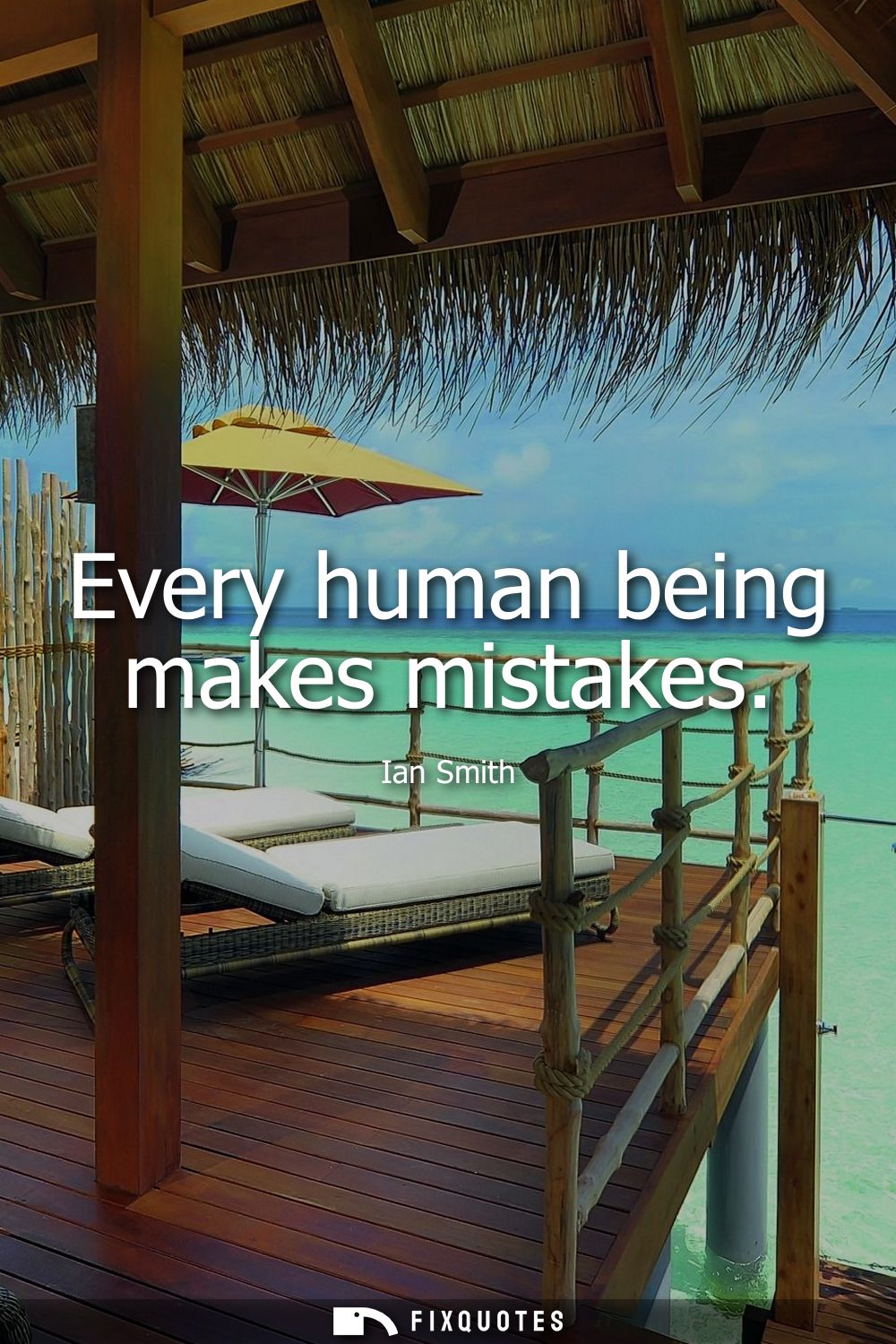
"Every human being makes mistakes"
About this Quote
A bland sentence can still carry a sharp political payload. “Every human being makes mistakes” reads like a soft, moral truism, but in a politician’s mouth it’s rarely just about humility; it’s about reframing blame. The genius of the line is its vagueness. It universalizes error, dissolving the difference between an accidental misjudgment and a catastrophic, deliberate policy choice. By turning “mistakes” into a shared human condition, it invites the listener to move from judgment to forgiveness without ever naming what, exactly, needs forgiving.
With Ian Smith, that evasiveness matters. Smith wasn’t a minor officeholder apologizing for a gaffe; he was the Rhodesian leader who defended minority rule and resisted majority-democratic transition until forced into it. In that shadow, “mistakes” becomes a strategic downgrade: history’s verdict reduced to personal imperfection. The subtext is: don’t treat this as ideology or injustice; treat it as fallibility. It’s a familiar political maneuver: slide from accountability (what did you do, and to whom?) to temperament (we’re all only human), hoping the moral arithmetic changes.
The line also performs a subtle solidarity play. It reaches for a common denominator with the audience, implying that to condemn him too harshly is to deny your own flaws. That’s why it works: it recruits empathy as a shield. But it also reveals the limits of contrition. Real reckoning is specific; this is abstract. When the stakes are governance and rights, the public hears “mistakes” and wonders which humans were forced to live inside them.
With Ian Smith, that evasiveness matters. Smith wasn’t a minor officeholder apologizing for a gaffe; he was the Rhodesian leader who defended minority rule and resisted majority-democratic transition until forced into it. In that shadow, “mistakes” becomes a strategic downgrade: history’s verdict reduced to personal imperfection. The subtext is: don’t treat this as ideology or injustice; treat it as fallibility. It’s a familiar political maneuver: slide from accountability (what did you do, and to whom?) to temperament (we’re all only human), hoping the moral arithmetic changes.
The line also performs a subtle solidarity play. It reaches for a common denominator with the audience, implying that to condemn him too harshly is to deny your own flaws. That’s why it works: it recruits empathy as a shield. But it also reveals the limits of contrition. Real reckoning is specific; this is abstract. When the stakes are governance and rights, the public hears “mistakes” and wonders which humans were forced to live inside them.
Quote Details
| Topic | Learning from Mistakes |
|---|---|
| Source | Help us find the source |
| Cite |
Citation Formats
APA Style (7th ed.)
Smith, Ian. (2026, January 16). Every human being makes mistakes. FixQuotes. https://fixquotes.com/quotes/every-human-being-makes-mistakes-85491/
Chicago Style
Smith, Ian. "Every human being makes mistakes." FixQuotes. January 16, 2026. https://fixquotes.com/quotes/every-human-being-makes-mistakes-85491/.
MLA Style (9th ed.)
"Every human being makes mistakes." FixQuotes, 16 Jan. 2026, https://fixquotes.com/quotes/every-human-being-makes-mistakes-85491/. Accessed 6 Mar. 2026.
More Quotes by Ian
Add to List