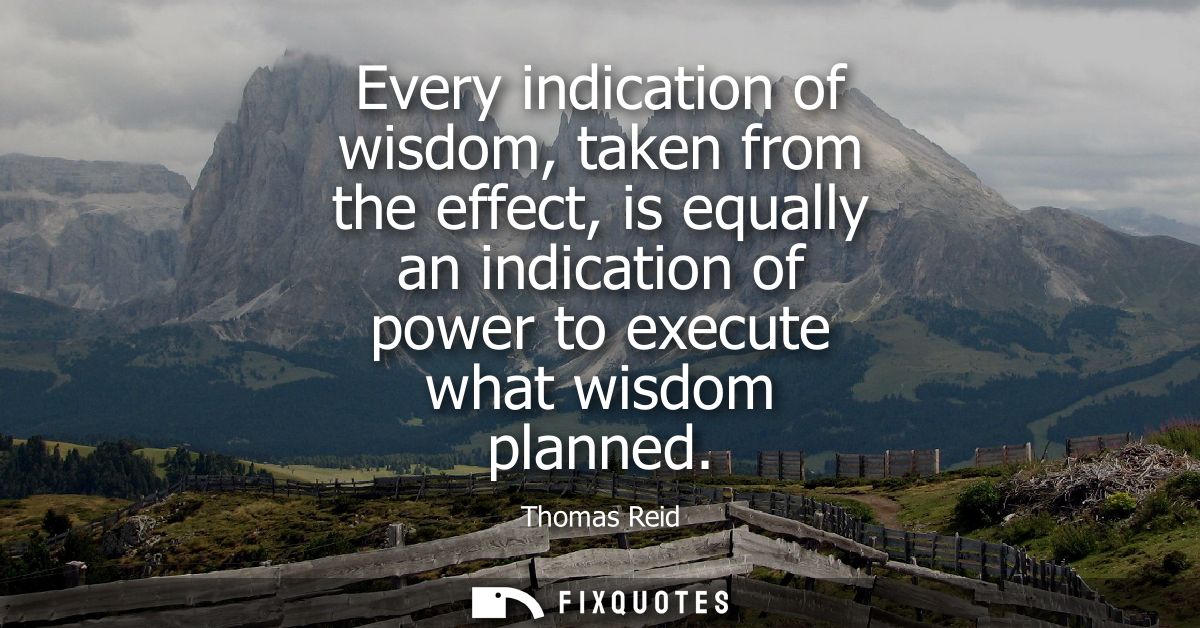
"Every indication of wisdom, taken from the effect, is equally an indication of power to execute what wisdom planned"
About this Quote
That’s a pointed intervention in Reid’s 18th-century terrain. As a leading figure of the Scottish Common Sense tradition, he was suspicious of philosophies that dissolved reality into mental theater. His era was full of epistemological doubt: how do we know causes, selves, God, or even the external world? Reid’s move is pragmatic without being modern “hustle culture.” He anchors lofty claims in publicly legible consequences: you know a mind by what it can reliably bring about.
The subtext is also theological and political. Read “wisdom” as divine providence and “effects” as the order of nature: the world’s intelligibility signals not just a clever designer but an effective one. Read it socially, and it becomes a critique of armchair rationality: planning is not a separate virtue from execution. Reid collapses the gap between knowing and doing, insisting that the most convincing evidence of intelligence is agency that leaves a footprint.
Quote Details
| Topic | Wisdom |
|---|---|
| Source | Help us find the source |
| Cite |
Citation Formats
APA Style (7th ed.)
Reid, Thomas. (2026, January 17). Every indication of wisdom, taken from the effect, is equally an indication of power to execute what wisdom planned. FixQuotes. https://fixquotes.com/quotes/every-indication-of-wisdom-taken-from-the-effect-65264/
Chicago Style
Reid, Thomas. "Every indication of wisdom, taken from the effect, is equally an indication of power to execute what wisdom planned." FixQuotes. January 17, 2026. https://fixquotes.com/quotes/every-indication-of-wisdom-taken-from-the-effect-65264/.
MLA Style (9th ed.)
"Every indication of wisdom, taken from the effect, is equally an indication of power to execute what wisdom planned." FixQuotes, 17 Jan. 2026, https://fixquotes.com/quotes/every-indication-of-wisdom-taken-from-the-effect-65264/. Accessed 30 Mar. 2026.