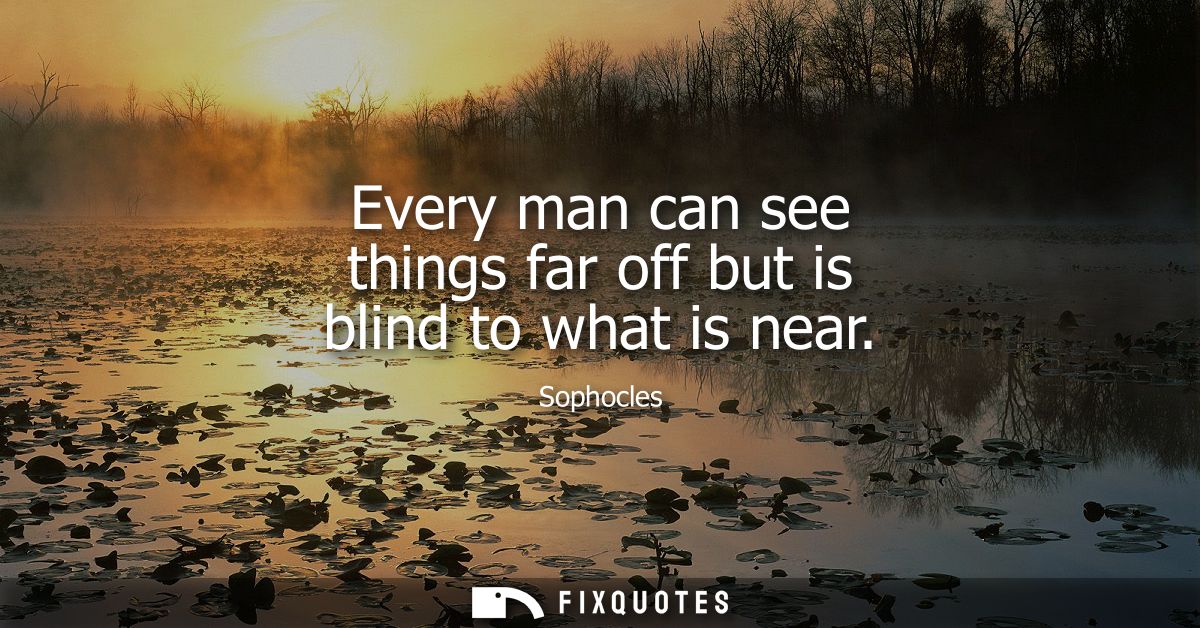
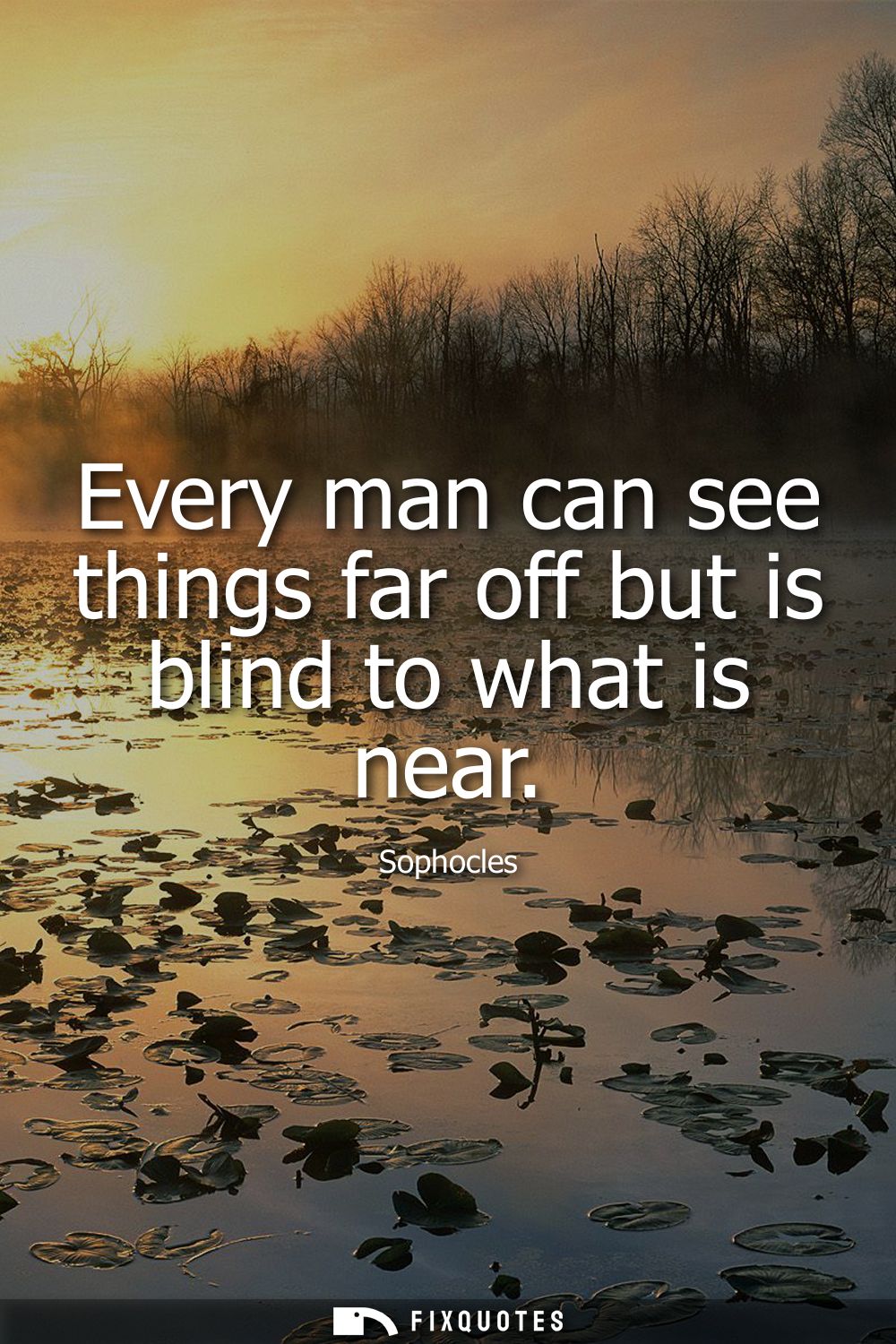
"Every man can see things far off but is blind to what is near"
About this Quote
A line like this lands because it flatters the reader for a split second, then withdraws the compliment. Yes, we can “see far off”: we can predict outcomes in politics, diagnose strangers’ relationships, sketch grand plans for our future selves. Sophocles then snaps the lens back to the humiliating truth that we routinely miss what’s right in front of us: the motive we won’t name, the compromise we’re already making, the warning signs in our own house.
The craft is in the distance metaphor. “Far off” suggests objectivity, the god’s-eye view, the clean geometry of cause and effect. “Near” is messy: it’s pride, family, obligation, the small daily decisions where character actually shows itself. Sophocles, writing tragedies obsessed with tragic blindness (sometimes literal, often moral), knows that humans prefer prophecy to self-knowledge because prophecy feels like information, while self-knowledge feels like indictment.
The subtext is a critique of a particular kind of confidence: the civic, masculine certainty of the polis that can debate fate and justice in public while failing at the private work of attention. Greek tragedy repeatedly stages leaders and fathers who can interpret omens yet cannot read the person beside them. That’s not a contradiction; it’s the engine. Distance gives you the illusion of control. Nearness demands responsibility.
What makes the line endure is how it weaponizes familiarity. Everyone recognizes the pattern, which means everyone is implicated. Sophocles doesn’t offer comfort; he offers a trapdoor under our smartest interpretations of the world.
The craft is in the distance metaphor. “Far off” suggests objectivity, the god’s-eye view, the clean geometry of cause and effect. “Near” is messy: it’s pride, family, obligation, the small daily decisions where character actually shows itself. Sophocles, writing tragedies obsessed with tragic blindness (sometimes literal, often moral), knows that humans prefer prophecy to self-knowledge because prophecy feels like information, while self-knowledge feels like indictment.
The subtext is a critique of a particular kind of confidence: the civic, masculine certainty of the polis that can debate fate and justice in public while failing at the private work of attention. Greek tragedy repeatedly stages leaders and fathers who can interpret omens yet cannot read the person beside them. That’s not a contradiction; it’s the engine. Distance gives you the illusion of control. Nearness demands responsibility.
What makes the line endure is how it weaponizes familiarity. Everyone recognizes the pattern, which means everyone is implicated. Sophocles doesn’t offer comfort; he offers a trapdoor under our smartest interpretations of the world.
Quote Details
| Topic | Wisdom |
|---|---|
| Source | Help us find the source |
| Cite |
Citation Formats
APA Style (7th ed.)
Sophocles. (2026, January 15). Every man can see things far off but is blind to what is near. FixQuotes. https://fixquotes.com/quotes/every-man-can-see-things-far-off-but-is-blind-to-33867/
Chicago Style
Sophocles. "Every man can see things far off but is blind to what is near." FixQuotes. January 15, 2026. https://fixquotes.com/quotes/every-man-can-see-things-far-off-but-is-blind-to-33867/.
MLA Style (9th ed.)
"Every man can see things far off but is blind to what is near." FixQuotes, 15 Jan. 2026, https://fixquotes.com/quotes/every-man-can-see-things-far-off-but-is-blind-to-33867/. Accessed 12 Feb. 2026.
More Quotes by Sophocles
Add to List