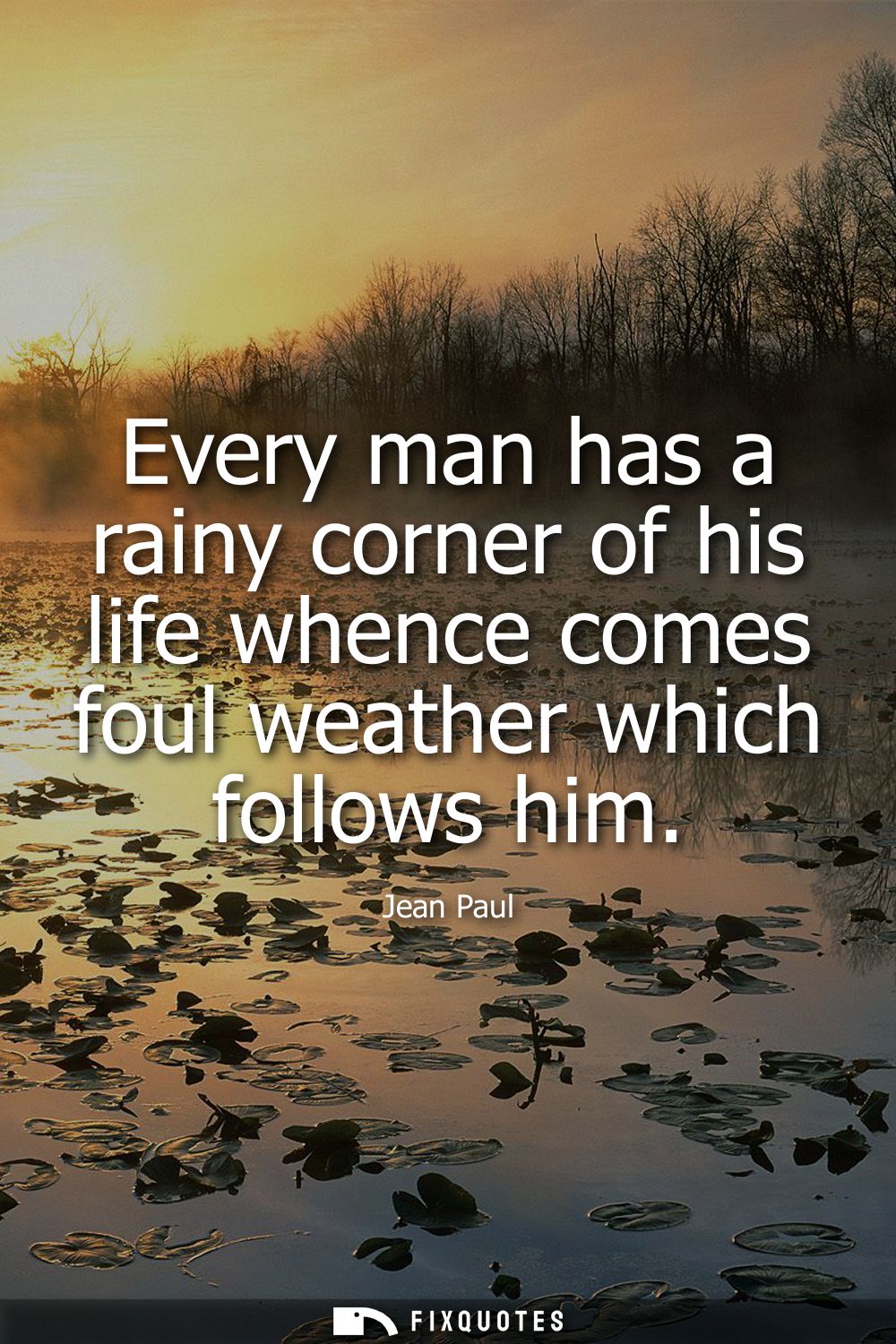
"Every man has a rainy corner of his life, whence comes foul weather which follows him"
About this Quote
The subtext is quietly accusatory. "Whence comes foul weather" frames misery as an origin point, a source you can trace back to a specific interior space. The "follows him" clause lands the cynicism: you can move cities, change jobs, marry for reinvention, but whatever you refuse to face will keep pace. It reads like an early psychological insight dressed in Romantic-era imagery, less clinical than Freud, more rueful than self-help.
Context matters here: Jean Paul wrote in a Germany shaped by war, rapid social change, and the long shadow of Enlightenment ideals colliding with Romantic introspection. His work often blends sentiment with sharp observation, and this line has that double edge. It comforts (you are not uniquely broken) while undermining the fantasy of a clean slate. The intent isn't to wallow; it's to make readers recognize their own hidden corner and, by naming it, loosen its grip.
Quote Details
| Topic | Tough Times |
|---|---|
| Source | Help us find the source |
| Cite |
Citation Formats
APA Style (7th ed.)
Paul, Jean. (2026, February 19). Every man has a rainy corner of his life, whence comes foul weather which follows him. FixQuotes. https://fixquotes.com/quotes/every-man-has-a-rainy-corner-of-his-life-whence-49822/
Chicago Style
Paul, Jean. "Every man has a rainy corner of his life, whence comes foul weather which follows him." FixQuotes. February 19, 2026. https://fixquotes.com/quotes/every-man-has-a-rainy-corner-of-his-life-whence-49822/.
MLA Style (9th ed.)
"Every man has a rainy corner of his life, whence comes foul weather which follows him." FixQuotes, 19 Feb. 2026, https://fixquotes.com/quotes/every-man-has-a-rainy-corner-of-his-life-whence-49822/. Accessed 27 Mar. 2026.