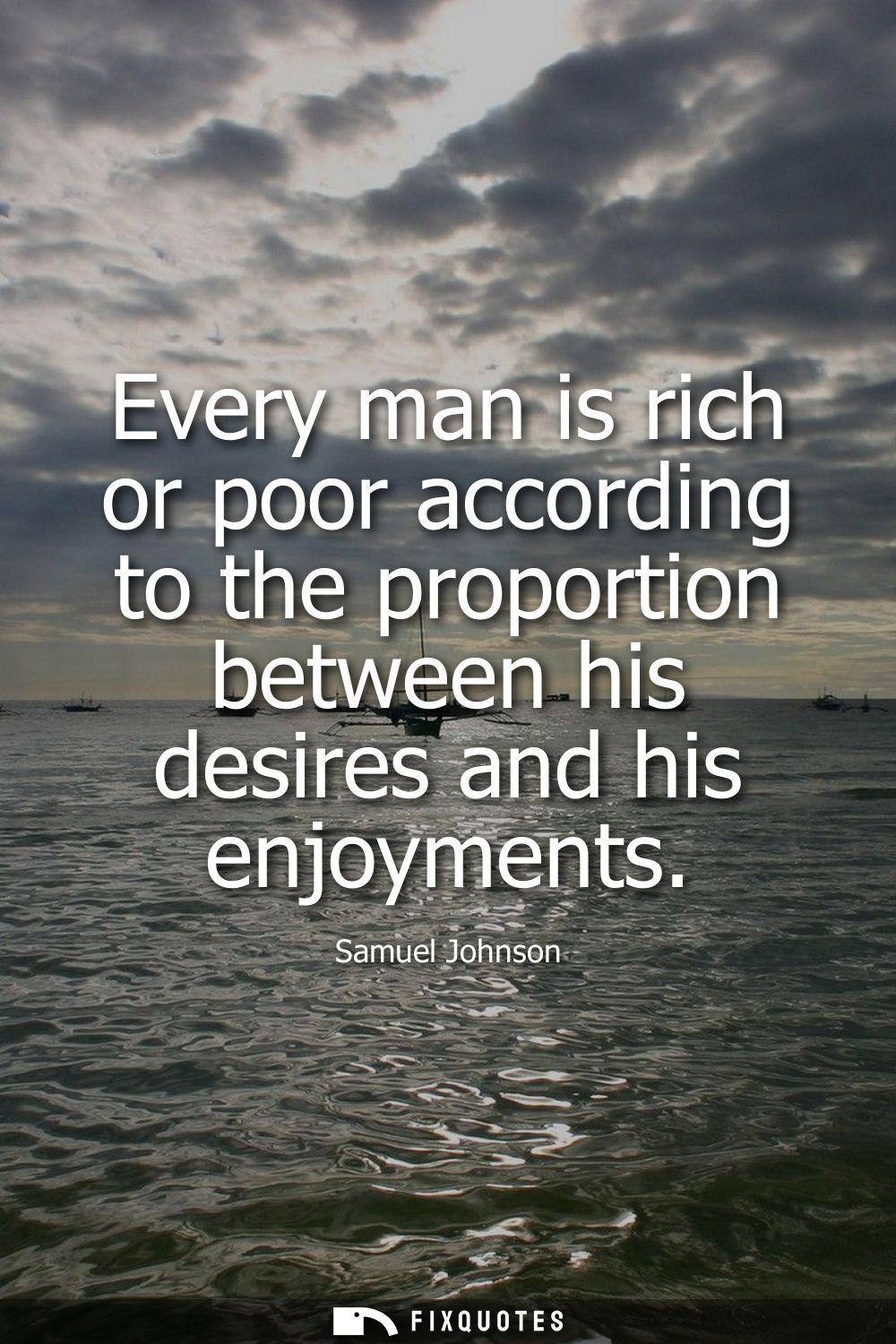
"Every man is rich or poor according to the proportion between his desires and his enjoyments"
About this Quote
The subtext carries a moral edge typical of an 18th-century author steeped in Christian ethics and classical restraint. Desire isn’t treated as a harmless appetite but as a solvent that dissolves satisfaction. Enjoyment, meanwhile, isn’t hedonism so much as the cultivated ability to relish what’s already in hand. The sentence quietly shifts responsibility inward: you can chase more, but you can also discipline wanting, train attention, and enlarge gratitude. That’s both liberating and accusatory.
Context matters. Johnson wrote in a Britain where commerce and empire were expanding, and where status anxiety was becoming a kind of public sport. His era was inventing modern consumer temptation, and he answers with a stoic counter-program: prosperity without contentment is a form of poverty; modest means with steady enjoyment can be genuine wealth. It’s also a critique of social comparison before social media made it an industry. Johnson’s ratio still lands because it identifies the hidden engine of inequality: not just what people have, but the appetites culture teaches them to feel entitled to.
Quote Details
| Topic | Contentment |
|---|---|
| Source | Verified source: The Rambler, No. 169 (Saturday, Oct. 26, 1751) (Samuel Johnson, 1751)
Evidence: Every man is rich or poor, according to the proportion between his desires and enjoyments; any enlargement of wishes is therefore equally destructive to happiness with the diminution of possession; and he that teaches another to long for what he never shall obtain, is no less an enemy to his quiet, than if he had robbed him of part of his patrimony. (Rambler No. 169 (within the periodical essay; exact page varies by edition)). This sentence appears in Samuel Johnson’s periodical essay The Rambler, No. 169, originally published on Saturday, October 26, 1751. The wording in many modern quotations slightly differs by adding an extra “his” before “enjoyments”; Johnson’s original reads “between his desires and enjoyments.” The ECCO scan (University of Michigan) is a primary-source reproduction of the 18th-century printed text; page numbering differs across printings/collected editions, so citing the Rambler number and date is the most reliable way to identify the first publication. Other candidates (1) The Oxford Handbook of Samuel Johnson (Jack Lynch, 2022)95.0% ... Every man is rich or poor according to the proportion between his desires and his enjoyments; any enlargement of ... |
| Cite |
Citation Formats
APA Style (7th ed.)
Johnson, Samuel. (2026, February 26). Every man is rich or poor according to the proportion between his desires and his enjoyments. FixQuotes. https://fixquotes.com/quotes/every-man-is-rich-or-poor-according-to-the-36060/
Chicago Style
Johnson, Samuel. "Every man is rich or poor according to the proportion between his desires and his enjoyments." FixQuotes. February 26, 2026. https://fixquotes.com/quotes/every-man-is-rich-or-poor-according-to-the-36060/.
MLA Style (9th ed.)
"Every man is rich or poor according to the proportion between his desires and his enjoyments." FixQuotes, 26 Feb. 2026, https://fixquotes.com/quotes/every-man-is-rich-or-poor-according-to-the-36060/. Accessed 31 Mar. 2026.