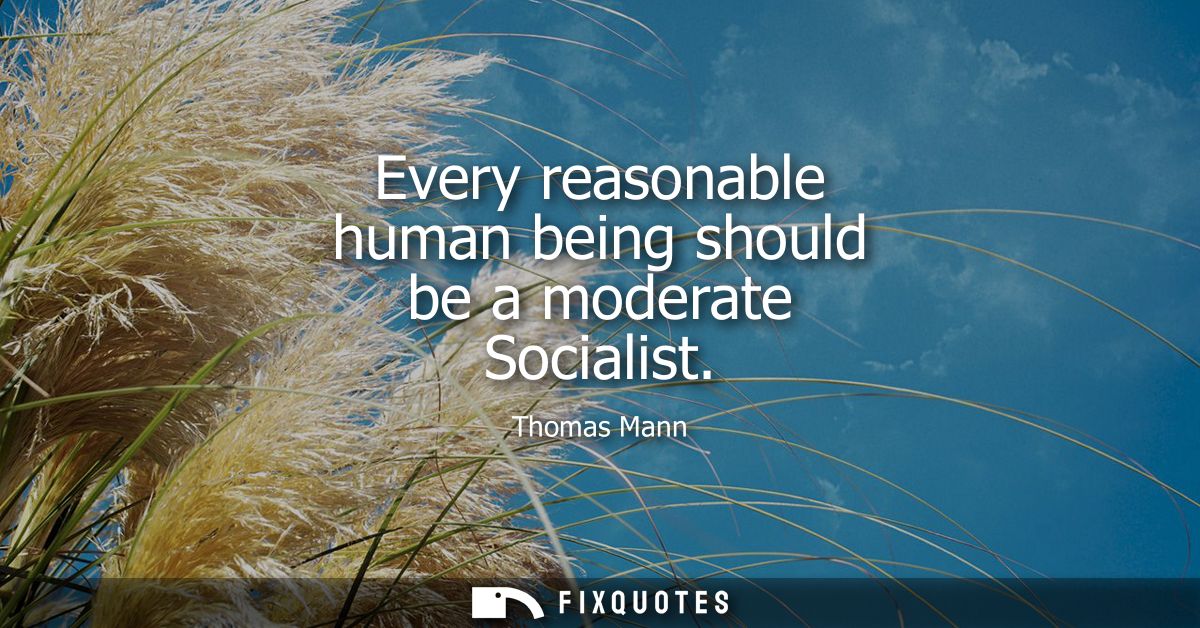
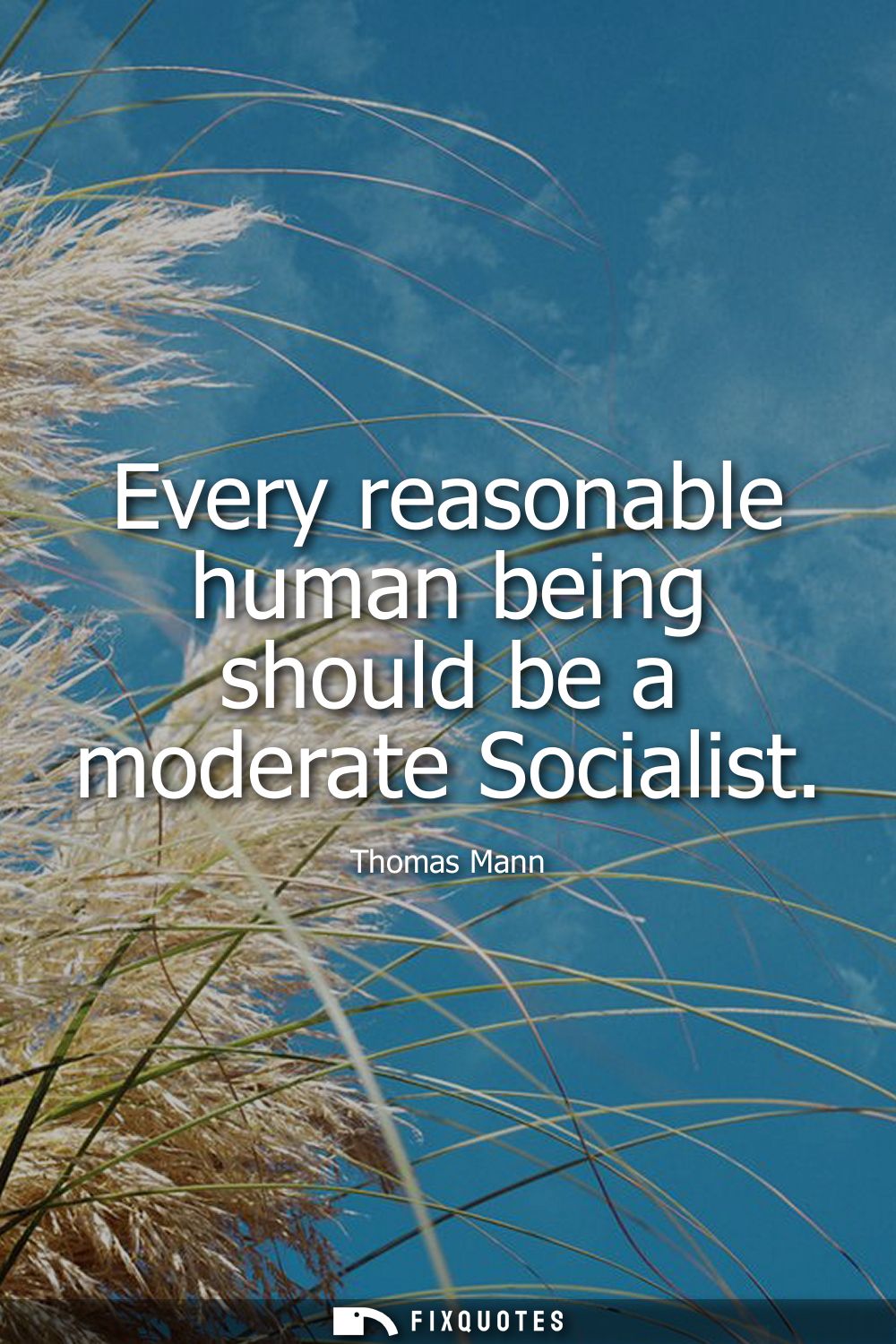
"Every reasonable human being should be a moderate Socialist"
About this Quote
Mann’s line is a provocation dressed up as common sense: “reasonable,” “human,” “moderate” all do rhetorical work before “Socialist” even lands. The sentence doesn’t argue for socialism so much as it tries to redefine rational adulthood as inevitably social-democratic. In Mann’s hands, “moderate Socialist” is not a barricade slogan; it’s an attempt to rescue collective responsibility from both revolutionary romanticism and reactionary panic.
The subtext is defensive and strategic. A bourgeois novelist, steeped in German Bildung, Mann knew how easily “socialism” could be caricatured as chaos or confiscation. So he adds “moderate” like a stabilizer, signaling parliamentary reform, welfare protections, labor dignity, and a state capable of curbing capitalism’s uglier instincts without pretending markets can be abolished by willpower. “Reasonable” also functions as a moral shaming device: if you reject this, you’re not merely wrong, you’re irrational.
Context matters: Mann’s political evolution tracks Europe’s fracture lines. He moved from conservative nationalism during World War I toward an increasingly explicit defense of the Weimar Republic and, later, an anti-fascist liberalism in exile. Between the Great Depression, mass unemployment, and the Nazi exploitation of social grievance, “moderate socialism” becomes less a utopian preference than a firewall. It’s Mann insisting that democracy needs material guarantees to survive; if it can’t offer security and fairness, demagogues will. The wit is in the understatement: the “moderate Socialist” is framed not as an extremist, but as the only adult left in the room.
The subtext is defensive and strategic. A bourgeois novelist, steeped in German Bildung, Mann knew how easily “socialism” could be caricatured as chaos or confiscation. So he adds “moderate” like a stabilizer, signaling parliamentary reform, welfare protections, labor dignity, and a state capable of curbing capitalism’s uglier instincts without pretending markets can be abolished by willpower. “Reasonable” also functions as a moral shaming device: if you reject this, you’re not merely wrong, you’re irrational.
Context matters: Mann’s political evolution tracks Europe’s fracture lines. He moved from conservative nationalism during World War I toward an increasingly explicit defense of the Weimar Republic and, later, an anti-fascist liberalism in exile. Between the Great Depression, mass unemployment, and the Nazi exploitation of social grievance, “moderate socialism” becomes less a utopian preference than a firewall. It’s Mann insisting that democracy needs material guarantees to survive; if it can’t offer security and fairness, demagogues will. The wit is in the understatement: the “moderate Socialist” is framed not as an extremist, but as the only adult left in the room.
Quote Details
| Topic | Equality |
|---|---|
| Source | Help us find the source |
| Cite |
Citation Formats
APA Style (7th ed.)
Mann, Thomas. (2026, January 18). Every reasonable human being should be a moderate Socialist. FixQuotes. https://fixquotes.com/quotes/every-reasonable-human-being-should-be-a-moderate-3936/
Chicago Style
Mann, Thomas. "Every reasonable human being should be a moderate Socialist." FixQuotes. January 18, 2026. https://fixquotes.com/quotes/every-reasonable-human-being-should-be-a-moderate-3936/.
MLA Style (9th ed.)
"Every reasonable human being should be a moderate Socialist." FixQuotes, 18 Jan. 2026, https://fixquotes.com/quotes/every-reasonable-human-being-should-be-a-moderate-3936/. Accessed 28 Mar. 2026.
More Quotes by Thomas
Add to List