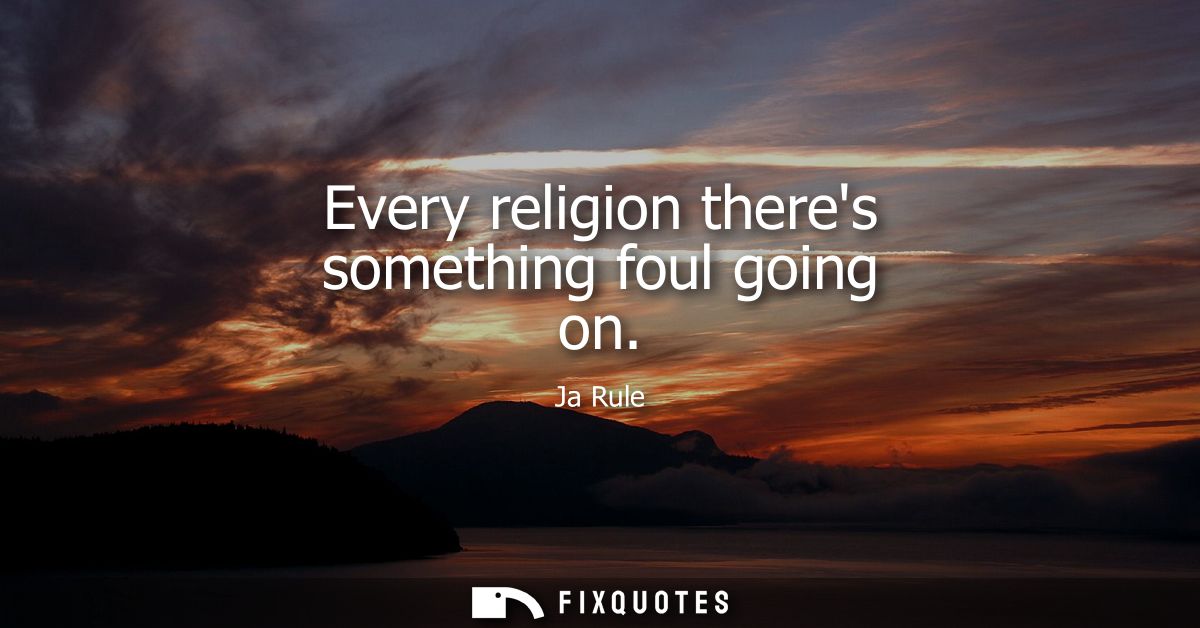
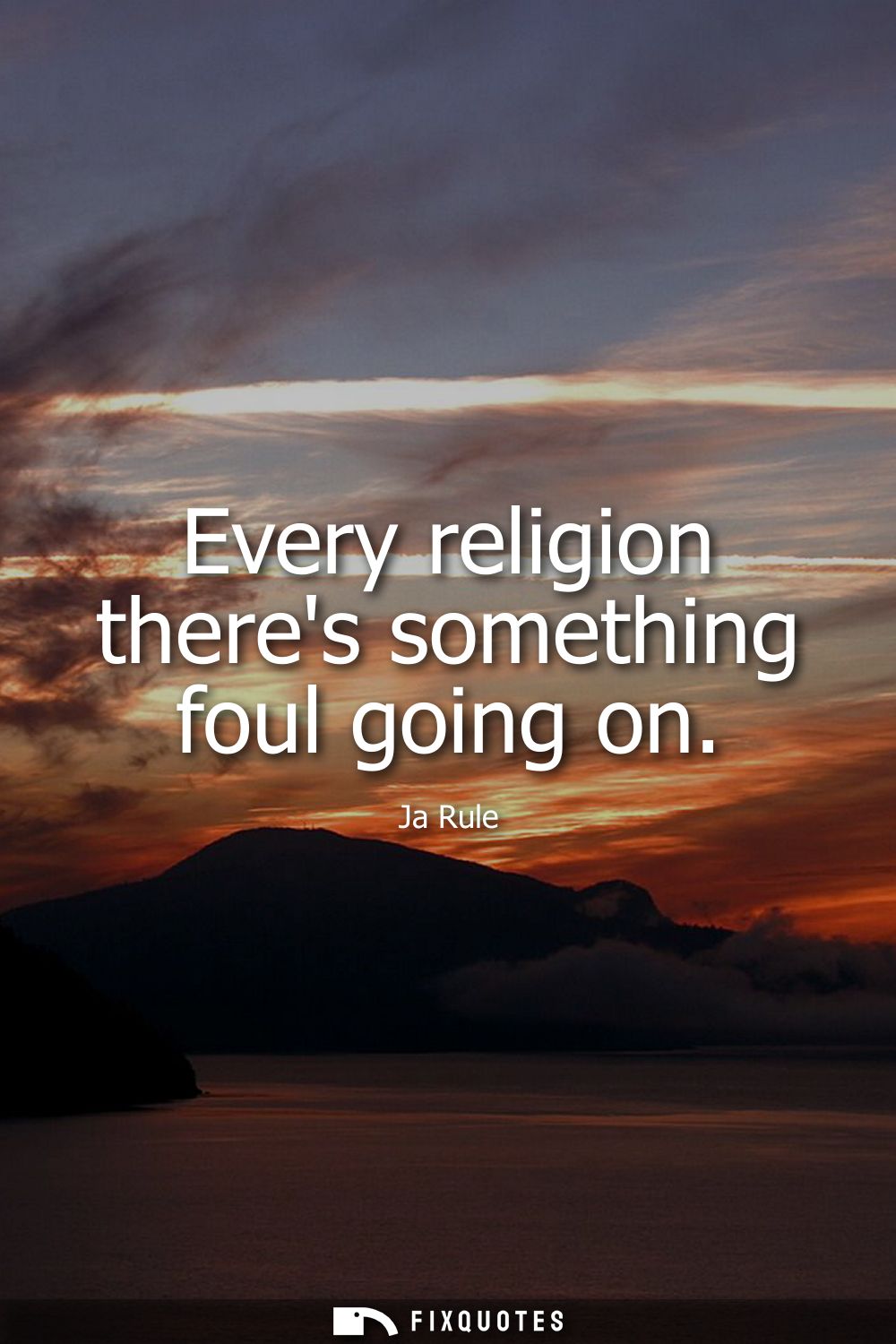
"Every religion, there's something foul going on"
About this Quote
Suspicion is the point here, not theology. Ja Rule’s line lands like a blunt street-level audit of institutions that claim moral authority while operating with the same human incentives as everyone else: money, power, access, secrecy. “Every religion” is deliberately sweeping, a provocation that refuses the polite carve-outs people make for their own tradition. It’s not a nuanced comparative-religion thesis; it’s a lived conclusion drawn from watching how organizations behave when they’re insulated from scrutiny.
The phrasing matters. “Something foul going on” is colloquial and prosecutorial at once: not “flawed” or “imperfect,” but tainted. “Going on” implies ongoing activity, a present-tense machine that keeps running. That casual cadence is part of the critique: corruption isn’t an abstract scandal, it’s background noise. In hip-hop, that tone reads as credibility, the voice of someone who’s seen systems up close and doesn’t bother dressing the observation in formal language.
Culturally, the line fits a late-90s/early-2000s era when rap increasingly narrated institutional hypocrisy alongside personal survival. It also anticipates a broader public mood that’s only intensified since: revelations of abuse cover-ups, financial grift, political entanglements, and “spiritual” branding used as leverage. The subtext isn’t “faith is fake,” it’s “power corrupts, even when it wears sacred clothing.” The sting comes from collapsing the distance between pulpit and hustle, insisting they’re not opposite worlds but adjacent economies.
The phrasing matters. “Something foul going on” is colloquial and prosecutorial at once: not “flawed” or “imperfect,” but tainted. “Going on” implies ongoing activity, a present-tense machine that keeps running. That casual cadence is part of the critique: corruption isn’t an abstract scandal, it’s background noise. In hip-hop, that tone reads as credibility, the voice of someone who’s seen systems up close and doesn’t bother dressing the observation in formal language.
Culturally, the line fits a late-90s/early-2000s era when rap increasingly narrated institutional hypocrisy alongside personal survival. It also anticipates a broader public mood that’s only intensified since: revelations of abuse cover-ups, financial grift, political entanglements, and “spiritual” branding used as leverage. The subtext isn’t “faith is fake,” it’s “power corrupts, even when it wears sacred clothing.” The sting comes from collapsing the distance between pulpit and hustle, insisting they’re not opposite worlds but adjacent economies.
Quote Details
| Topic | Ethics & Morality |
|---|---|
| Source | Help us find the source |
| Cite |
Citation Formats
APA Style (7th ed.)
Rule, Ja. (2026, February 16). Every religion, there's something foul going on. FixQuotes. https://fixquotes.com/quotes/every-religion-theres-something-foul-going-on-154565/
Chicago Style
Rule, Ja. "Every religion, there's something foul going on." FixQuotes. February 16, 2026. https://fixquotes.com/quotes/every-religion-theres-something-foul-going-on-154565/.
MLA Style (9th ed.)
"Every religion, there's something foul going on." FixQuotes, 16 Feb. 2026, https://fixquotes.com/quotes/every-religion-theres-something-foul-going-on-154565/. Accessed 9 Mar. 2026.
More Quotes by Ja
Add to List