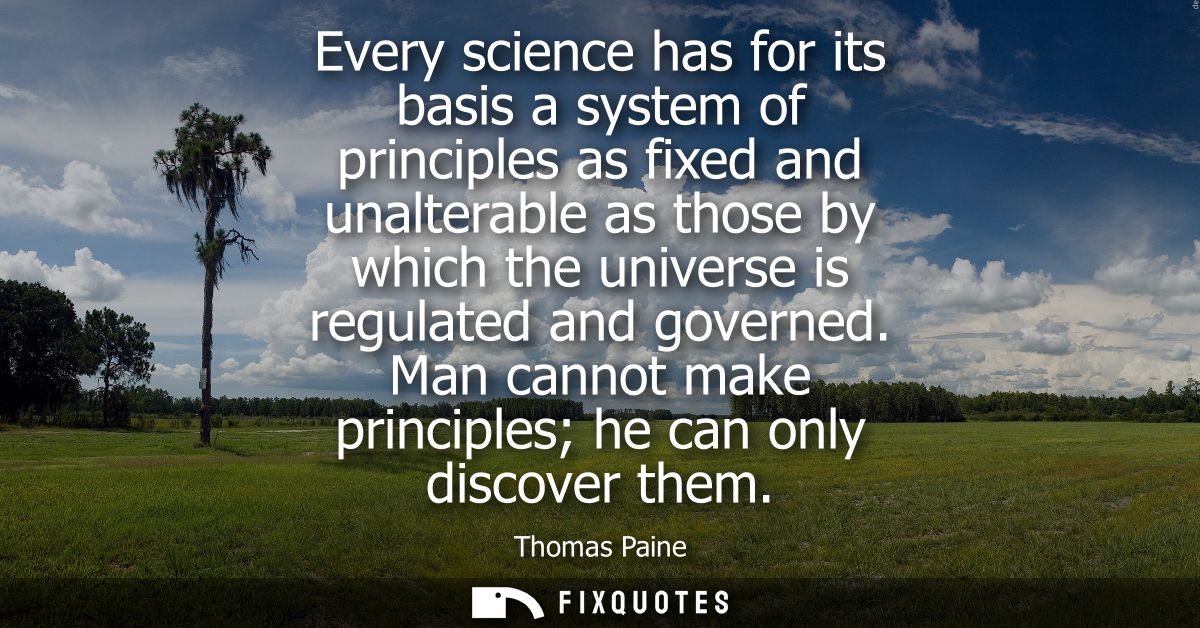
"Every science has for its basis a system of principles as fixed and unalterable as those by which the universe is regulated and governed. Man cannot make principles; he can only discover them"
About this Quote
The subtext is an Enlightenment power move. Paine frames reason as a kind of public property: anyone can test, recognize, and appeal to principles the way anyone can observe gravity. That is a direct hit on inherited hierarchy and revealed doctrine, both of which depend on the idea that truth arrives through special channels - bloodline, ordination, tradition. In Paine’s formulation, institutions don’t “create” justice; they either align with it or they don’t. The implication is brutal: a government that violates natural rights isn’t merely mistaken, it’s illegitimate in the same way a scientist is illegitimate if he denies basic laws.
Context matters. Paine is writing from the combustible era of the American and French Revolutions, when “self-evident” truths and “natural rights” were rhetorical weapons, not classroom abstractions. His science-talk isn’t neutral. It’s a bid to replace obedience with verification, deference with standards, and political argument with something closer to a universal audit.
Quote Details
| Topic | Truth |
|---|---|
| Source | Help us find the source |
| Cite |
Citation Formats
APA Style (7th ed.)
Paine, Thomas. (2026, January 18). Every science has for its basis a system of principles as fixed and unalterable as those by which the universe is regulated and governed. Man cannot make principles; he can only discover them. FixQuotes. https://fixquotes.com/quotes/every-science-has-for-its-basis-a-system-of-2102/
Chicago Style
Paine, Thomas. "Every science has for its basis a system of principles as fixed and unalterable as those by which the universe is regulated and governed. Man cannot make principles; he can only discover them." FixQuotes. January 18, 2026. https://fixquotes.com/quotes/every-science-has-for-its-basis-a-system-of-2102/.
MLA Style (9th ed.)
"Every science has for its basis a system of principles as fixed and unalterable as those by which the universe is regulated and governed. Man cannot make principles; he can only discover them." FixQuotes, 18 Jan. 2026, https://fixquotes.com/quotes/every-science-has-for-its-basis-a-system-of-2102/. Accessed 6 Mar. 2026.