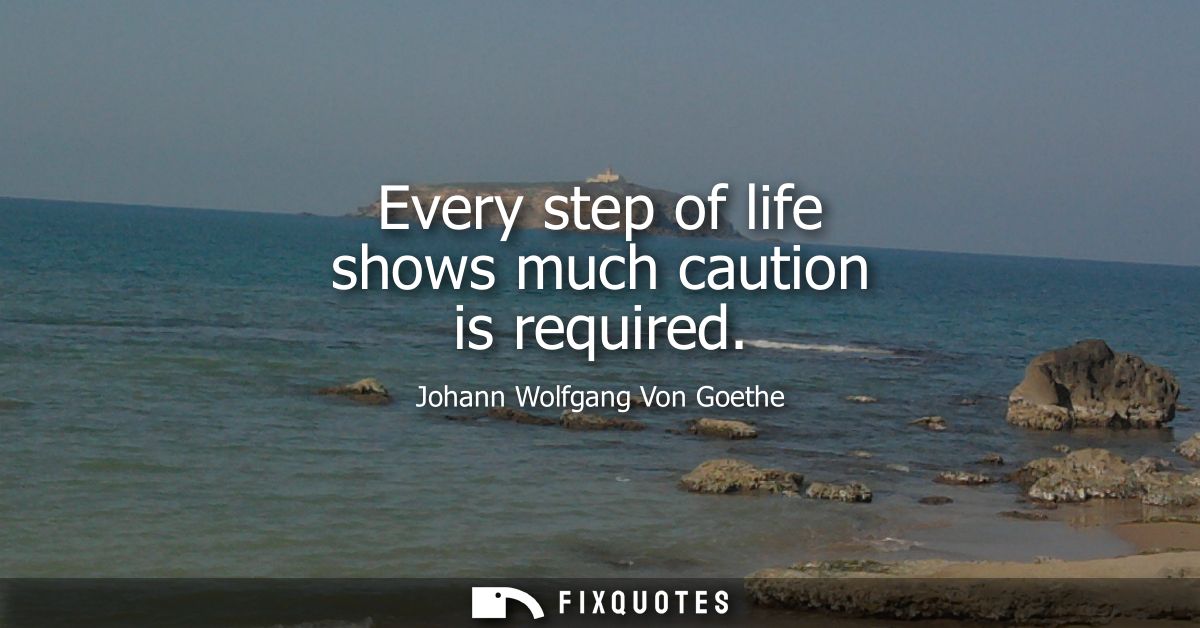
"Every step of life shows much caution is required"
About this Quote
Goethe’s line lands with the calm authority of someone who watched an age of revolutions chew up bright certainties. “Every step of life” sounds almost soothing, but it’s a totalizing claim: not just the big moral crossroads, not just politics or art, but each ordinary movement forward. The quiet menace is in “step” - life as a sequence where misplacement has consequences. He’s not selling paranoia; he’s warning against the Enlightenment temptation to treat living as a solvable equation.
“Shows” matters, too. The sentence doesn’t argue; it reports, as if experience itself is the evidence. That posture fits Goethe’s broader sensibility: a writer-scientist who distrusted abstractions that ignore the grain of reality. Caution, here, isn’t timidity. It’s attention. It’s the discipline of noticing how desire, ambition, and ego can turn a minor choice into a long-term trap.
The subtext reads like a critique of romantic impulsiveness - including the kind Goethe famously dramatized. After the cult of feeling and the glamour of spontaneity, this is the sober afterimage: yes, passion moves us, but it also blinds us, and history rarely forgives the blind. Coming from late 18th- and early 19th-century Europe, where reputations, careers, and even states could pivot overnight, the aphorism carries social realism. It’s advice that doubles as an aesthetic principle: the best lives, like the best sentences, are made with deliberation, not just heat.
“Shows” matters, too. The sentence doesn’t argue; it reports, as if experience itself is the evidence. That posture fits Goethe’s broader sensibility: a writer-scientist who distrusted abstractions that ignore the grain of reality. Caution, here, isn’t timidity. It’s attention. It’s the discipline of noticing how desire, ambition, and ego can turn a minor choice into a long-term trap.
The subtext reads like a critique of romantic impulsiveness - including the kind Goethe famously dramatized. After the cult of feeling and the glamour of spontaneity, this is the sober afterimage: yes, passion moves us, but it also blinds us, and history rarely forgives the blind. Coming from late 18th- and early 19th-century Europe, where reputations, careers, and even states could pivot overnight, the aphorism carries social realism. It’s advice that doubles as an aesthetic principle: the best lives, like the best sentences, are made with deliberation, not just heat.
Quote Details
| Topic | Wisdom |
|---|
More Quotes by Johann
Add to List