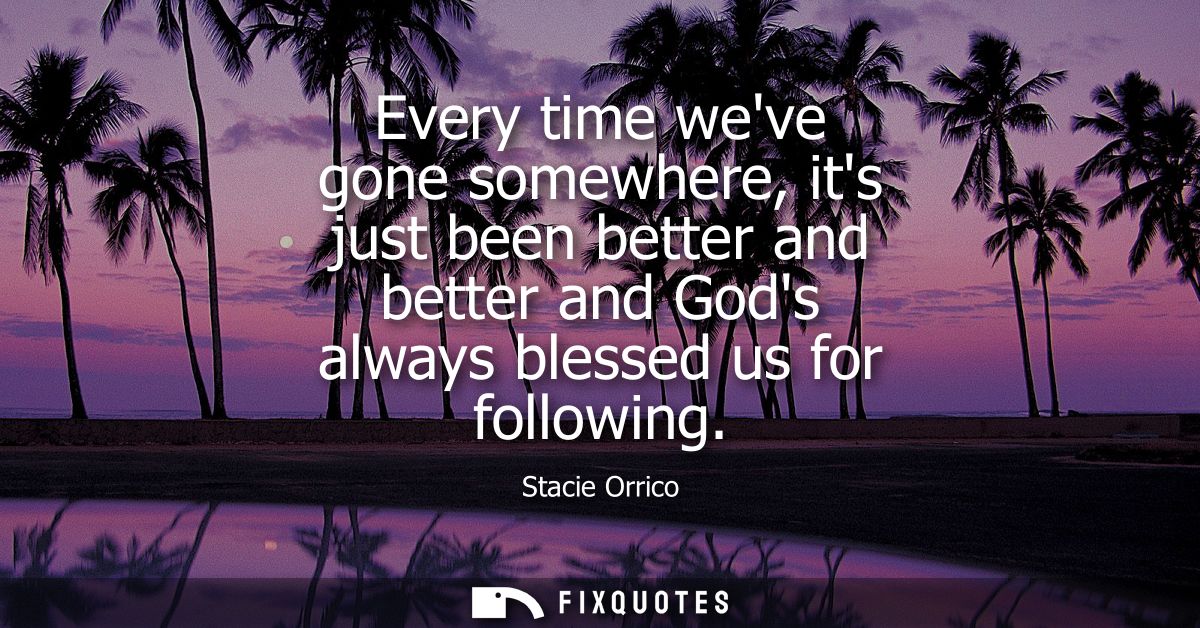
"Every time we've gone somewhere, it's just been better and better, and God's always blessed us for following"
About this Quote
The intent is plainly devotional, but the phrasing does a lot of cultural work. “God’s always blessed us for following” implies a call-and-response relationship with faith: we obey, God rewards. That’s emotionally soothing for anyone living through uncertainty, and it fits the early-2000s pop/Christian crossover moment where success could be spoken about without sounding crass, because it’s rebranded as favor. The “we” matters, too. It distributes the risk across a community - family, team, church - so ambition doesn’t read as ego; it reads as collective obedience.
The subtext is the delicate negotiation artists often make when their careers take off: how to accept ascent without owning it too loudly. By crediting God for the upward curve, Orrico keeps humility intact while still making a claim about directionality. If things are “better and better,” then doubt becomes not just fear but a spiritual misread.
It’s also a subtle prosperity logic in miniature: the road opens because you stepped onto it. The comfort and the danger are the same - success becomes a moral signal, and setbacks, by implication, can start to feel like a spiritual verdict.
Quote Details
| Topic | God |
|---|---|
| Source | Help us find the source |
| Cite |
Citation Formats
APA Style (7th ed.)
Orrico, Stacie. (2026, February 18). Every time we've gone somewhere, it's just been better and better, and God's always blessed us for following. FixQuotes. https://fixquotes.com/quotes/every-time-weve-gone-somewhere-its-just-been-77362/
Chicago Style
Orrico, Stacie. "Every time we've gone somewhere, it's just been better and better, and God's always blessed us for following." FixQuotes. February 18, 2026. https://fixquotes.com/quotes/every-time-weve-gone-somewhere-its-just-been-77362/.
MLA Style (9th ed.)
"Every time we've gone somewhere, it's just been better and better, and God's always blessed us for following." FixQuotes, 18 Feb. 2026, https://fixquotes.com/quotes/every-time-weve-gone-somewhere-its-just-been-77362/. Accessed 26 Mar. 2026.