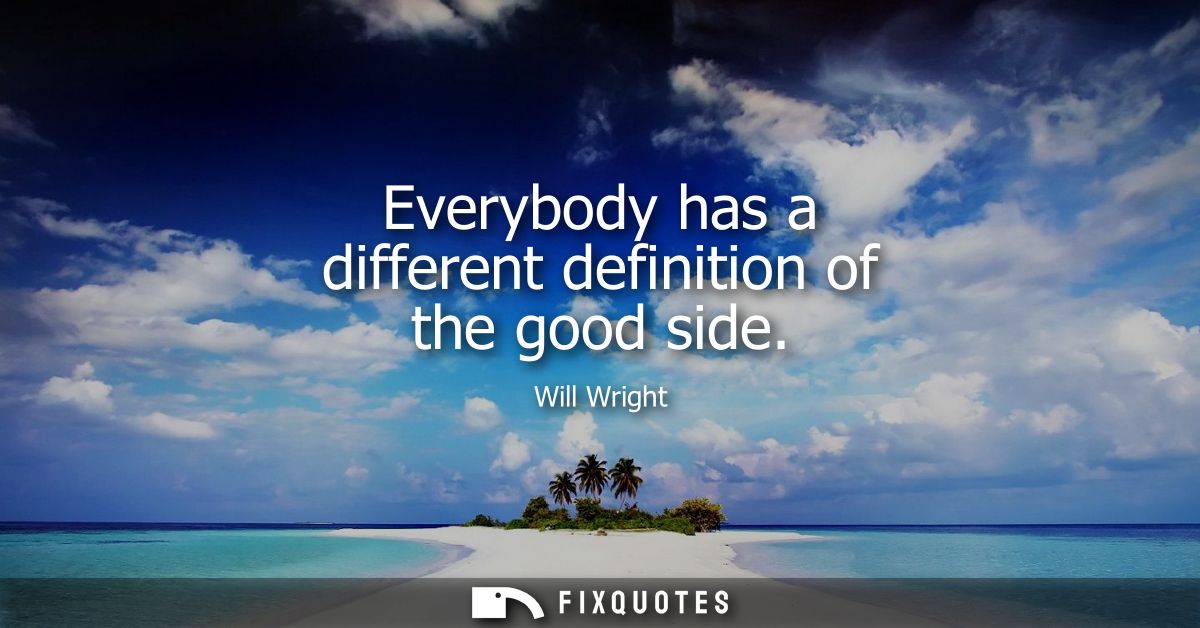
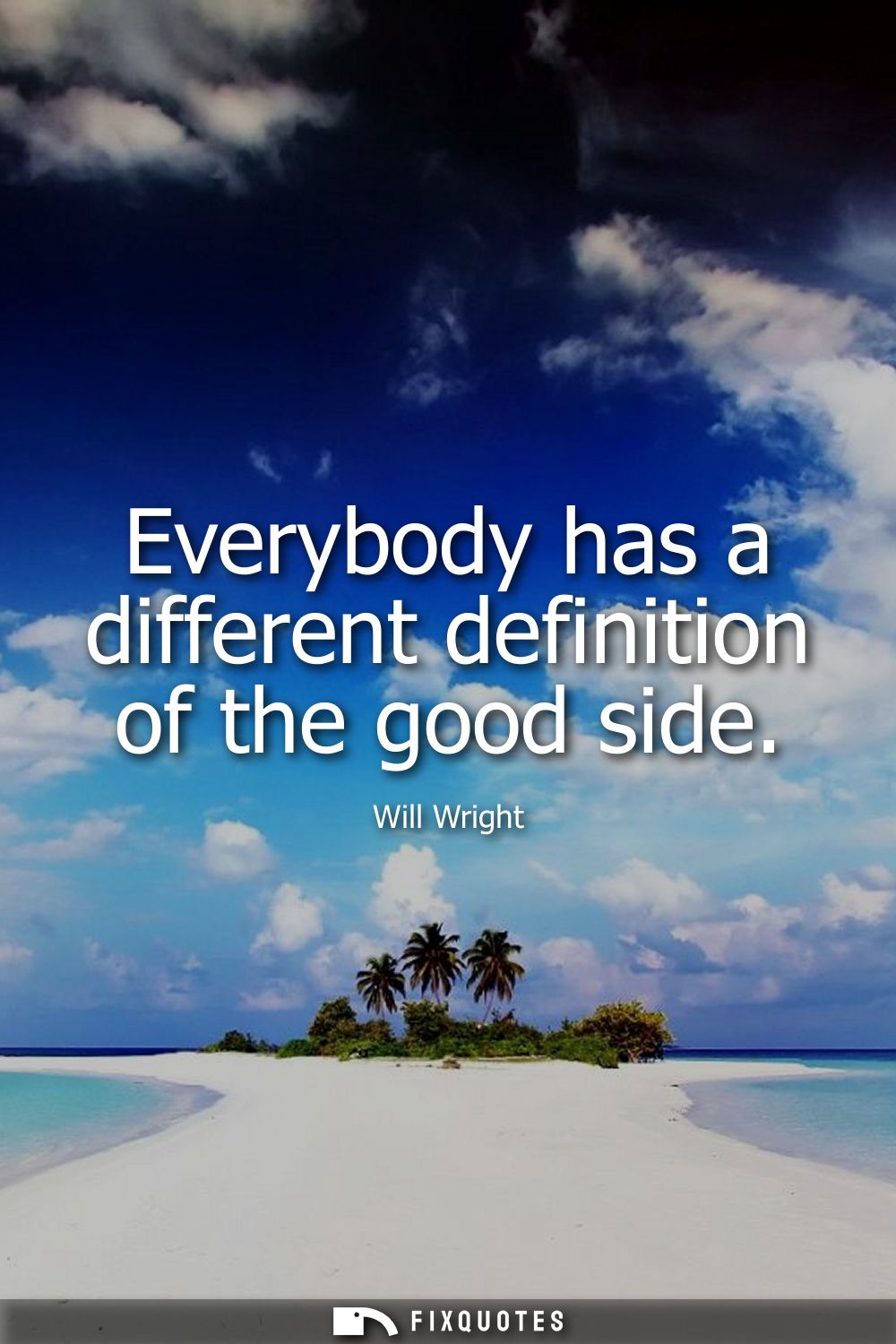
"Everybody has a different definition of the good side"
About this Quote
“Everybody has a different definition of the good side” reads like a calm sentence with a live wire inside it. Coming from Will Wright, a scientist, it carries the temperament of someone who’s watched “objective” systems get bent by subjective inputs: the data may be clean, but the categories rarely are. The line doesn’t argue that morality is meaningless; it argues that moral language is often a masking tape label slapped onto contested goals.
The intent is disarming. By choosing “definition” instead of “belief” or “values,” Wright shifts the fight from virtue-signaling to framing. Definitions are engineered; they’re built from assumptions about what matters, what counts, who gets measured, and who gets ignored. In scientific and technological contexts, this is a warning shot: the moment you code “good” into a model, a policy, or a research agenda, you’ve already smuggled in a worldview. “Good side” evokes the fantasy of clean teams and clear villains, the kind of narrative that makes institutions feel righteous while doing messy trade-offs.
The subtext is less relativist than procedural: if everyone defines “good” differently, the responsible move isn’t to preach harder, it’s to surface the hidden criteria. Who benefits? Who pays? What’s being optimized, and what’s being sacrificed as “externalities”? The quote works because it punctures the comforting idea that ethics is a destination. It’s a set of competing definitions, and the real contest is over whose gets to become default.
The intent is disarming. By choosing “definition” instead of “belief” or “values,” Wright shifts the fight from virtue-signaling to framing. Definitions are engineered; they’re built from assumptions about what matters, what counts, who gets measured, and who gets ignored. In scientific and technological contexts, this is a warning shot: the moment you code “good” into a model, a policy, or a research agenda, you’ve already smuggled in a worldview. “Good side” evokes the fantasy of clean teams and clear villains, the kind of narrative that makes institutions feel righteous while doing messy trade-offs.
The subtext is less relativist than procedural: if everyone defines “good” differently, the responsible move isn’t to preach harder, it’s to surface the hidden criteria. Who benefits? Who pays? What’s being optimized, and what’s being sacrificed as “externalities”? The quote works because it punctures the comforting idea that ethics is a destination. It’s a set of competing definitions, and the real contest is over whose gets to become default.
Quote Details
| Topic | Ethics & Morality |
|---|---|
| Source | Help us find the source |
| Cite |
Citation Formats
APA Style (7th ed.)
Wright, Will. (2026, January 17). Everybody has a different definition of the good side. FixQuotes. https://fixquotes.com/quotes/everybody-has-a-different-definition-of-the-good-72091/
Chicago Style
Wright, Will. "Everybody has a different definition of the good side." FixQuotes. January 17, 2026. https://fixquotes.com/quotes/everybody-has-a-different-definition-of-the-good-72091/.
MLA Style (9th ed.)
"Everybody has a different definition of the good side." FixQuotes, 17 Jan. 2026, https://fixquotes.com/quotes/everybody-has-a-different-definition-of-the-good-72091/. Accessed 27 Mar. 2026.
More Quotes by Will
Add to List