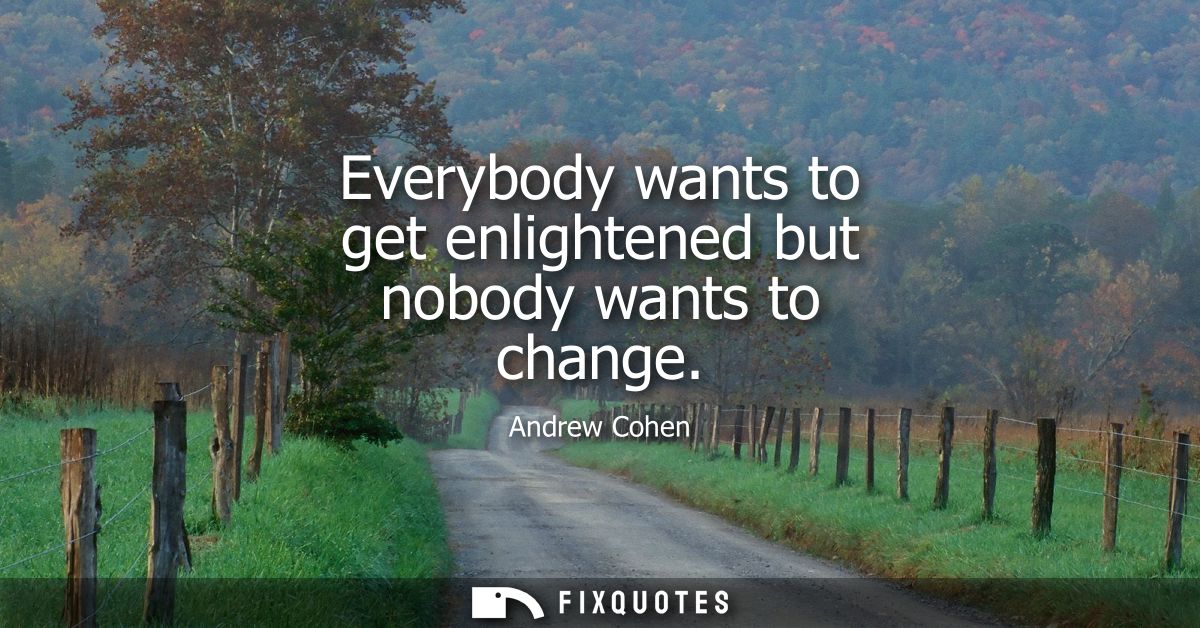
"Everybody wants to get enlightened, but nobody wants to change"
About this Quote
Enlightenment has become a consumer good: sleek, aspirational, and conveniently nonbinding. Andrew Cohen’s line punctures the modern spiritual marketplace with a simple accusation: people crave the halo of awakening more than the inconvenience of transformation. The bite comes from the contrast between “get” and “change.” “Get enlightened” frames insight as something you acquire, like a credential or a wellness upgrade. “Change” is messier; it implies relinquishing habits, status, relationships, even the story you tell about who you are. Cohen is calling out the spiritual version of wanting results without reps.
The subtext is sharper than self-help. He’s pointing to the ego’s talent for colonizing everything, even its own supposed dissolution. Many seekers want the aesthetic of depth - calm, certainty, specialness - while keeping their core preferences intact. That’s why the phrase “nobody wants” lands as provocation, not sociology. It’s rhetorical pressure, meant to make the reader flinch and self-audit: Which parts of my “practice” are actually negotiations with discomfort?
Contextually, Cohen writes out of a strain of contemporary spirituality that emphasizes rigorous self-confrontation over soothing affirmation. In that world, “enlightenment” isn’t a mood; it’s an ethical and psychological overhaul. The line works because it exposes a familiar cultural pattern: we embrace the language of growth while maintaining the same incentives, the same self-protective scripts. It’s a reminder that insight without behavioral consequence is just another form of entertainment, performed privately but curated like identity.
The subtext is sharper than self-help. He’s pointing to the ego’s talent for colonizing everything, even its own supposed dissolution. Many seekers want the aesthetic of depth - calm, certainty, specialness - while keeping their core preferences intact. That’s why the phrase “nobody wants” lands as provocation, not sociology. It’s rhetorical pressure, meant to make the reader flinch and self-audit: Which parts of my “practice” are actually negotiations with discomfort?
Contextually, Cohen writes out of a strain of contemporary spirituality that emphasizes rigorous self-confrontation over soothing affirmation. In that world, “enlightenment” isn’t a mood; it’s an ethical and psychological overhaul. The line works because it exposes a familiar cultural pattern: we embrace the language of growth while maintaining the same incentives, the same self-protective scripts. It’s a reminder that insight without behavioral consequence is just another form of entertainment, performed privately but curated like identity.
Quote Details
| Topic | Change |
|---|---|
| Source | Help us find the source |
| Cite |
Citation Formats
APA Style (7th ed.)
Cohen, Andrew. (2026, February 19). Everybody wants to get enlightened, but nobody wants to change. FixQuotes. https://fixquotes.com/quotes/everybody-wants-to-get-enlightened-but-nobody-38228/
Chicago Style
Cohen, Andrew. "Everybody wants to get enlightened, but nobody wants to change." FixQuotes. February 19, 2026. https://fixquotes.com/quotes/everybody-wants-to-get-enlightened-but-nobody-38228/.
MLA Style (9th ed.)
"Everybody wants to get enlightened, but nobody wants to change." FixQuotes, 19 Feb. 2026, https://fixquotes.com/quotes/everybody-wants-to-get-enlightened-but-nobody-38228/. Accessed 31 Mar. 2026.
More Quotes by Andrew
Add to List