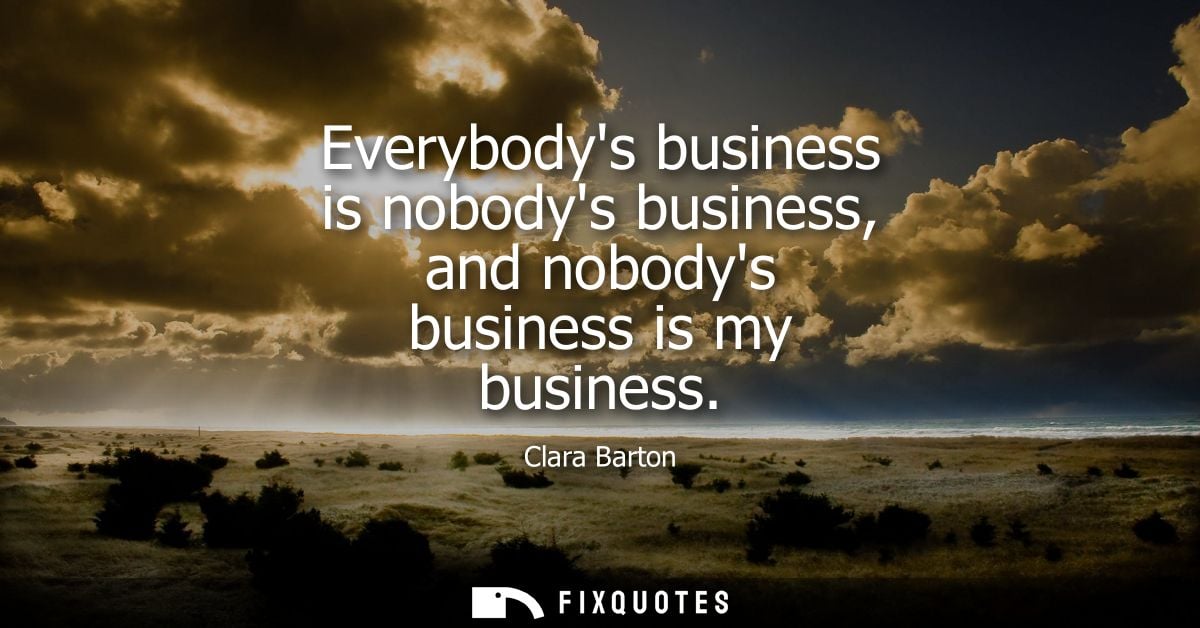
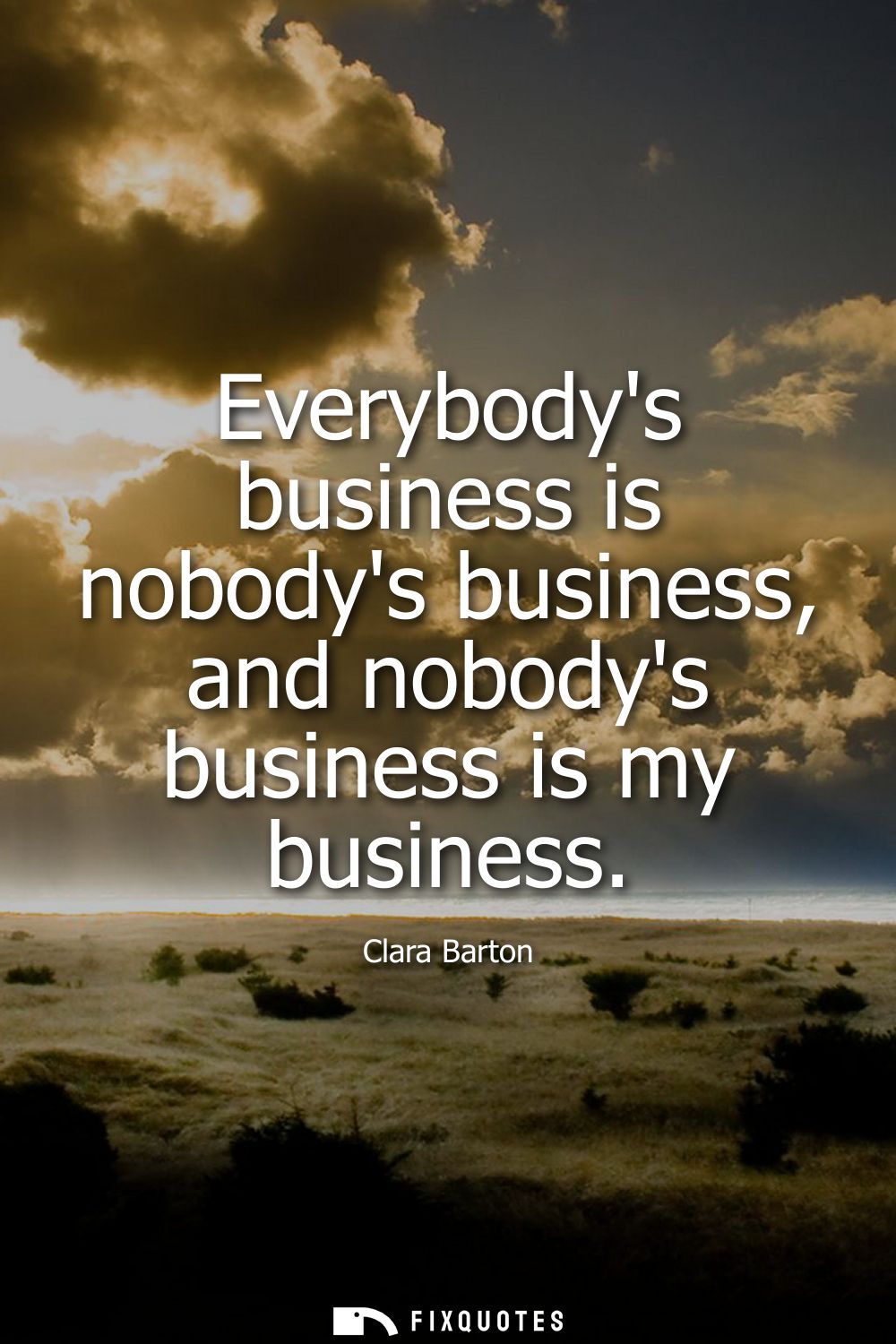
"Everybody's business is nobody's business, and nobody's business is my business"
About this Quote
The intent is quietly radical for a 19th-century public servant, especially a woman operating in a world that prized female benevolence but distrusted female authority. Barton doesn’t ask permission to care; she asserts a mandate. The subtext is a critique of collective indifference dressed in plain language: if systems are designed to let crises fall between departments, then someone has to become the department. Her “my” isn’t ego so much as an ethical lever, the individual will stepping into the vacuum created by committees, customs, and cowardice.
Context sharpens the edge. Barton’s work in Civil War relief and later founding the American Red Cross was built on moving toward neglected emergencies - the wounded without supplies, families without information, disasters without coordinated response. The line captures how modern humanitarianism often begins: not with a grand theory, but with one person refusing the comfort of saying, “Someone should handle that.” It’s a credo for acting where accountability goes to die.
Quote Details
| Topic | Witty One-Liners |
|---|---|
| Source | Help us find the source |
| Cite |
Citation Formats
APA Style (7th ed.)
Barton, Clara. (2026, January 15). Everybody's business is nobody's business, and nobody's business is my business. FixQuotes. https://fixquotes.com/quotes/everybodys-business-is-nobodys-business-and-145653/
Chicago Style
Barton, Clara. "Everybody's business is nobody's business, and nobody's business is my business." FixQuotes. January 15, 2026. https://fixquotes.com/quotes/everybodys-business-is-nobodys-business-and-145653/.
MLA Style (9th ed.)
"Everybody's business is nobody's business, and nobody's business is my business." FixQuotes, 15 Jan. 2026, https://fixquotes.com/quotes/everybodys-business-is-nobodys-business-and-145653/. Accessed 13 Mar. 2026.