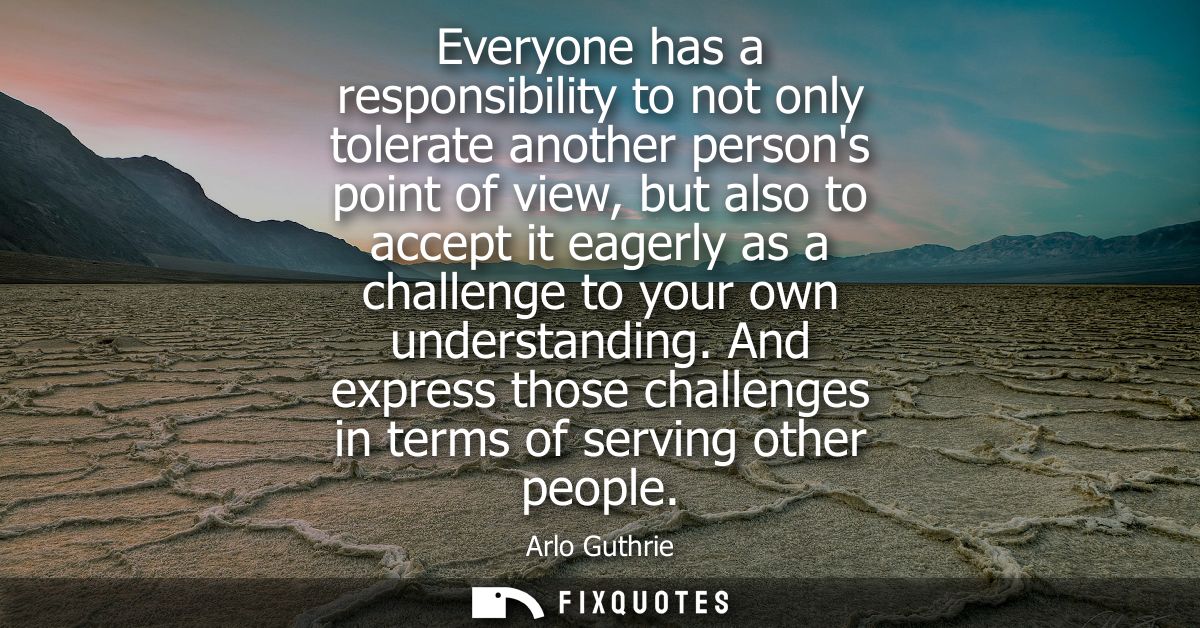
"Everyone has a responsibility to not only tolerate another person's point of view, but also to accept it eagerly as a challenge to your own understanding. And express those challenges in terms of serving other people"
About this Quote
Guthrie smuggles a whole civic philosophy into the language of a jam session: don’t just “tolerate” someone else’s view like you’re gritting your teeth through a bad set, take it as material. “Eagerly” is the tell. He’s not preaching passive pluralism or the limp “agree to disagree” etiquette of talk shows; he’s pushing a kind of curiosity with stakes. The other person’s perspective isn’t a nuisance to be managed, it’s a provocation that can sharpen your own thinking if you let it.
That challenge, though, comes with a leash. Guthrie’s last line reroutes the energy away from ego and toward use: argue in “terms of serving other people.” Subtext: debate as performance is cheap. If your worldview sparring ends at winning points, you’ve missed the point. He’s setting a standard where intellectual openness has to cash out as care, policy, community, mutual survival. It’s a musician’s ethic applied to democracy: listen hard, respond honestly, make something that helps the room.
The context matters because Guthrie isn’t an abstract philosopher; he’s folk royalty with an inherited suspicion of authority and a working-class radar for hypocrisy. Coming out of the counterculture’s hangover and today’s outrage economy, the quote reads like an antidote to both censorship panic and contrarian posturing. It insists that pluralism isn’t just permission; it’s labor. The real test isn’t whether you can endure disagreement. It’s whether you can turn it into a better way of being useful.
That challenge, though, comes with a leash. Guthrie’s last line reroutes the energy away from ego and toward use: argue in “terms of serving other people.” Subtext: debate as performance is cheap. If your worldview sparring ends at winning points, you’ve missed the point. He’s setting a standard where intellectual openness has to cash out as care, policy, community, mutual survival. It’s a musician’s ethic applied to democracy: listen hard, respond honestly, make something that helps the room.
The context matters because Guthrie isn’t an abstract philosopher; he’s folk royalty with an inherited suspicion of authority and a working-class radar for hypocrisy. Coming out of the counterculture’s hangover and today’s outrage economy, the quote reads like an antidote to both censorship panic and contrarian posturing. It insists that pluralism isn’t just permission; it’s labor. The real test isn’t whether you can endure disagreement. It’s whether you can turn it into a better way of being useful.
Quote Details
| Topic | Servant Leadership |
|---|
More Quotes by Arlo
Add to List