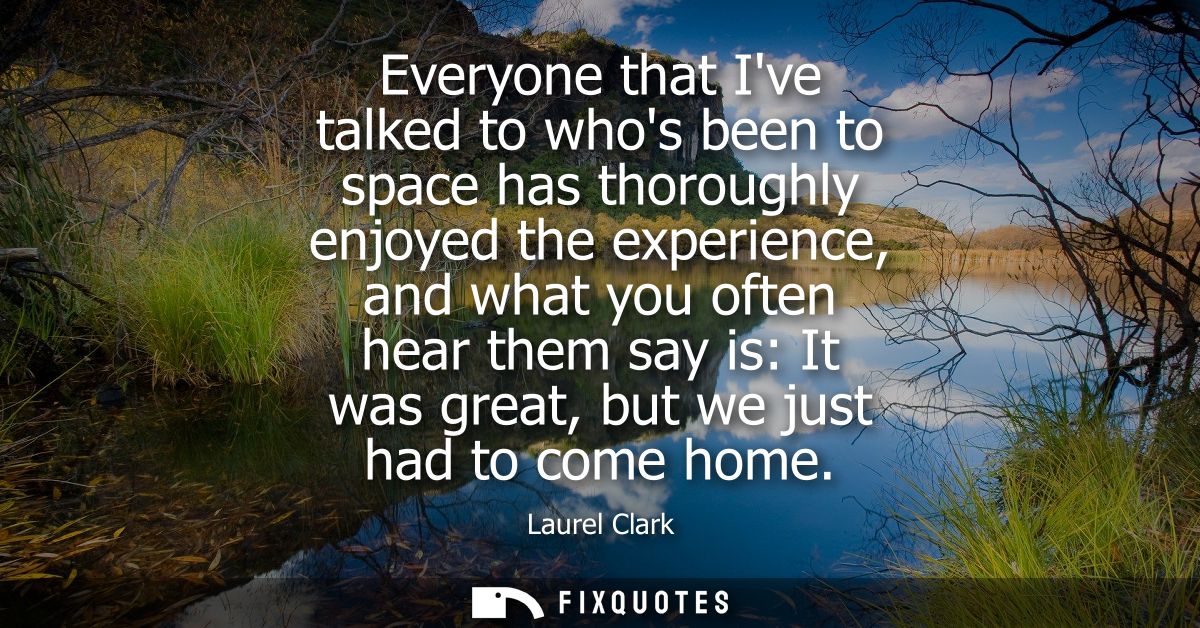
"Everyone that I've talked to who's been to space has thoroughly enjoyed the experience, and what you often hear them say is: It was great, but we just had to come home"
About this Quote
The intent feels both practical and humane. Clark is normalizing an experience that gets mythologized, translating it into something legible: even after the mind-bending privilege of orbit, the dominant impulse is return. The subtext is that space isn’t a new homeland; it’s a perspective machine. You go to see, to learn, to be changed - and then you bring that change back to the only place built for human life at scale, with all its obligations and entanglements.
Context sharpens the resonance. Clark, a physician-astronaut who died on Columbia, speaks from a culture that treats exploration as forward motion. Her phrasing reframes “forward” as circular: launch, look, come back. It’s an ethic of stewardship hiding inside a travel anecdote. The line also hints at the psychological truth astronauts often report: the Overview Effect can make Earth feel less like a background planet and more like the point. In a single, conversational sentence, Clark reminds us that the most radical part of going to space may be realizing you still belong to home.
Quote Details
| Topic | Adventure |
|---|---|
| Source | Help us find the source |
| Cite |
Citation Formats
APA Style (7th ed.)
Clark, Laurel. (2026, January 18). Everyone that I've talked to who's been to space has thoroughly enjoyed the experience, and what you often hear them say is: It was great, but we just had to come home. FixQuotes. https://fixquotes.com/quotes/everyone-that-ive-talked-to-whos-been-to-space-20343/
Chicago Style
Clark, Laurel. "Everyone that I've talked to who's been to space has thoroughly enjoyed the experience, and what you often hear them say is: It was great, but we just had to come home." FixQuotes. January 18, 2026. https://fixquotes.com/quotes/everyone-that-ive-talked-to-whos-been-to-space-20343/.
MLA Style (9th ed.)
"Everyone that I've talked to who's been to space has thoroughly enjoyed the experience, and what you often hear them say is: It was great, but we just had to come home." FixQuotes, 18 Jan. 2026, https://fixquotes.com/quotes/everyone-that-ive-talked-to-whos-been-to-space-20343/. Accessed 5 Apr. 2026.