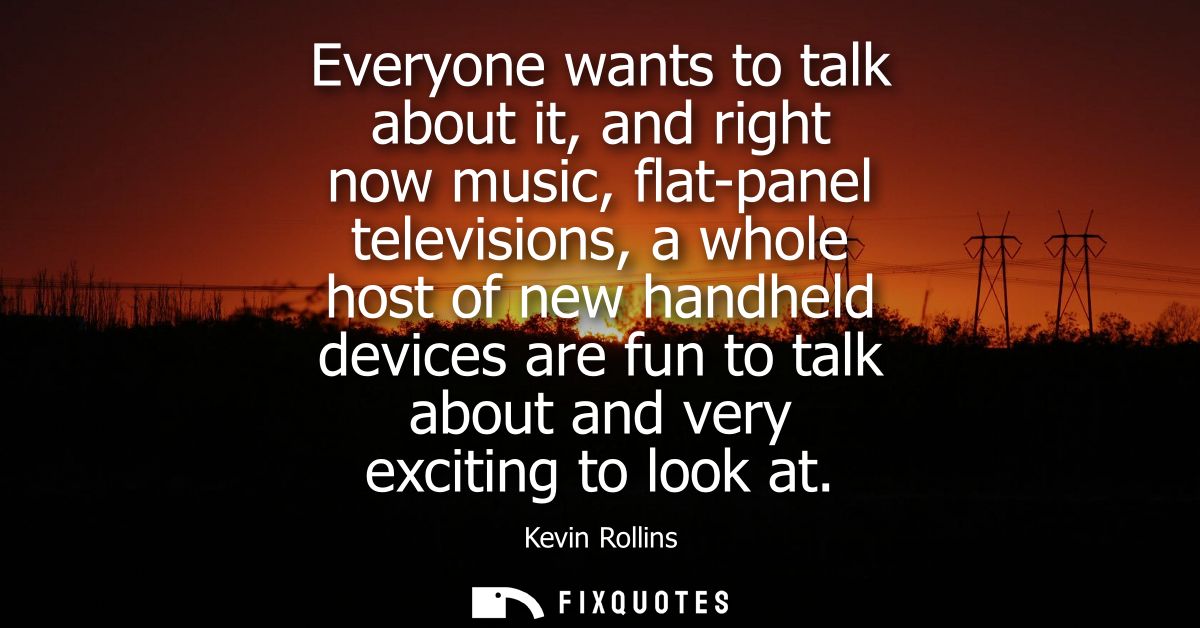
"Everyone wants to talk about it, and right now, music, flat-panel televisions, a whole host of new handheld devices are fun to talk about and very exciting to look at"
About this Quote
The list is telling. Music comes first because it’s portable identity; then flat-panel TVs, the era’s living-room status upgrade; then “a whole host of new handheld devices,” a deliberately vague bucket that lets the future stay flexible while still sounding inevitable. He’s speaking in the language of the showroom and the keynote: “fun,” “exciting,” “look at.” Those are sensory verbs, not technical ones. The subtext is that the winning companies won’t be the ones with the most elegant internals, but the ones that can turn consumer electronics into spectacle and conversation.
Context matters: this was the period when Apple’s iPod halo was reshaping expectations, HDTVs were becoming aspirational mainstream purchases, and “handheld” was sliding from niche to daily necessity. For a corporate leader, this kind of sentence is also defensive. It reassures stakeholders that the company is oriented toward the growth categories that captivate the public, even if the underlying strategy is still forming.
It works because it’s a thesis about modern desire disguised as small talk: we buy devices, but we also buy the chance to be part of what people are talking about.
Quote Details
| Topic | Technology |
|---|---|
| Source | Help us find the source |
| Cite |
Citation Formats
APA Style (7th ed.)
Rollins, Kevin. (2026, February 17). Everyone wants to talk about it, and right now, music, flat-panel televisions, a whole host of new handheld devices are fun to talk about and very exciting to look at. FixQuotes. https://fixquotes.com/quotes/everyone-wants-to-talk-about-it-and-right-now-101791/
Chicago Style
Rollins, Kevin. "Everyone wants to talk about it, and right now, music, flat-panel televisions, a whole host of new handheld devices are fun to talk about and very exciting to look at." FixQuotes. February 17, 2026. https://fixquotes.com/quotes/everyone-wants-to-talk-about-it-and-right-now-101791/.
MLA Style (9th ed.)
"Everyone wants to talk about it, and right now, music, flat-panel televisions, a whole host of new handheld devices are fun to talk about and very exciting to look at." FixQuotes, 17 Feb. 2026, https://fixquotes.com/quotes/everyone-wants-to-talk-about-it-and-right-now-101791/. Accessed 31 Mar. 2026.