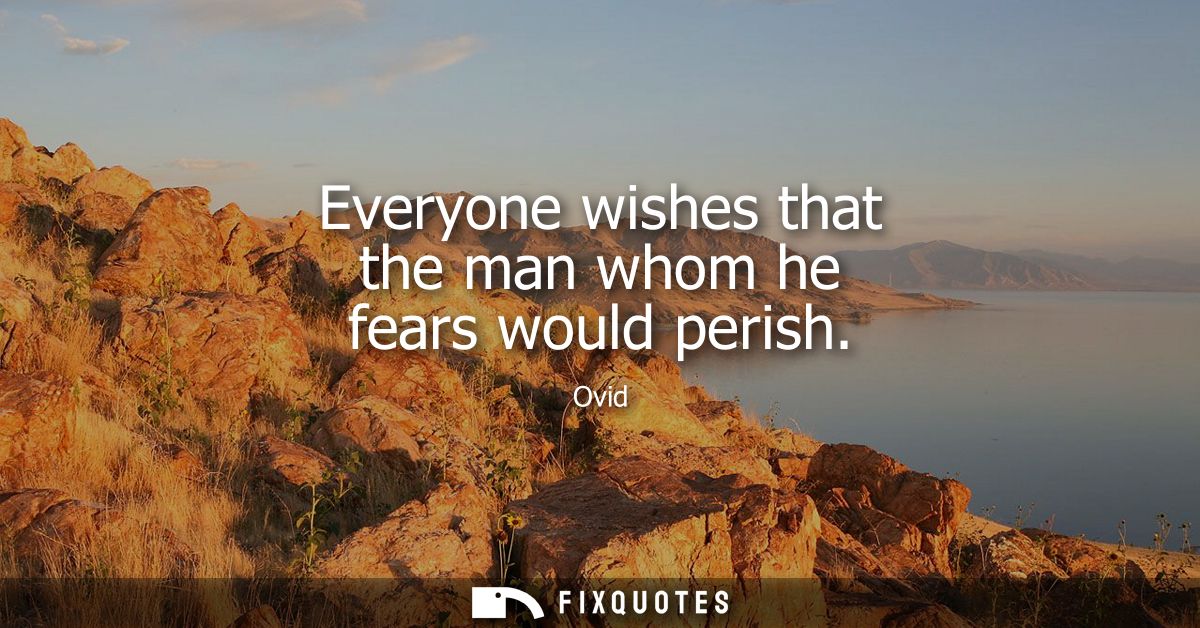
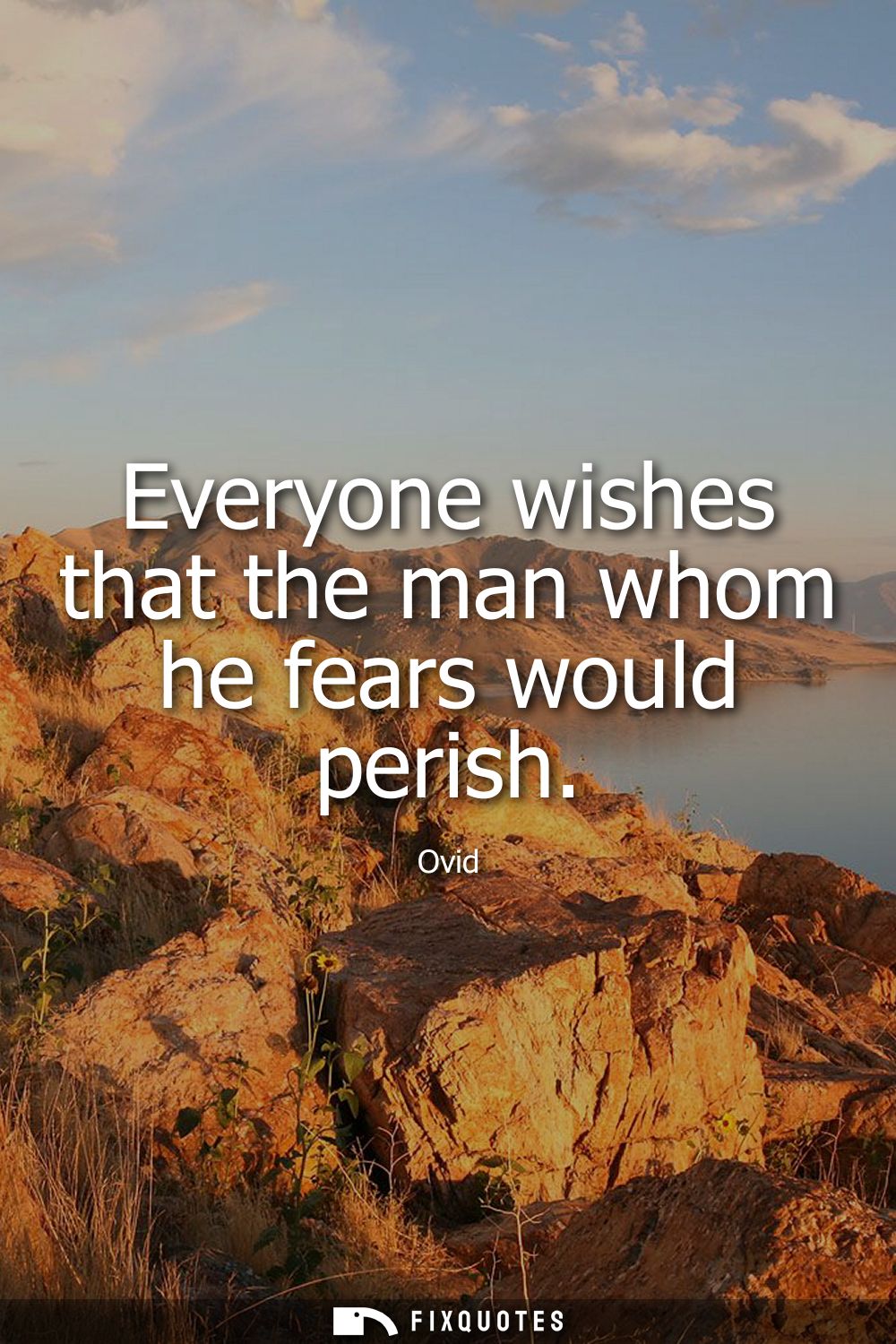
"Everyone wishes that the man whom he fears would perish"
About this Quote
Fear is rarely content to stay private; it wants a body. Ovid’s line sketches a grim psychological shortcut: when someone unnerves you, it’s tempting to treat their existence as the problem. Not their power, not your vulnerability, not the unstable world that produced the threat, but the person. If they vanished, the thinking goes, you could relax. The wish for another’s death becomes a fantasy of restored control.
As a poet of love, metamorphosis, and social gamesmanship, Ovid knows how quickly desire curdles into cruelty. “Wishes” is the tell: he’s not describing a noble motive or a public policy, but a reflex people prefer not to confess. The “man whom he fears” isn’t necessarily a villain; he’s a rival, an authority figure, a judge, an emperor. Fear collapses complexity into a single target, and the mind reaches for the most absolute solution available: erasure. It’s cynicism with a clean, Roman blade.
The context matters. Ovid wrote in an empire where status was precarious and political displeasure could be lethal, where punishment and exile were routine instruments of order. In that atmosphere, fear isn’t abstract; it’s a daily relationship with power. The line also doubles as a quiet indictment: if everyone secretly wants the feared person gone, then fear doesn’t just protect rulers - it breeds resentment that corrodes the social fabric. Ovid makes the uncomfortable point that violence begins long before swords; it starts as a widely shared wish.
As a poet of love, metamorphosis, and social gamesmanship, Ovid knows how quickly desire curdles into cruelty. “Wishes” is the tell: he’s not describing a noble motive or a public policy, but a reflex people prefer not to confess. The “man whom he fears” isn’t necessarily a villain; he’s a rival, an authority figure, a judge, an emperor. Fear collapses complexity into a single target, and the mind reaches for the most absolute solution available: erasure. It’s cynicism with a clean, Roman blade.
The context matters. Ovid wrote in an empire where status was precarious and political displeasure could be lethal, where punishment and exile were routine instruments of order. In that atmosphere, fear isn’t abstract; it’s a daily relationship with power. The line also doubles as a quiet indictment: if everyone secretly wants the feared person gone, then fear doesn’t just protect rulers - it breeds resentment that corrodes the social fabric. Ovid makes the uncomfortable point that violence begins long before swords; it starts as a widely shared wish.
Quote Details
| Topic | Wisdom |
|---|---|
| Source | Help us find the source |
More Quotes by Ovid
Add to List