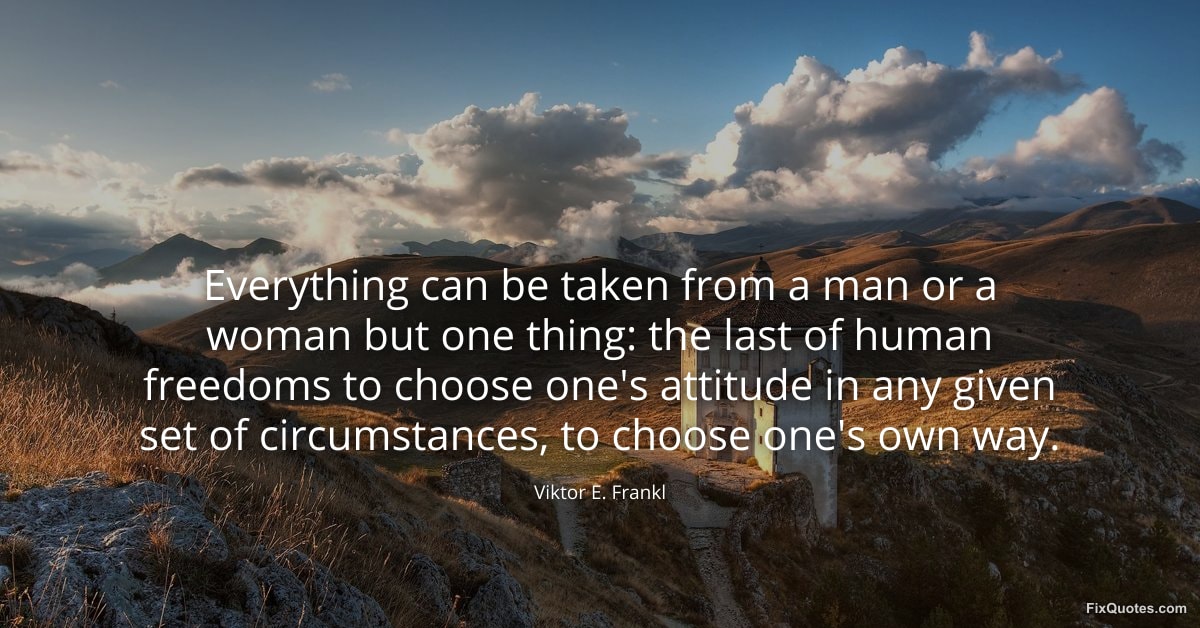
"Everything can be taken from a man or a woman, but one thing: the last of human freedoms to choose one's attitude in any given set of circumstances, to choose one's own way"
About this Quote
The intent is psychological and political at once. As a clinician, Frankl is staking out a theory of agency that doesn’t depend on good conditions. As a witness, he’s rebutting a totalitarian premise: that a person is nothing but a bundle of reactions to force. The subtext is an argument about dignity. If you can choose your stance, you remain a subject, not an object, even when everything external is stripped away.
The phrasing does quiet rhetorical work. “Everything” is absolute, then immediately qualified by “but one thing,” a pivot that dramatizes scarcity. “The last of human freedoms” sounds constitutional, almost civic; he frames interior choice as a right, not a mood. And “in any given set of circumstances” is clinical language smuggling in an existential claim: meaning isn’t found; it’s made under pressure.
Context matters because the quote can be misused as a scolding toward people in pain. Frankl’s point isn’t that victims are responsible for their suffering; it’s that even in extremity, the self can still resist being rewritten. That’s not optimism. It’s defiance with a pulse.
Quote Details
| Topic | Free Will & Fate |
|---|---|
| Source | Man's Search for Meaning, Viktor E. Frankl; English translation (1959). Passage commonly cited from his account of concentration-camp experiences in this book. |
| Cite |
Citation Formats
APA Style (7th ed.)
Frankl, Viktor E. (2026, February 20). Everything can be taken from a man or a woman, but one thing: the last of human freedoms to choose one's attitude in any given set of circumstances, to choose one's own way. FixQuotes. https://fixquotes.com/quotes/everything-can-be-taken-from-a-man-or-a-woman-but-14981/
Chicago Style
Frankl, Viktor E. "Everything can be taken from a man or a woman, but one thing: the last of human freedoms to choose one's attitude in any given set of circumstances, to choose one's own way." FixQuotes. February 20, 2026. https://fixquotes.com/quotes/everything-can-be-taken-from-a-man-or-a-woman-but-14981/.
MLA Style (9th ed.)
"Everything can be taken from a man or a woman, but one thing: the last of human freedoms to choose one's attitude in any given set of circumstances, to choose one's own way." FixQuotes, 20 Feb. 2026, https://fixquotes.com/quotes/everything-can-be-taken-from-a-man-or-a-woman-but-14981/. Accessed 1 Apr. 2026.