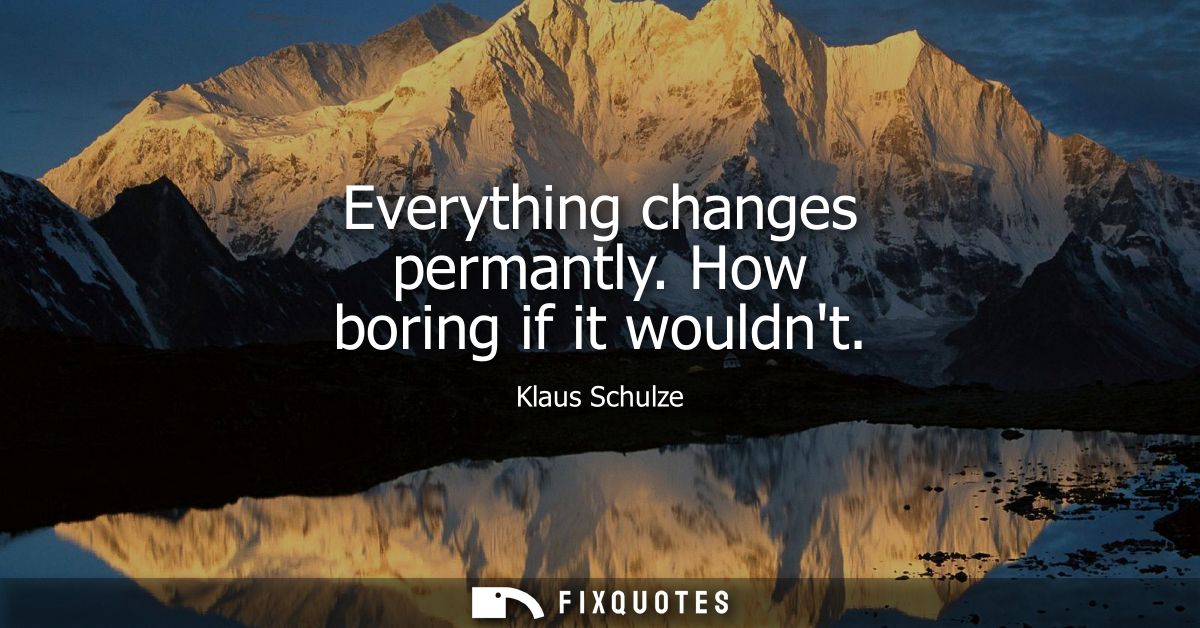
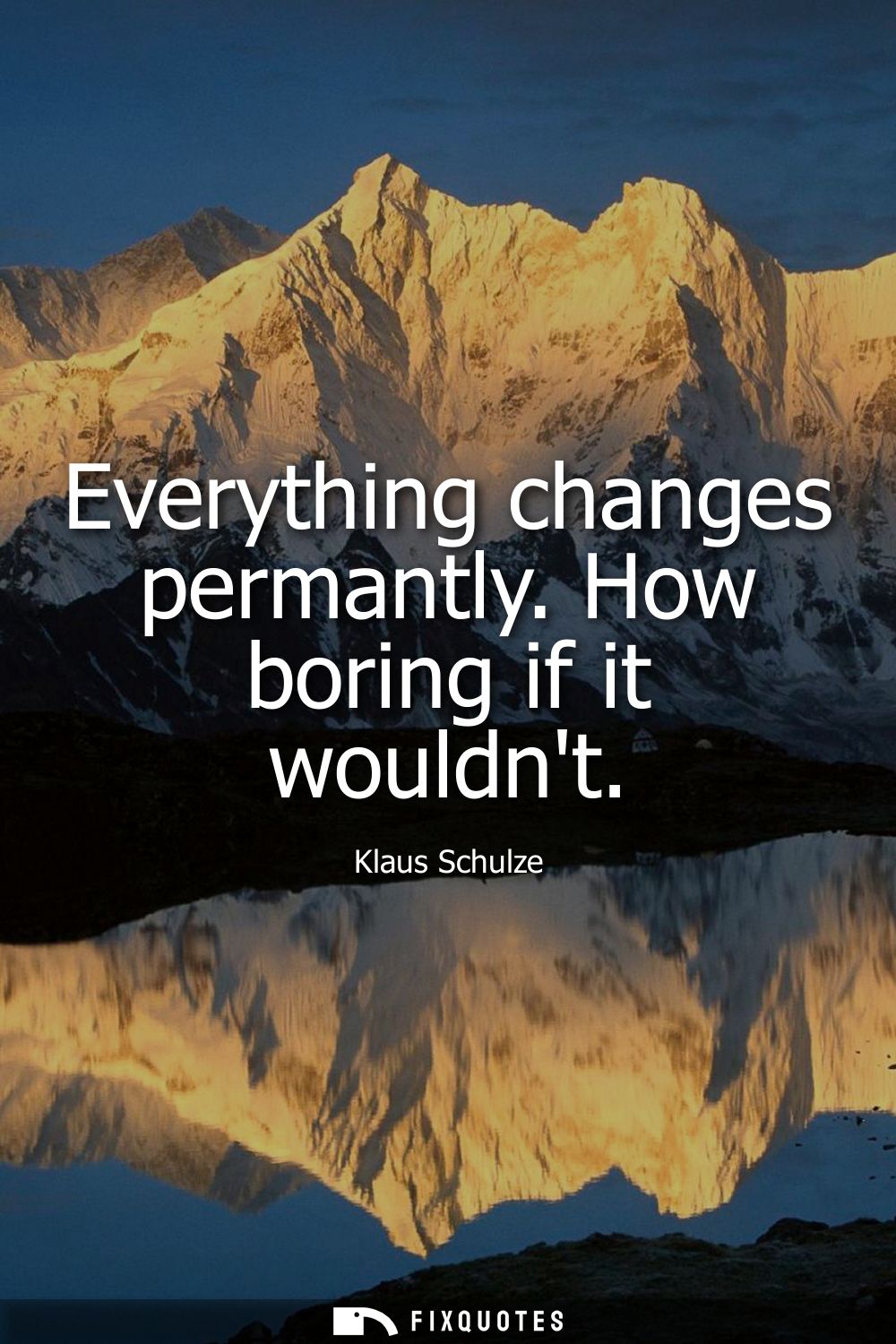
"Everything changes permantly. How boring if it wouldn't?"
About this Quote
“Everything changes permantly. How boring if it wouldn’t” reads like a shrug turned into a worldview: part cosmic observation, part sly provocation. Coming from Klaus Schulze, a composer who helped define the long-form, synthesizer-driven terrain of German electronic music, it’s less philosophy-class pronouncement than studio logic. His work lives on gradual mutation: sequenced patterns that slowly drift, timbres that bloom and decay, repetition that becomes hypnotic only because it’s never perfectly static. The misspelling of “permanently” even adds an accidental (or fitting) human glitch to a line about flux.
The intent is almost defiant. Schulze isn’t selling change as self-improvement or reinvention-as-brand; he’s insisting that permanence is the real fantasy, and a dull one. The second sentence is the hook: it reframes instability as a creative necessity, not a threat. Boredom is the enemy, and boredom is what happens when you demand stasis from systems that don’t offer it: art scenes, technologies, careers, even identities.
Subtextually, it’s a swipe at nostalgia and at the museum impulse in music culture, where genres get embalmed into “classic” periods and audiences ask artists to reproduce a past peak on command. Schulze came out of a postwar German avant-garde that distrusted fixed narratives and embraced process. In that context, change isn’t a slogan; it’s survival, and it’s composition. The line flatters no one, offers no comfort, and that’s why it works: it treats motion as the baseline reality, then dares you to admit you’d be bored without it.
The intent is almost defiant. Schulze isn’t selling change as self-improvement or reinvention-as-brand; he’s insisting that permanence is the real fantasy, and a dull one. The second sentence is the hook: it reframes instability as a creative necessity, not a threat. Boredom is the enemy, and boredom is what happens when you demand stasis from systems that don’t offer it: art scenes, technologies, careers, even identities.
Subtextually, it’s a swipe at nostalgia and at the museum impulse in music culture, where genres get embalmed into “classic” periods and audiences ask artists to reproduce a past peak on command. Schulze came out of a postwar German avant-garde that distrusted fixed narratives and embraced process. In that context, change isn’t a slogan; it’s survival, and it’s composition. The line flatters no one, offers no comfort, and that’s why it works: it treats motion as the baseline reality, then dares you to admit you’d be bored without it.
Quote Details
| Topic | Embrace Change |
|---|---|
| Source | Help us find the source |
| Cite |
Citation Formats
APA Style (7th ed.)
Schulze, Klaus. (2026, February 18). Everything changes permantly. How boring if it wouldn't? FixQuotes. https://fixquotes.com/quotes/everything-changes-permantly-how-boring-if-it-69797/
Chicago Style
Schulze, Klaus. "Everything changes permantly. How boring if it wouldn't?" FixQuotes. February 18, 2026. https://fixquotes.com/quotes/everything-changes-permantly-how-boring-if-it-69797/.
MLA Style (9th ed.)
"Everything changes permantly. How boring if it wouldn't?" FixQuotes, 18 Feb. 2026, https://fixquotes.com/quotes/everything-changes-permantly-how-boring-if-it-69797/. Accessed 6 Mar. 2026.
More Quotes by Klaus
Add to List