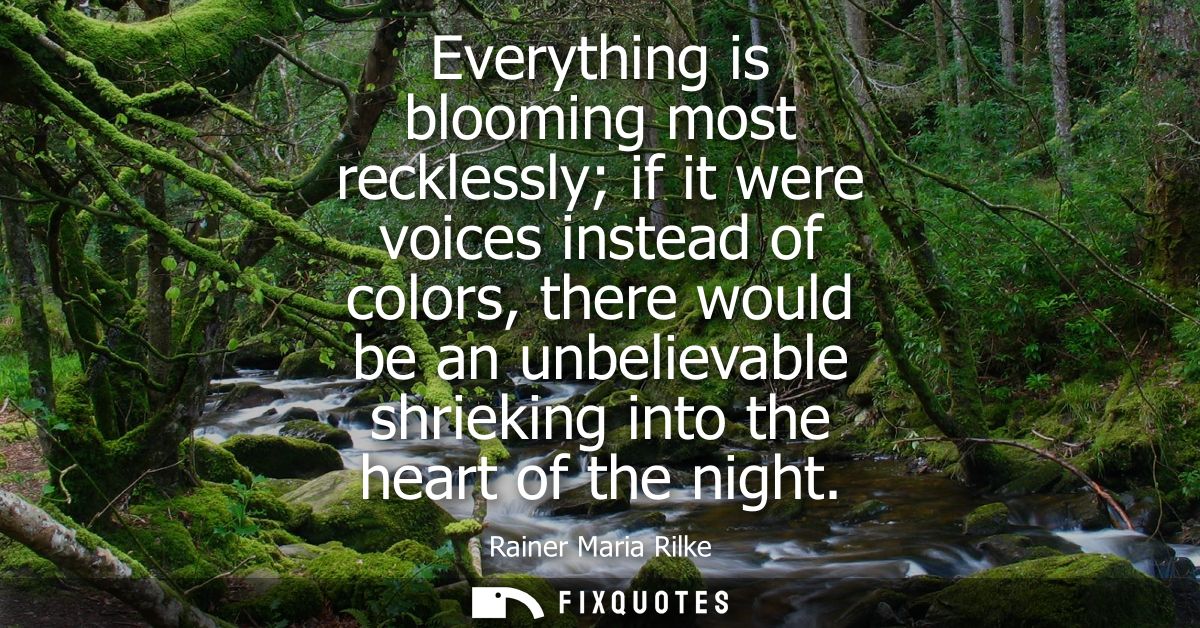
"Everything is blooming most recklessly; if it were voices instead of colors, there would be an unbelievable shrieking into the heart of the night"
About this Quote
The subtext is Rilke’s suspicion that the world’s intensity is always on the verge of becoming unlivable if we actually heard it. Color is safe because it is silent; sound would force intimacy. By translating bloom into “voices,” he smuggles in the human: longing, prayer, panic, the rawness we typically hide behind the aesthetic category of “pretty.” Nature becomes a chorus of needs.
Context matters because Rilke is a poet of heightened perception and spiritual pressure. His work keeps testing what happens when inner life meets the sheer volume of the external world. This sentence performs that test formally: it starts in lush visual calm and then swerves into a nocturnal scene of psychic noise. The “heart of the night” is where those unprocessed feelings live, and the flowers, absurdly, are what unlock them.
Quote Details
| Topic | Spring |
|---|---|
| Source | Help us find the source |
| Cite |
Citation Formats
APA Style (7th ed.)
Rilke, Rainer Maria. (2026, January 18). Everything is blooming most recklessly; if it were voices instead of colors, there would be an unbelievable shrieking into the heart of the night. FixQuotes. https://fixquotes.com/quotes/everything-is-blooming-most-recklessly-if-it-were-14910/
Chicago Style
Rilke, Rainer Maria. "Everything is blooming most recklessly; if it were voices instead of colors, there would be an unbelievable shrieking into the heart of the night." FixQuotes. January 18, 2026. https://fixquotes.com/quotes/everything-is-blooming-most-recklessly-if-it-were-14910/.
MLA Style (9th ed.)
"Everything is blooming most recklessly; if it were voices instead of colors, there would be an unbelievable shrieking into the heart of the night." FixQuotes, 18 Jan. 2026, https://fixquotes.com/quotes/everything-is-blooming-most-recklessly-if-it-were-14910/. Accessed 26 Mar. 2026.