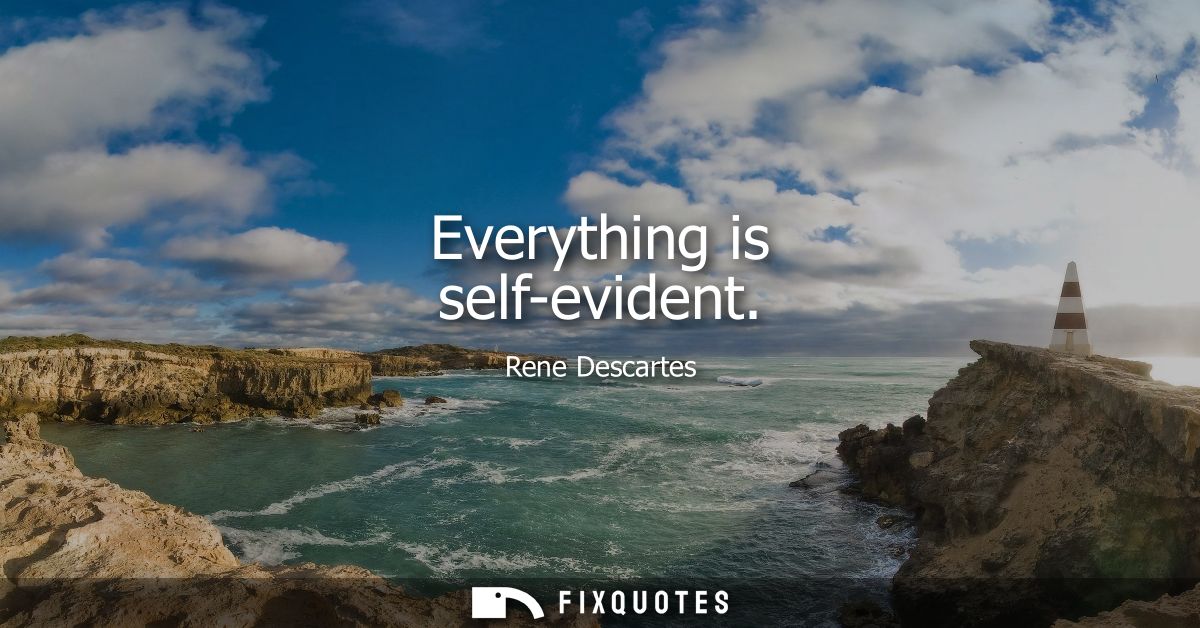
"Everything is self-evident"
About this Quote
"Everything is self-evident" lands like a dare from the guy who made doubting fashionable. Descartes is usually remembered for the opposite posture: strip away assumptions, distrust the senses, rebuild knowledge on something you cannot help but assent to. So the line reads less like a victory lap and more like a provocation about where certainty is supposed to come from.
In Descartes's world, "self-evident" is not the breezy modern sense of "obviously true". It is closer to his technical standard of clarity and distinctness: ideas that, once properly grasped, compel agreement without needing backup from tradition, authority, or even experience. The subtext is a rebellion against inherited knowledge. Scholastic philosophy leaned on received frameworks; Descartes wants a kind of mental geometry where the mind can see the truth the way it sees that a triangle has three sides.
The intent is double-edged. On one hand, it sells a clean ideal for mathematics and rational inquiry: start from premises so basic they need no defense, then deduce the rest. On the other, it smuggles in a huge claim about the human intellect: that reality is, in principle, legible to reason, and that confusion is a fault of method, not a feature of the world.
Context matters: a 17th-century Europe cracking under religious conflict and scientific upheaval needed new anchors. "Everything is self-evident" offers one, but it also exposes the risk. If self-evidence becomes a personal feeling rather than a disciplined standard, it turns from philosophy into permission slip.
In Descartes's world, "self-evident" is not the breezy modern sense of "obviously true". It is closer to his technical standard of clarity and distinctness: ideas that, once properly grasped, compel agreement without needing backup from tradition, authority, or even experience. The subtext is a rebellion against inherited knowledge. Scholastic philosophy leaned on received frameworks; Descartes wants a kind of mental geometry where the mind can see the truth the way it sees that a triangle has three sides.
The intent is double-edged. On one hand, it sells a clean ideal for mathematics and rational inquiry: start from premises so basic they need no defense, then deduce the rest. On the other, it smuggles in a huge claim about the human intellect: that reality is, in principle, legible to reason, and that confusion is a fault of method, not a feature of the world.
Context matters: a 17th-century Europe cracking under religious conflict and scientific upheaval needed new anchors. "Everything is self-evident" offers one, but it also exposes the risk. If self-evidence becomes a personal feeling rather than a disciplined standard, it turns from philosophy into permission slip.
Quote Details
| Topic | Reason & Logic |
|---|---|
| Source | Help us find the source |
| Cite |
Citation Formats
APA Style (7th ed.)
Descartes, Rene. (2026, January 14). Everything is self-evident. FixQuotes. https://fixquotes.com/quotes/everything-is-self-evident-1316/
Chicago Style
Descartes, Rene. "Everything is self-evident." FixQuotes. January 14, 2026. https://fixquotes.com/quotes/everything-is-self-evident-1316/.
MLA Style (9th ed.)
"Everything is self-evident." FixQuotes, 14 Jan. 2026, https://fixquotes.com/quotes/everything-is-self-evident-1316/. Accessed 13 Feb. 2026.
More Quotes by Rene
Add to List