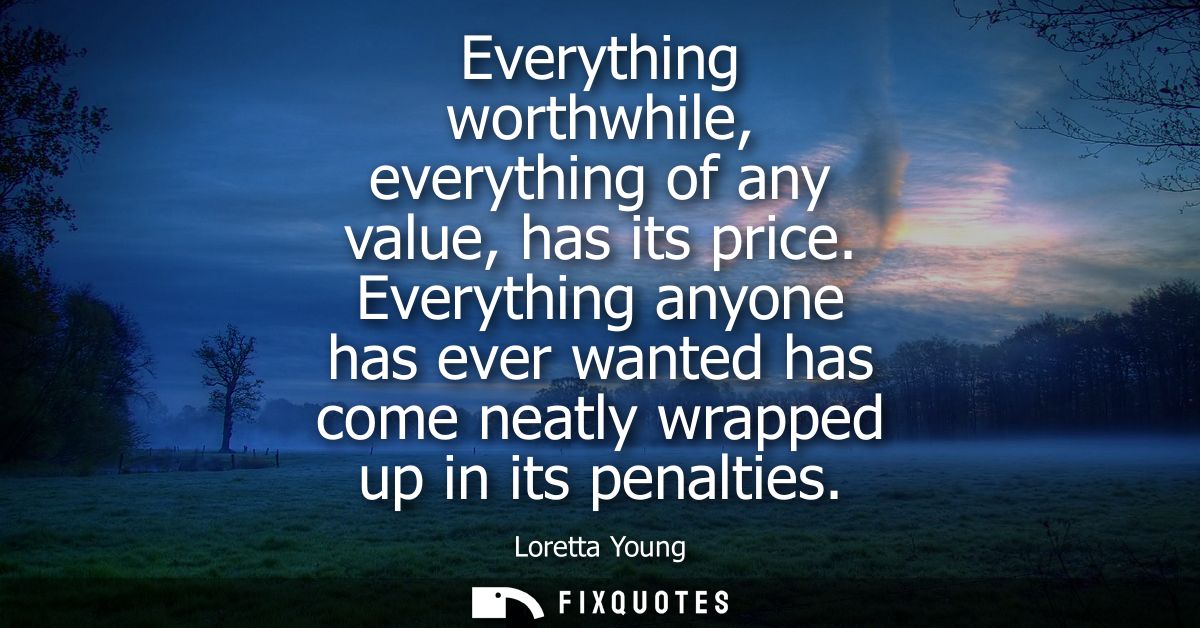
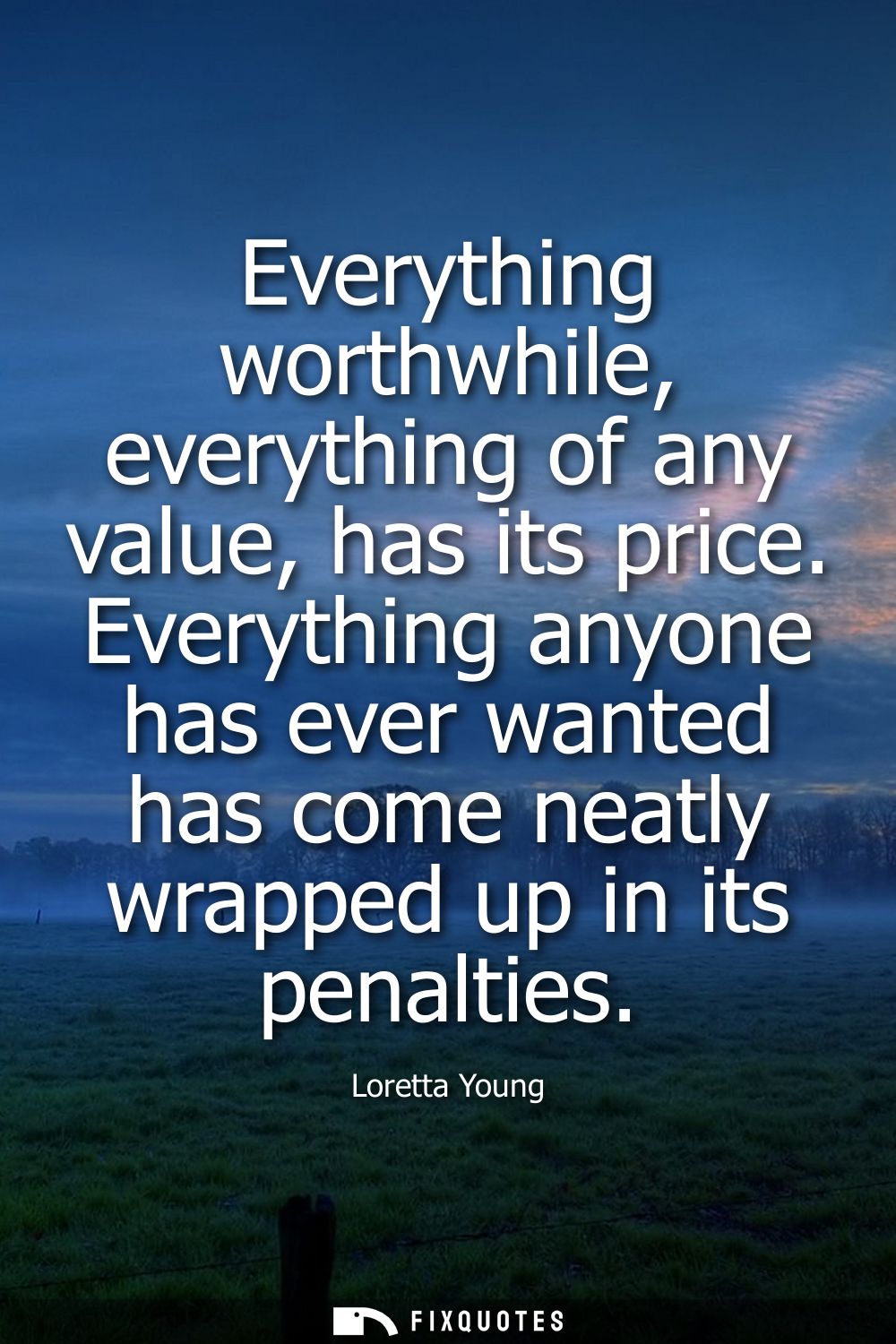
"Everything worthwhile, everything of any value, has its price. Everything anyone has ever wanted has come neatly wrapped up in its penalties"
About this Quote
As an actress who lived through the studio system’s high-control machinery, Young is speaking from a world that literally monetized ambition and beauty. Classic-era stardom offered access, wealth, and cultural immortality, but it also demanded discipline, silence, and a managed public self. Her emphasis on “everything anyone has ever wanted” widens the net beyond celebrity into a broader American ethic: aspiration as a moral test. If you pursue the prize, you implicitly accept the cost. That’s the subtextual pressure: you don’t get to complain about the penalties without sounding childish, ungrateful, or naive.
The quote also works because it refuses the comforting lie that pain automatically ennobles. A “price” can be fair, extortionate, or stupidly paid. Young isn’t romanticizing sacrifice; she’s warning that desire is a contract you sign before you read the fine print. In a culture that sells dreams by cropping out the consequences, her bluntness feels like insider knowledge passed across the velvet rope.
Quote Details
| Topic | Wisdom |
|---|---|
| Source | Help us find the source |
| Cite |
Citation Formats
APA Style (7th ed.)
Young, Loretta. (2026, January 16). Everything worthwhile, everything of any value, has its price. Everything anyone has ever wanted has come neatly wrapped up in its penalties. FixQuotes. https://fixquotes.com/quotes/everything-worthwhile-everything-of-any-value-has-96428/
Chicago Style
Young, Loretta. "Everything worthwhile, everything of any value, has its price. Everything anyone has ever wanted has come neatly wrapped up in its penalties." FixQuotes. January 16, 2026. https://fixquotes.com/quotes/everything-worthwhile-everything-of-any-value-has-96428/.
MLA Style (9th ed.)
"Everything worthwhile, everything of any value, has its price. Everything anyone has ever wanted has come neatly wrapped up in its penalties." FixQuotes, 16 Jan. 2026, https://fixquotes.com/quotes/everything-worthwhile-everything-of-any-value-has-96428/. Accessed 26 Mar. 2026.