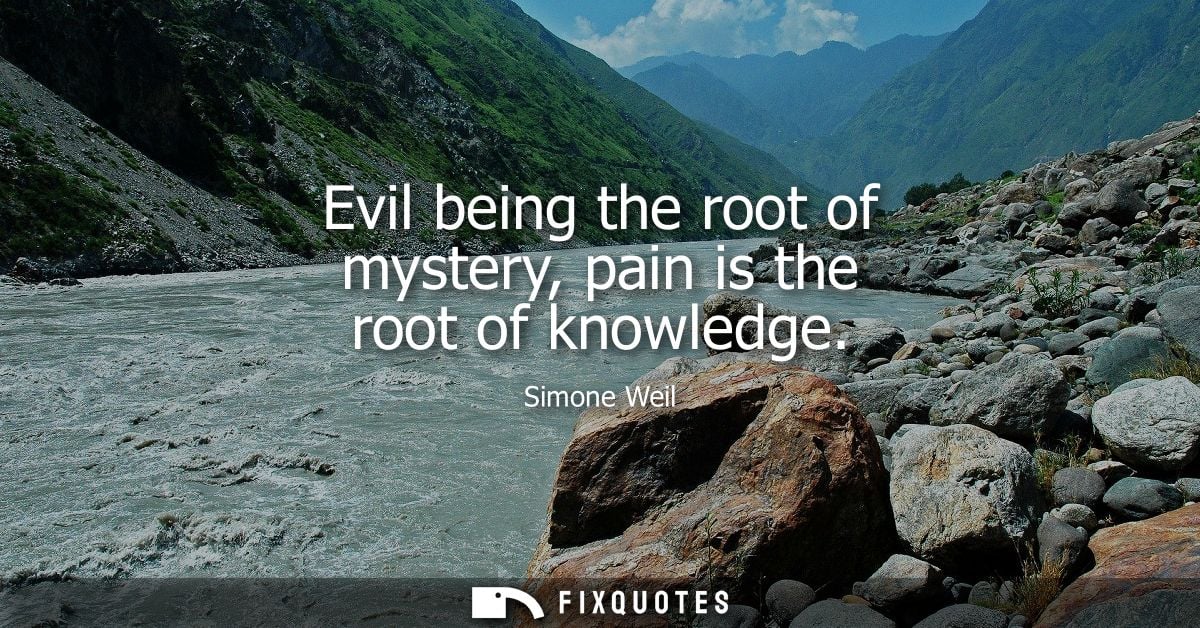
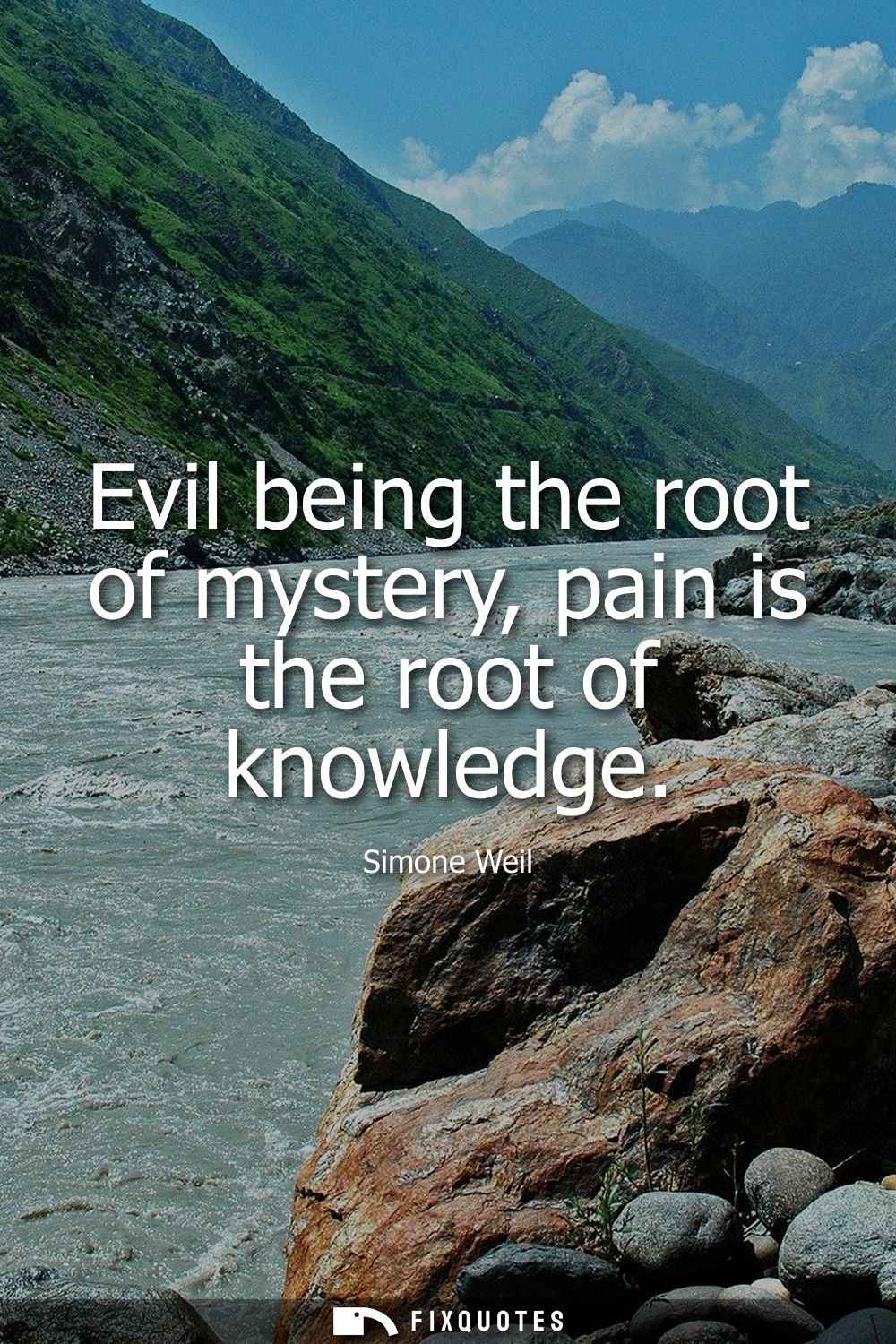
"Evil being the root of mystery, pain is the root of knowledge"
About this Quote
Weil flips the usual spiritual consolations into something colder and more exacting: if evil is what makes the world opaque, then pain is what makes it legible. Mystery, for her, isn’t a charming metaphysical fog; it’s the brute fact that suffering exists without fitting our moral bookkeeping. Evil scrambles the story. Pain, by contrast, forces attention. It strips away the narratives we use to stay comfortable - about merit, progress, fairness - and replaces them with a kind of knowledge that is less “understanding” than exposure.
The intent isn’t masochistic self-help. Weil is drawing a line between information and truth. You can learn plenty at a distance; you “know” in her sense only when you’ve been pressed into the limits of the body and the humiliations of dependence. Pain becomes an epistemology: it teaches what cannot be arrived at by cleverness, because cleverness is itself a defense. That’s the subtext - pain breaks the ego’s monopoly on interpretation. It makes you confront necessity, what Weil called gravity: the impersonal forces (social, economic, physical) that keep grinding regardless of your virtues.
Context sharpens the severity. Weil wrote in the shadow of total war, political extremity, and her own ascetic, often self-destructive commitments - factory labor, activism, a Christianity haunted by affliction. Her line reads like a rebuke to salon philosophy and to any spirituality that treats evil as a riddle to be solved rather than a reality to be endured. Pain doesn’t redeem evil; it simply refuses to let us lie about it.
The intent isn’t masochistic self-help. Weil is drawing a line between information and truth. You can learn plenty at a distance; you “know” in her sense only when you’ve been pressed into the limits of the body and the humiliations of dependence. Pain becomes an epistemology: it teaches what cannot be arrived at by cleverness, because cleverness is itself a defense. That’s the subtext - pain breaks the ego’s monopoly on interpretation. It makes you confront necessity, what Weil called gravity: the impersonal forces (social, economic, physical) that keep grinding regardless of your virtues.
Context sharpens the severity. Weil wrote in the shadow of total war, political extremity, and her own ascetic, often self-destructive commitments - factory labor, activism, a Christianity haunted by affliction. Her line reads like a rebuke to salon philosophy and to any spirituality that treats evil as a riddle to be solved rather than a reality to be endured. Pain doesn’t redeem evil; it simply refuses to let us lie about it.
Quote Details
| Topic | Wisdom |
|---|---|
| Source | Help us find the source |
| Cite |
Citation Formats
APA Style (7th ed.)
Weil, Simone. (2026, January 15). Evil being the root of mystery, pain is the root of knowledge. FixQuotes. https://fixquotes.com/quotes/evil-being-the-root-of-mystery-pain-is-the-root-2926/
Chicago Style
Weil, Simone. "Evil being the root of mystery, pain is the root of knowledge." FixQuotes. January 15, 2026. https://fixquotes.com/quotes/evil-being-the-root-of-mystery-pain-is-the-root-2926/.
MLA Style (9th ed.)
"Evil being the root of mystery, pain is the root of knowledge." FixQuotes, 15 Jan. 2026, https://fixquotes.com/quotes/evil-being-the-root-of-mystery-pain-is-the-root-2926/. Accessed 30 Mar. 2026.
More Quotes by Simone
Add to List