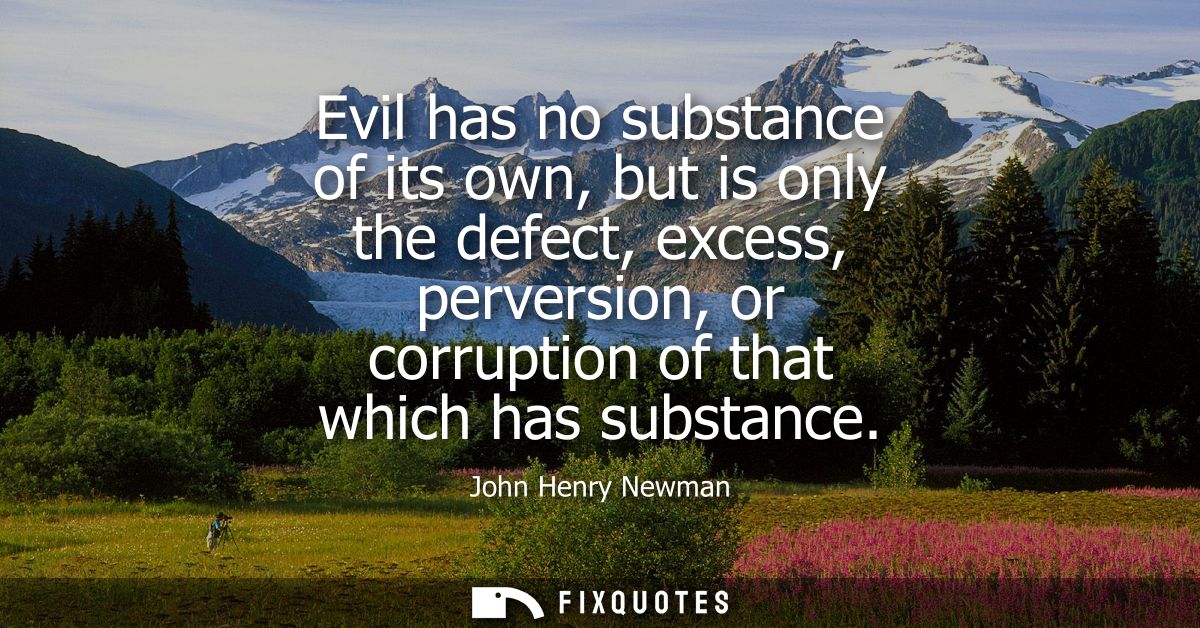
"Evil has no substance of its own, but is only the defect, excess, perversion, or corruption of that which has substance"
About this Quote
The phrasing matters: “defect, excess, perversion, or corruption” casts evil as misdirection of energies that begin as real goods. “Excess” is the particularly sharp word, because it implicates not only obvious vice but also distorted virtue: zeal that becomes cruelty, order that becomes tyranny, self-respect that turns into vanity. Newman is warning that the path to harm often runs through something initially substantial and even admirable. That’s an uncomfortable diagnosis for moralists who want villains, not neighbors.
Contextually, Newman’s Catholic-inflected worldview (and his battle with the confident moral arithmetic of his age) leans on an Augustinian tradition: the good is generative; evil is privative. The subtext is pastoral and polemical at once. Pastoral, because it suggests repair is possible - restore what’s been bent. Polemical, because it counters the melodramatic temptation to treat evil as an equal and opposite force, which can excuse surrender or invite obsession.
Quote Details
| Topic | Ethics & Morality |
|---|---|
| Source | Help us find the source |
| Cite |
Citation Formats
APA Style (7th ed.)
Newman, John Henry. (2026, January 18). Evil has no substance of its own, but is only the defect, excess, perversion, or corruption of that which has substance. FixQuotes. https://fixquotes.com/quotes/evil-has-no-substance-of-its-own-but-is-only-the-5641/
Chicago Style
Newman, John Henry. "Evil has no substance of its own, but is only the defect, excess, perversion, or corruption of that which has substance." FixQuotes. January 18, 2026. https://fixquotes.com/quotes/evil-has-no-substance-of-its-own-but-is-only-the-5641/.
MLA Style (9th ed.)
"Evil has no substance of its own, but is only the defect, excess, perversion, or corruption of that which has substance." FixQuotes, 18 Jan. 2026, https://fixquotes.com/quotes/evil-has-no-substance-of-its-own-but-is-only-the-5641/. Accessed 31 Mar. 2026.