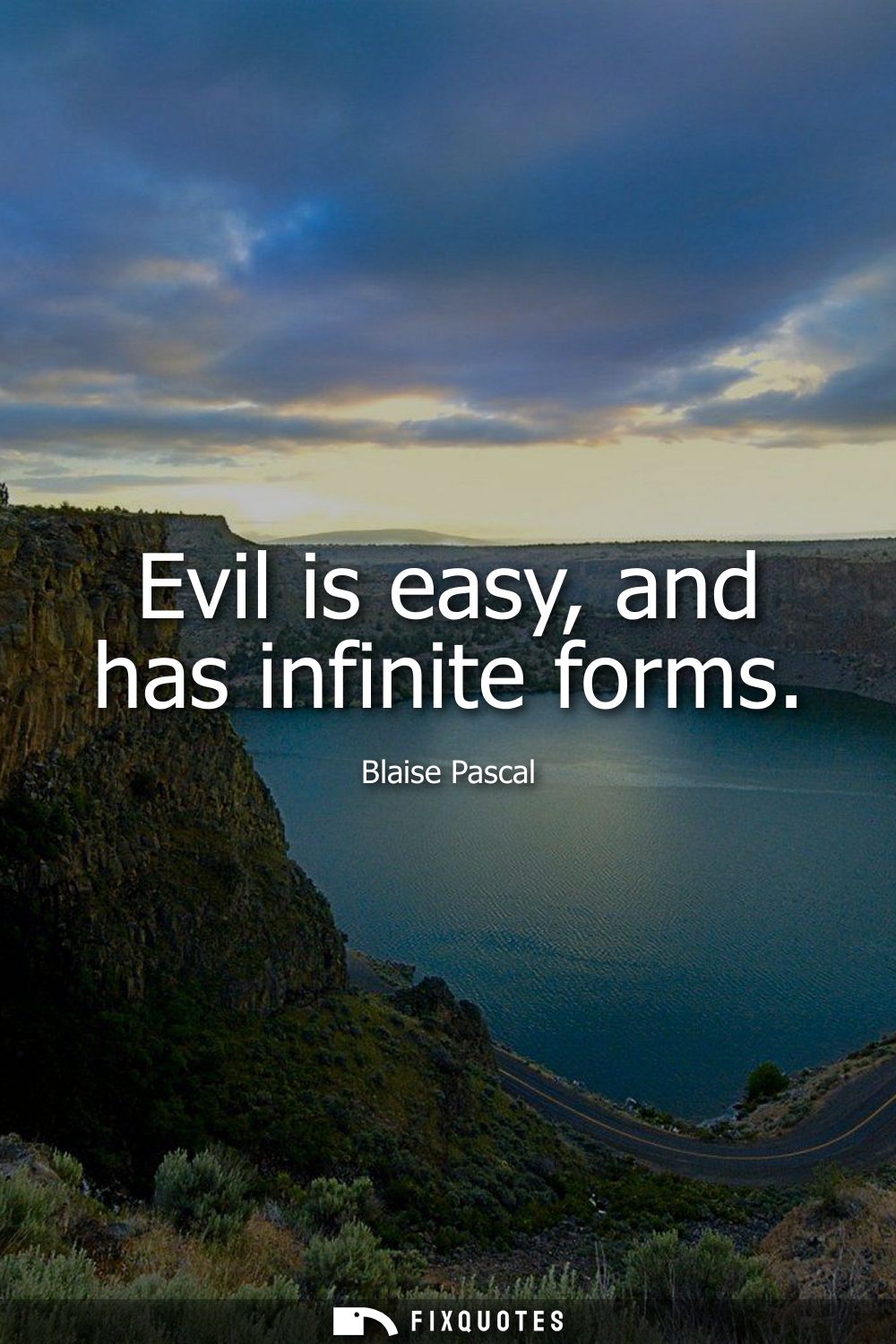
"Evil is easy, and has infinite forms"
About this Quote
“Evil is easy, and has infinite forms” lands like a quiet insult to human self-confidence. Pascal isn’t describing comic-book villainy; he’s diagnosing how effortlessly people slide into harm, error, and self-deception. “Easy” is the key barb: evil doesn’t require genius or even conviction. It thrives on laziness, appetite, fear, and the countless small exemptions we grant ourselves. Good, by contrast, tends to be narrower and more demanding: it asks for discipline, clarity, sacrifice, coherence.
The second clause sharpens the knife. “Infinite forms” suggests not a single adversary but a shapeshifter. Evil can look like cruelty, but also like sophistication, common sense, zeal, prudence, patriotism, even piety. That’s Pascal’s darker insight: moral failure isn’t only about breaking rules; it’s about the human capacity to rebrand vice as virtue. The line anticipates modern propaganda and personal rationalization alike: the lie that feels “necessary,” the compromise framed as “realism,” the vanity dressed up as “taste.”
Context matters. Pascal wrote in a 17th-century France obsessed with religious debate, scientific discovery, and the precariousness of political order. A mathematician who could quantify probability and a Christian thinker who distrusted human pride, he aimed his skepticism at the self. The quote compresses that worldview: humans are brilliant at invention, and that brilliance doesn’t automatically bend toward the good. If anything, it gives wrongdoing better costumes.
The second clause sharpens the knife. “Infinite forms” suggests not a single adversary but a shapeshifter. Evil can look like cruelty, but also like sophistication, common sense, zeal, prudence, patriotism, even piety. That’s Pascal’s darker insight: moral failure isn’t only about breaking rules; it’s about the human capacity to rebrand vice as virtue. The line anticipates modern propaganda and personal rationalization alike: the lie that feels “necessary,” the compromise framed as “realism,” the vanity dressed up as “taste.”
Context matters. Pascal wrote in a 17th-century France obsessed with religious debate, scientific discovery, and the precariousness of political order. A mathematician who could quantify probability and a Christian thinker who distrusted human pride, he aimed his skepticism at the self. The quote compresses that worldview: humans are brilliant at invention, and that brilliance doesn’t automatically bend toward the good. If anything, it gives wrongdoing better costumes.
Quote Details
| Topic | Ethics & Morality |
|---|---|
| Source | Help us find the source |
| Cite |
Citation Formats
APA Style (7th ed.)
Pascal, Blaise. (2026, January 17). Evil is easy, and has infinite forms. FixQuotes. https://fixquotes.com/quotes/evil-is-easy-and-has-infinite-forms-30226/
Chicago Style
Pascal, Blaise. "Evil is easy, and has infinite forms." FixQuotes. January 17, 2026. https://fixquotes.com/quotes/evil-is-easy-and-has-infinite-forms-30226/.
MLA Style (9th ed.)
"Evil is easy, and has infinite forms." FixQuotes, 17 Jan. 2026, https://fixquotes.com/quotes/evil-is-easy-and-has-infinite-forms-30226/. Accessed 26 Mar. 2026.
More Quotes by Blaise
Add to List