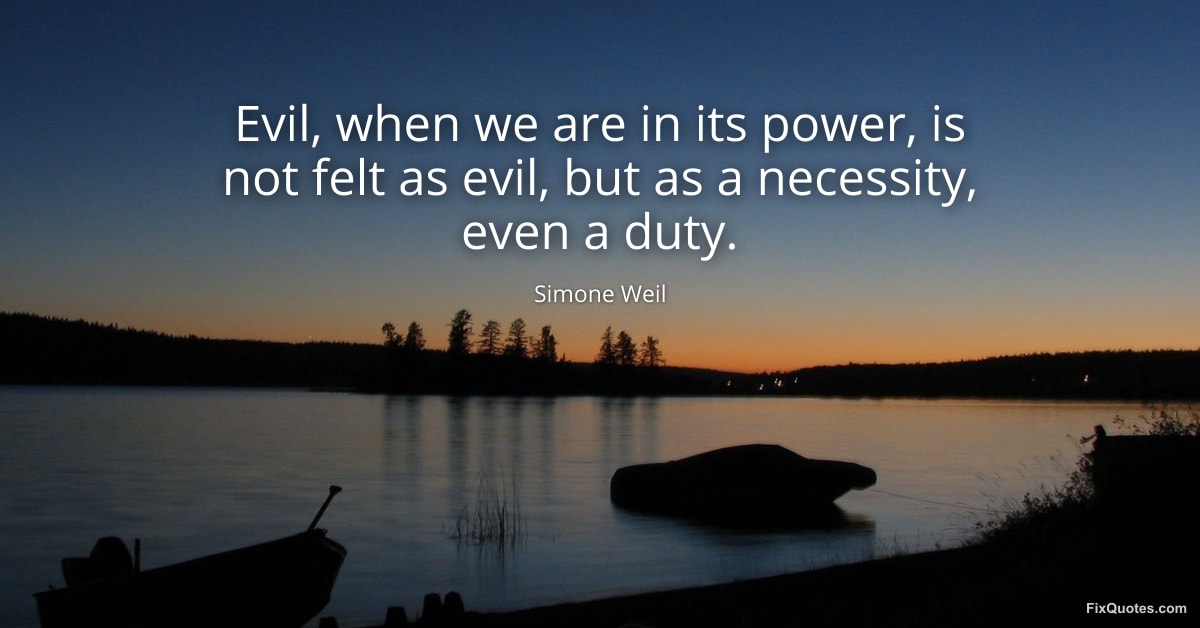
"Evil, when we are in its power, is not felt as evil, but as a necessity, even a duty"
About this Quote
Weil isn’t offering a cheap paradox. She’s naming a psychological mechanism she watched at scale in the 20th century: war, bureaucracy, ideological movements, the way institutions make complicity feel like maturity. “Necessity” is the magic word. It implies there is no alternative, and when there is no alternative, conscience becomes indulgence. “Even a duty” is sharper still, because duty is normally the bridge between private morality and public life. Weil flips it: duty can be the costume evil wears to get past our defenses.
The subtext is a warning about self-exoneration. People don’t only obey; they tell themselves a story in which obedience is virtue. Weil’s own context matters here: a philosopher steeped in mysticism and political reality, writing in the shadow of fascism and total war, suspicious of any system that converts human beings into functions. The line isn’t just about monsters. It’s about the everyday moral anesthesia that lets ordinary people do extraordinary harm while feeling, sincerely, that they’re being responsible.
Quote Details
| Topic | Ethics & Morality |
|---|---|
| Source | Help us find the source |
| Cite |
Citation Formats
APA Style (7th ed.)
Weil, Simone. (2026, January 14). Evil, when we are in its power, is not felt as evil, but as a necessity, even a duty. FixQuotes. https://fixquotes.com/quotes/evil-when-we-are-in-its-power-is-not-felt-as-evil-2927/
Chicago Style
Weil, Simone. "Evil, when we are in its power, is not felt as evil, but as a necessity, even a duty." FixQuotes. January 14, 2026. https://fixquotes.com/quotes/evil-when-we-are-in-its-power-is-not-felt-as-evil-2927/.
MLA Style (9th ed.)
"Evil, when we are in its power, is not felt as evil, but as a necessity, even a duty." FixQuotes, 14 Jan. 2026, https://fixquotes.com/quotes/evil-when-we-are-in-its-power-is-not-felt-as-evil-2927/. Accessed 15 Mar. 2026.