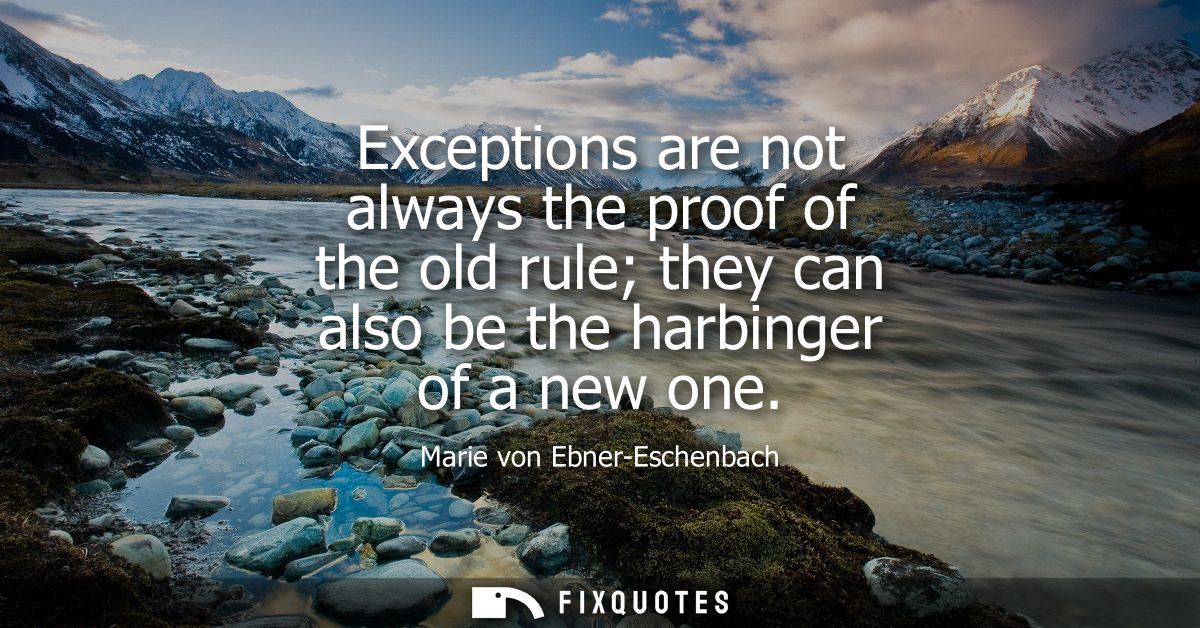
"Exceptions are not always the proof of the old rule; they can also be the harbinger of a new one"
About this Quote
The line works because it’s less a slogan than a warning about intellectual laziness. “Proof of the old rule” names a rhetorical habit: we preserve existing frameworks by treating contradictions as quirks, not signals. The pivot - “they can also be the harbinger of a new one” - is where the sentence gains its bite. “Harbinger” carries a faintly ominous, historical weight; it suggests that change arrives first as an anomaly, not a manifesto. In other words, revolutions often begin as edge cases.
Context matters. Ebner-Eschenbach wrote as a sharp-eyed realist in the late Habsburg world, a society propped up by hierarchies that insisted on their own naturalness. For a woman novelist in that milieu, the “exception” isn’t abstract: it’s the person, the behavior, the truth that official categories can’t comfortably explain. Her intent is quietly insurgent. Don’t just tolerate the outlier; study it. It may be the future arriving early, asking whether your “rule” is wisdom or merely inertia.
Quote Details
| Topic | Embrace Change |
|---|---|
| Source | Help us find the source |
| Cite |
Citation Formats
APA Style (7th ed.)
Ebner-Eschenbach, Marie von. (2026, January 16). Exceptions are not always the proof of the old rule; they can also be the harbinger of a new one. FixQuotes. https://fixquotes.com/quotes/exceptions-are-not-always-the-proof-of-the-old-116705/
Chicago Style
Ebner-Eschenbach, Marie von. "Exceptions are not always the proof of the old rule; they can also be the harbinger of a new one." FixQuotes. January 16, 2026. https://fixquotes.com/quotes/exceptions-are-not-always-the-proof-of-the-old-116705/.
MLA Style (9th ed.)
"Exceptions are not always the proof of the old rule; they can also be the harbinger of a new one." FixQuotes, 16 Jan. 2026, https://fixquotes.com/quotes/exceptions-are-not-always-the-proof-of-the-old-116705/. Accessed 5 Apr. 2026.