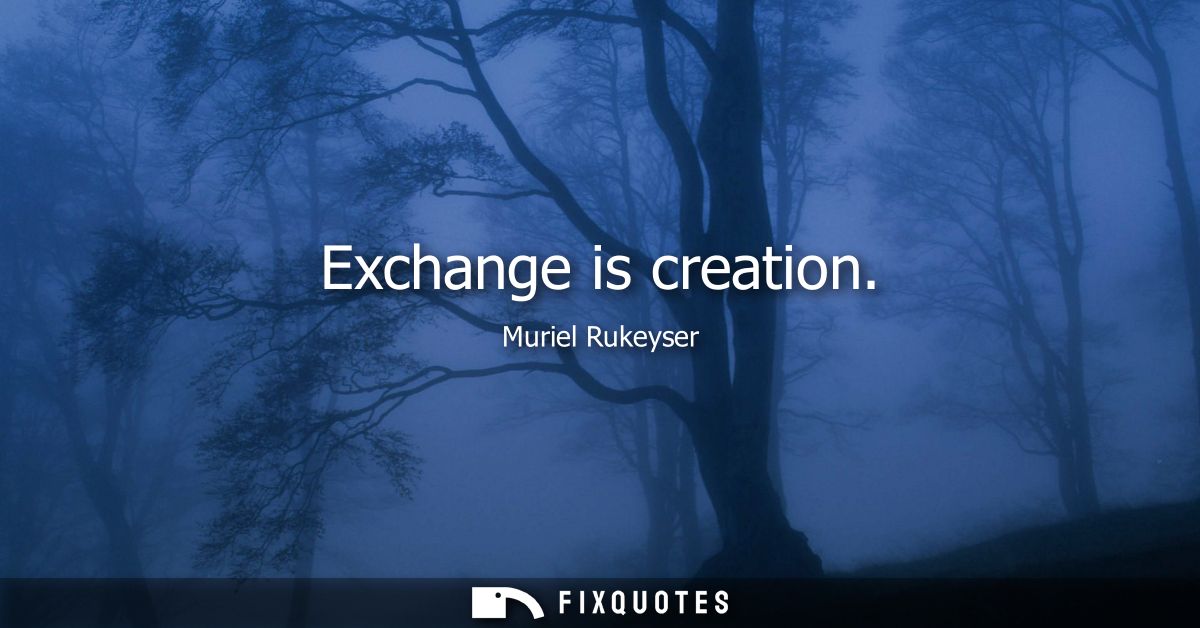
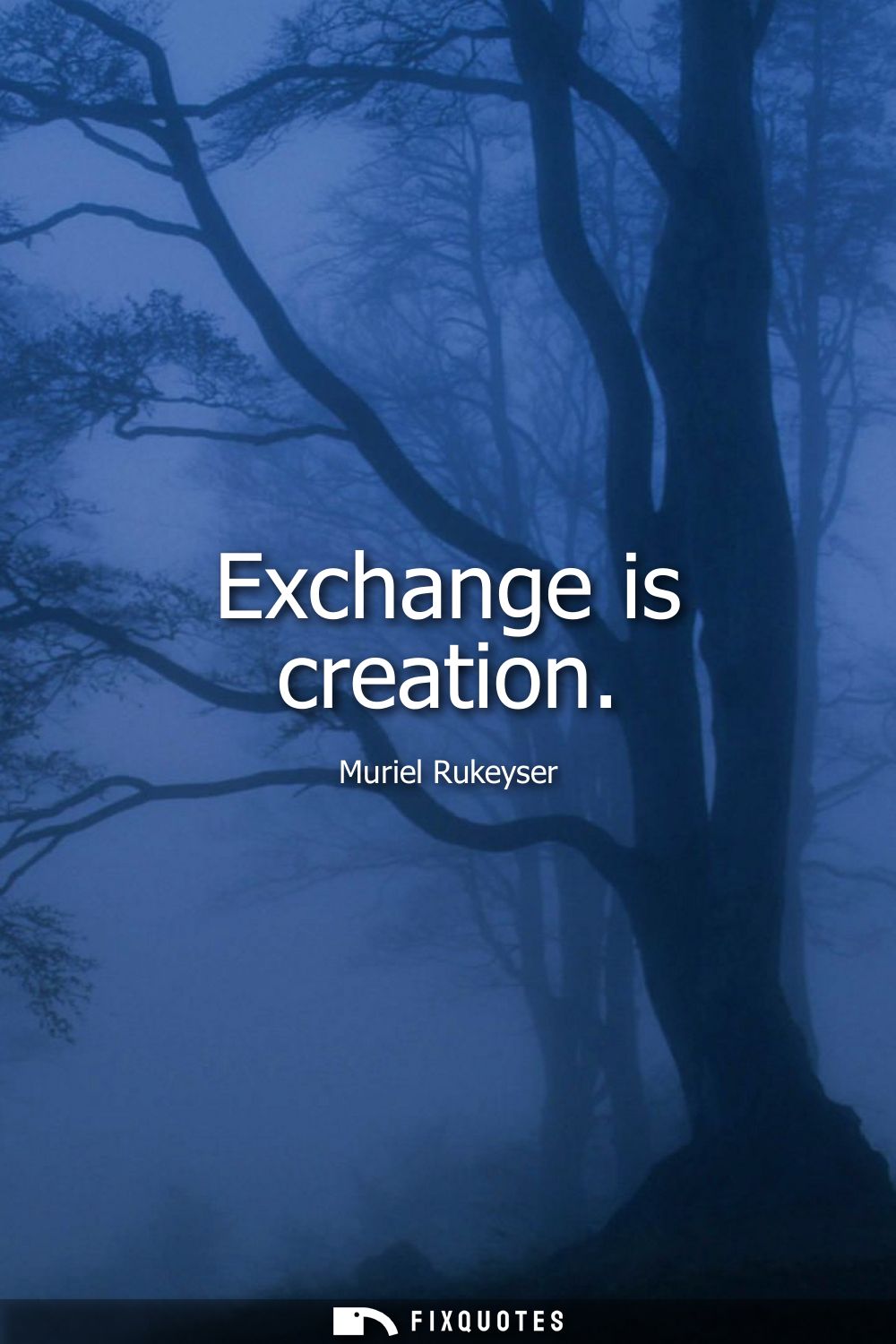
"Exchange is creation"
About this Quote
Muriel Rukeyser’s “Exchange is creation” reads like a manifesto smuggled into five syllables. It rejects the romantic myth of the solitary genius and insists that making art is less a private miracle than a social transaction: voices meeting, ideas rubbing up against each other, material and meaning moving hand to hand. “Exchange” is a deliberately unglamorous word. It evokes labor, markets, conversation, translation, even bargaining. Pairing it with “creation” collapses the distance between the everyday and the sublime, arguing that the conditions we tend to treat as contamination of art - influence, collaboration, audience, politics - are the engine of it.
Rukeyser’s context matters: a 20th-century poet deeply engaged with documentary poetics, anti-fascism, and the ethics of attention. She wrote toward the world, not away from it, often treating poetry as a civic technology: a way to connect lives that power prefers kept separate. In that light, exchange isn’t merely interpersonal niceness; it’s a counterforce to isolation, propaganda, and the kind of authoritarian certainty that thrives when dialogue is shut down. Creation becomes the byproduct of contact, not purity.
The line also carries a quiet challenge to readers: if exchange creates, then receiving is a form of making. Listening, quoting, teaching, arguing, reading across difference - these aren’t secondary acts. They’re generative, and they place responsibility on community, not just the artist, for what gets made and what gets possible.
Rukeyser’s context matters: a 20th-century poet deeply engaged with documentary poetics, anti-fascism, and the ethics of attention. She wrote toward the world, not away from it, often treating poetry as a civic technology: a way to connect lives that power prefers kept separate. In that light, exchange isn’t merely interpersonal niceness; it’s a counterforce to isolation, propaganda, and the kind of authoritarian certainty that thrives when dialogue is shut down. Creation becomes the byproduct of contact, not purity.
The line also carries a quiet challenge to readers: if exchange creates, then receiving is a form of making. Listening, quoting, teaching, arguing, reading across difference - these aren’t secondary acts. They’re generative, and they place responsibility on community, not just the artist, for what gets made and what gets possible.
Quote Details
| Topic | Wisdom |
|---|---|
| Source | Help us find the source |
| Cite |
Citation Formats
APA Style (7th ed.)
Rukeyser, Muriel. (2026, January 17). Exchange is creation. FixQuotes. https://fixquotes.com/quotes/exchange-is-creation-80166/
Chicago Style
Rukeyser, Muriel. "Exchange is creation." FixQuotes. January 17, 2026. https://fixquotes.com/quotes/exchange-is-creation-80166/.
MLA Style (9th ed.)
"Exchange is creation." FixQuotes, 17 Jan. 2026, https://fixquotes.com/quotes/exchange-is-creation-80166/. Accessed 27 Mar. 2026.
More Quotes by Muriel
Add to List