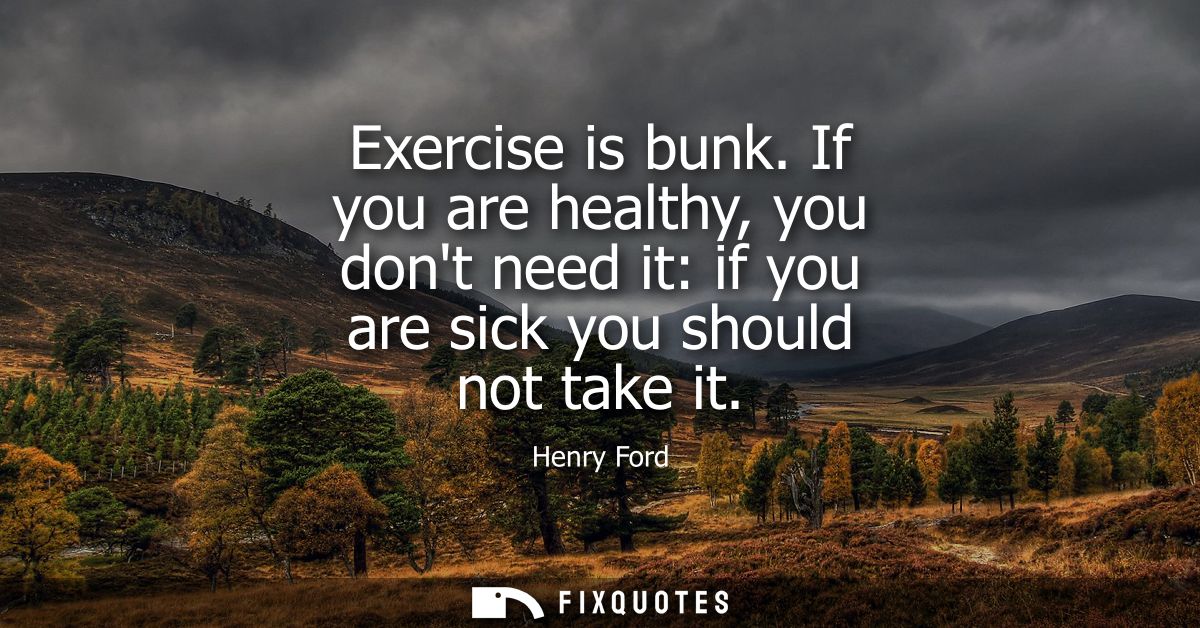
"Exercise is bunk. If you are healthy, you don't need it: if you are sick you should not take it"
About this Quote
The intent reads as practical disdain: Ford, the apostle of productivity, rejects anything that looks like non-productive effort. Exercise, in his framing, is motion without output, labor without a product rolling off the line. Calling it “bunk” also performs a class stance. Early 20th-century “physical culture” could smell like leisure, self-improvement fads, and upscale sanitariums - the kinds of rituals that don’t fit a worldview built around measurable work.
The subtext is control. Fordism prized standardization and predictability, and this quote imagines health the same way: you either pass inspection or you don’t. Preventive care doesn’t register; neither does the idea that bodies are shaped over time by habits, stress, and environment. It’s also a revealing inversion of his broader legacy: the man who engineered motion at massive scale dismisses voluntary motion as pointless.
Culturally, it’s a snapshot of an era when “exercise” wasn’t yet a public-health consensus but a suspicious pastime. The irony is that modern life, made more sedentary by the very efficiencies Ford helped normalize, is exactly what makes exercise necessary.
Quote Details
| Topic | Fitness |
|---|---|
| Source | Later attribution: Henry Ford’s Quotes by Henry Ford’s (Henry Ford’s, 2025) modern compilation
Evidence: Wisdom from the man who revolutionized industry. Henry Ford's. develop character, and we must learn that the ... Exercise is bunk. If you are healthy, you don't need it: if you are sick you should not take it. ***. Nothing is ... Other candidates (2) Today and Tomorrow (Ford, Henry; Crowther, Samuel, 1926) primary39.3% did someone make it for you did you start the work you are in or did someone else have you ever found or made an Henry Ford (Henry Ford) compilation36.3% y they are so unalterably on the side of sound money that it is a serious question how they would regard the syst |
| Cite |
Citation Formats
APA Style (7th ed.)
Ford, Henry. (2026, February 7). Exercise is bunk. If you are healthy, you don't need it: if you are sick you should not take it. FixQuotes. https://fixquotes.com/quotes/exercise-is-bunk-if-you-are-healthy-you-dont-need-27278/
Chicago Style
Ford, Henry. "Exercise is bunk. If you are healthy, you don't need it: if you are sick you should not take it." FixQuotes. February 7, 2026. https://fixquotes.com/quotes/exercise-is-bunk-if-you-are-healthy-you-dont-need-27278/.
MLA Style (9th ed.)
"Exercise is bunk. If you are healthy, you don't need it: if you are sick you should not take it." FixQuotes, 7 Feb. 2026, https://fixquotes.com/quotes/exercise-is-bunk-if-you-are-healthy-you-dont-need-27278/. Accessed 30 Mar. 2026.