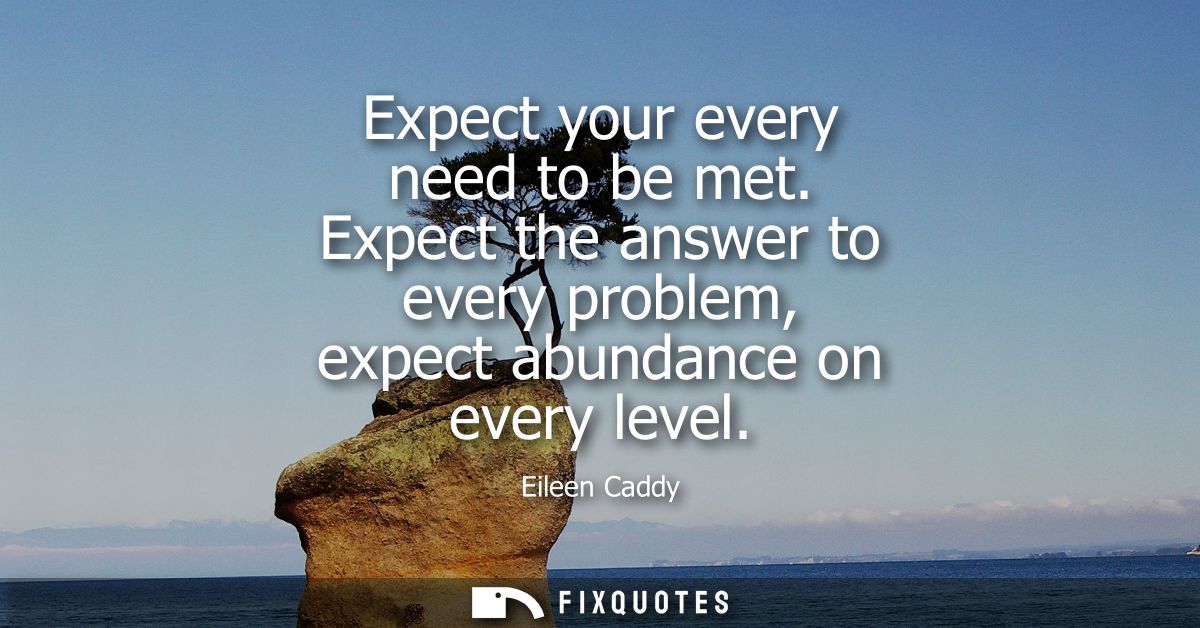
"Expect your every need to be met. Expect the answer to every problem, expect abundance on every level"
About this Quote
The subtext is psychological as much as mystical. If you truly expect good outcomes, you behave like someone who believes they’re possible: you notice openings, you take risks, you stop negotiating with scarcity. That can be empowering, especially for people trained by money, family, or institutions to pre-reject themselves. But it also smuggles in a sharp implication: if abundance doesn’t arrive, your expectation wasn’t pure enough. The rhetoric protects the promise by quietly relocating failure onto the believer.
Context matters. Caddy’s celebrity wasn’t pop-star fame; it was spiritual renown, tied to the Findhorn Foundation and the 20th-century New Age boom, when self-actualization, Eastern-inflected mysticism, and postwar affluence braided together into a marketable inner life. This quote fits that cultural moment perfectly: it offers cosmic permission to want more, while avoiding the messy question of who gets abundance, who doesn’t, and why. It’s aspiration as spiritual practice, comforting precisely because it refuses to sound like a negotiation with reality.
Quote Details
| Topic | Motivational |
|---|---|
| Source | Help us find the source |
| Cite |
Citation Formats
APA Style (7th ed.)
Caddy, Eileen. (2026, January 18). Expect your every need to be met. Expect the answer to every problem, expect abundance on every level. FixQuotes. https://fixquotes.com/quotes/expect-your-every-need-to-be-met-expect-the-11949/
Chicago Style
Caddy, Eileen. "Expect your every need to be met. Expect the answer to every problem, expect abundance on every level." FixQuotes. January 18, 2026. https://fixquotes.com/quotes/expect-your-every-need-to-be-met-expect-the-11949/.
MLA Style (9th ed.)
"Expect your every need to be met. Expect the answer to every problem, expect abundance on every level." FixQuotes, 18 Jan. 2026, https://fixquotes.com/quotes/expect-your-every-need-to-be-met-expect-the-11949/. Accessed 31 Mar. 2026.