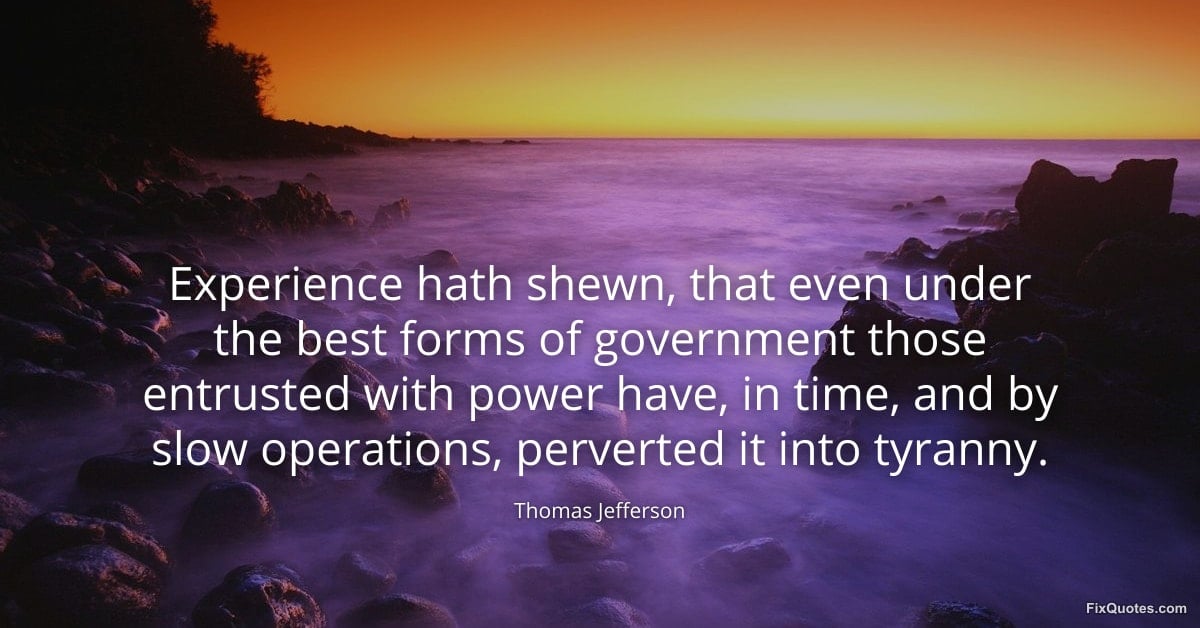
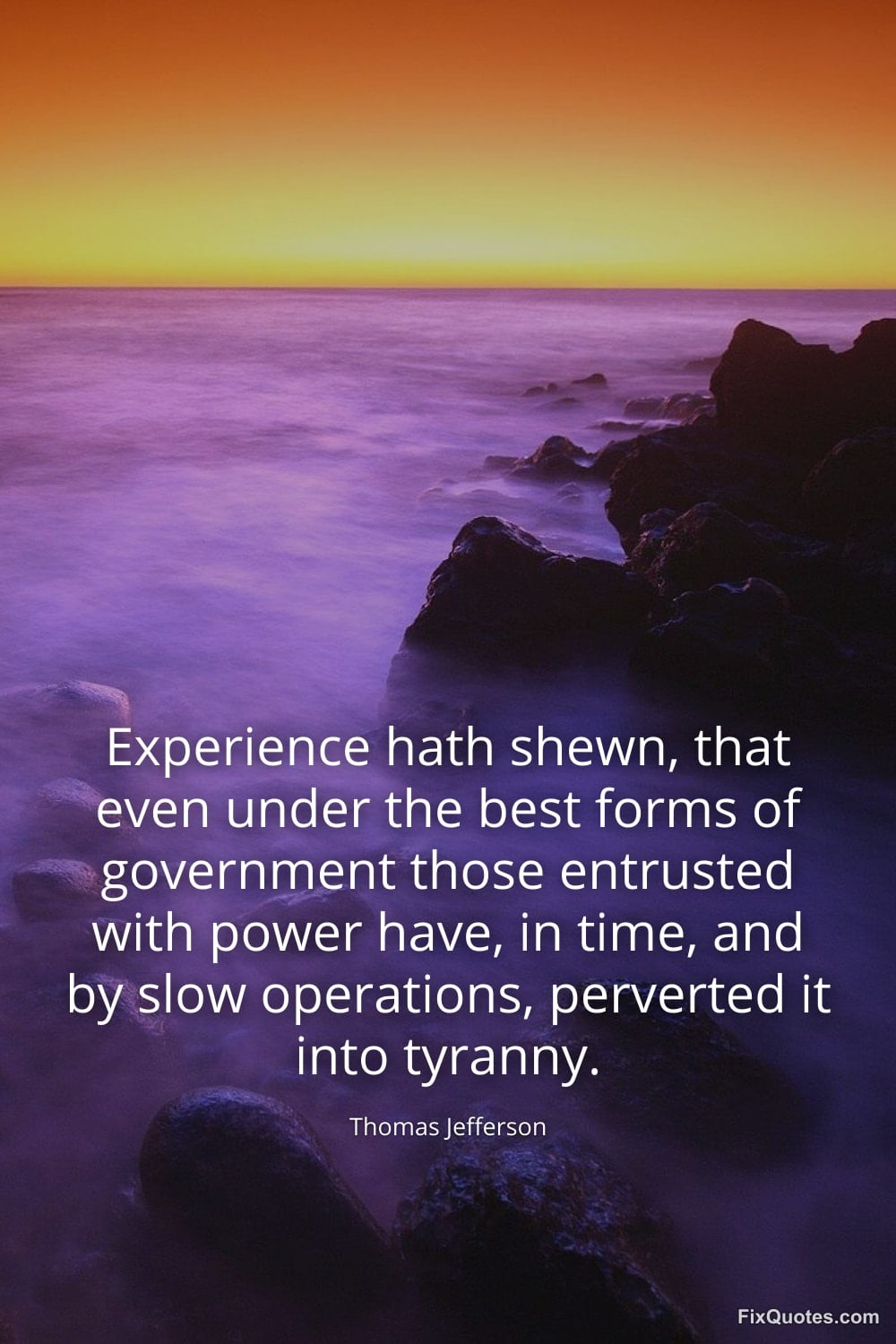
"Experience hath shewn, that even under the best forms of government, those entrusted with power have, in time, and by slow operations, perverted it into tyranny"
About this Quote
The intent is surgical: he’s not attacking monarchy alone or some obviously corrupt regime. He’s indicting the comforting belief that good design guarantees good outcomes. Even the best-written constitutions, he argues, can be quietly reinterpreted, selectively enforced, padded with exceptions, and administered by people who come to confuse public office with private entitlement. “Those entrusted with power” sounds polite, almost deferential, which makes the accusation land harder: the villains are not always outsiders; they’re the very stewards you authorized.
Context matters. Jefferson is speaking from a revolutionary generation that had watched Britain’s imperial apparatus tighten through taxes, courts, soldiers, and governors - incremental instruments that made domination feel bureaucratic rather than brutal. That experience fed the American obsession with checks and balances, rotation in office, and an armed skepticism toward standing authority.
The subtext is a challenge to democratic laziness. If tyranny is a “slow operation,” then the antidote can’t be occasional outrage; it has to be continuous scrutiny. Jefferson is selling vigilance as civic realism: not paranoia, not fatalism, just the sober recognition that human incentives outlast political ideals.
Quote Details
| Topic | Freedom |
|---|---|
| Source | Help us find the source |
| Cite |
Citation Formats
APA Style (7th ed.)
Jefferson, Thomas. (2026, February 19). Experience hath shewn, that even under the best forms of government, those entrusted with power have, in time, and by slow operations, perverted it into tyranny. FixQuotes. https://fixquotes.com/quotes/experience-hath-shewn-that-even-under-the-best-37734/
Chicago Style
Jefferson, Thomas. "Experience hath shewn, that even under the best forms of government, those entrusted with power have, in time, and by slow operations, perverted it into tyranny." FixQuotes. February 19, 2026. https://fixquotes.com/quotes/experience-hath-shewn-that-even-under-the-best-37734/.
MLA Style (9th ed.)
"Experience hath shewn, that even under the best forms of government, those entrusted with power have, in time, and by slow operations, perverted it into tyranny." FixQuotes, 19 Feb. 2026, https://fixquotes.com/quotes/experience-hath-shewn-that-even-under-the-best-37734/. Accessed 27 Mar. 2026.