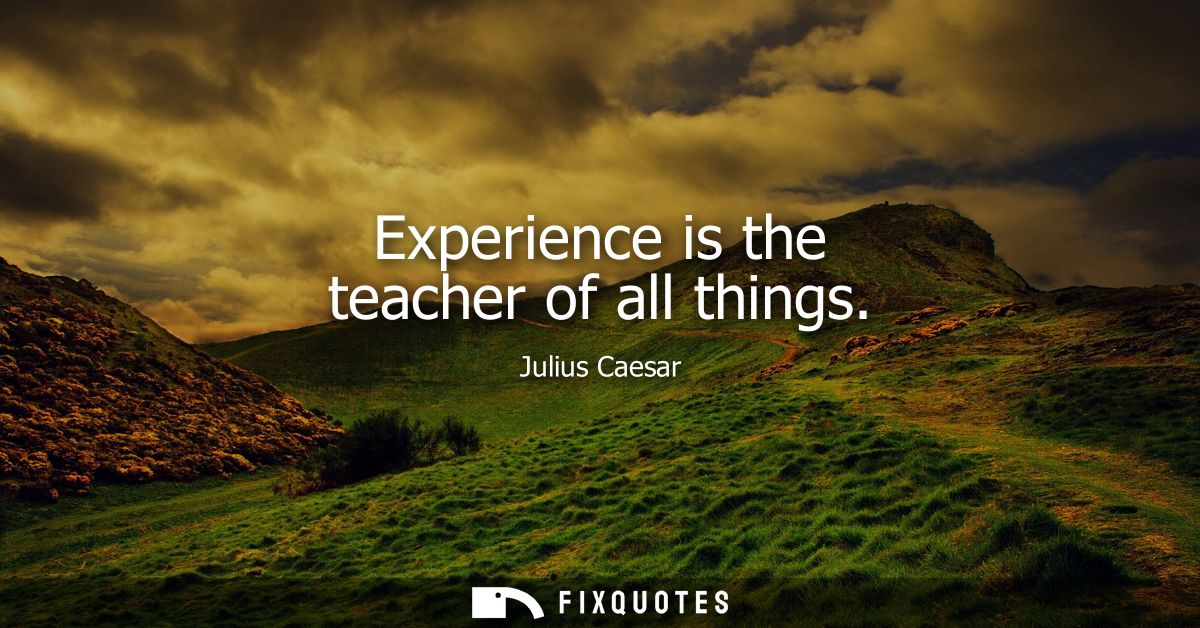
"Experience is the teacher of all things"
About this Quote
"Experience is the teacher of all things" isn’t a cozy nod to lifelong learning; it’s a commander’s epistemology. In Caesar’s world, knowledge that can’t survive contact with mud, weather, betrayal, and logistics is ornamental. The line carries the hard, Roman suspicion of theory: you can study courage, politics, and war in books, but you only understand them when the stakes are real and irreversible.
The intent is quietly authoritarian in the best Roman sense of the term: reality adjudicates. Caesar isn’t asking for patience with trial-and-error so much as insisting that legitimacy comes from demonstrated outcomes. The subtext flatters the practitioner and sidelines the armchair critic. It’s also self-justifying. Caesar’s career was an extended argument that he deserved power because he had earned competence in the only arena that mattered: action. If you’ve marched with an army, governed provinces, survived factional knife-fights, you don’t just have opinions; you have proof.
Context matters because Roman public life ran on performance under pressure. Leadership wasn’t a résumé bullet point; it was a spectacle of capability. The phrase functions like a compressed military briefing: learn fast, adapt, and let consequences do the grading. It’s persuasive because it sounds humble (let experience teach) while actually staking a claim to authority (I have more experience than you). In an age where catastrophe was a curriculum, Caesar’s line is less motivational poster than operating system.
The intent is quietly authoritarian in the best Roman sense of the term: reality adjudicates. Caesar isn’t asking for patience with trial-and-error so much as insisting that legitimacy comes from demonstrated outcomes. The subtext flatters the practitioner and sidelines the armchair critic. It’s also self-justifying. Caesar’s career was an extended argument that he deserved power because he had earned competence in the only arena that mattered: action. If you’ve marched with an army, governed provinces, survived factional knife-fights, you don’t just have opinions; you have proof.
Context matters because Roman public life ran on performance under pressure. Leadership wasn’t a résumé bullet point; it was a spectacle of capability. The phrase functions like a compressed military briefing: learn fast, adapt, and let consequences do the grading. It’s persuasive because it sounds humble (let experience teach) while actually staking a claim to authority (I have more experience than you). In an age where catastrophe was a curriculum, Caesar’s line is less motivational poster than operating system.
Quote Details
| Topic | Wisdom |
|---|---|
| Source | Help us find the source |
| Cite |
Citation Formats
APA Style (7th ed.)
Caesar, Julius. (2026, January 17). Experience is the teacher of all things. FixQuotes. https://fixquotes.com/quotes/experience-is-the-teacher-of-all-things-25760/
Chicago Style
Caesar, Julius. "Experience is the teacher of all things." FixQuotes. January 17, 2026. https://fixquotes.com/quotes/experience-is-the-teacher-of-all-things-25760/.
MLA Style (9th ed.)
"Experience is the teacher of all things." FixQuotes, 17 Jan. 2026, https://fixquotes.com/quotes/experience-is-the-teacher-of-all-things-25760/. Accessed 4 Apr. 2026.
More Quotes by Julius
Add to List