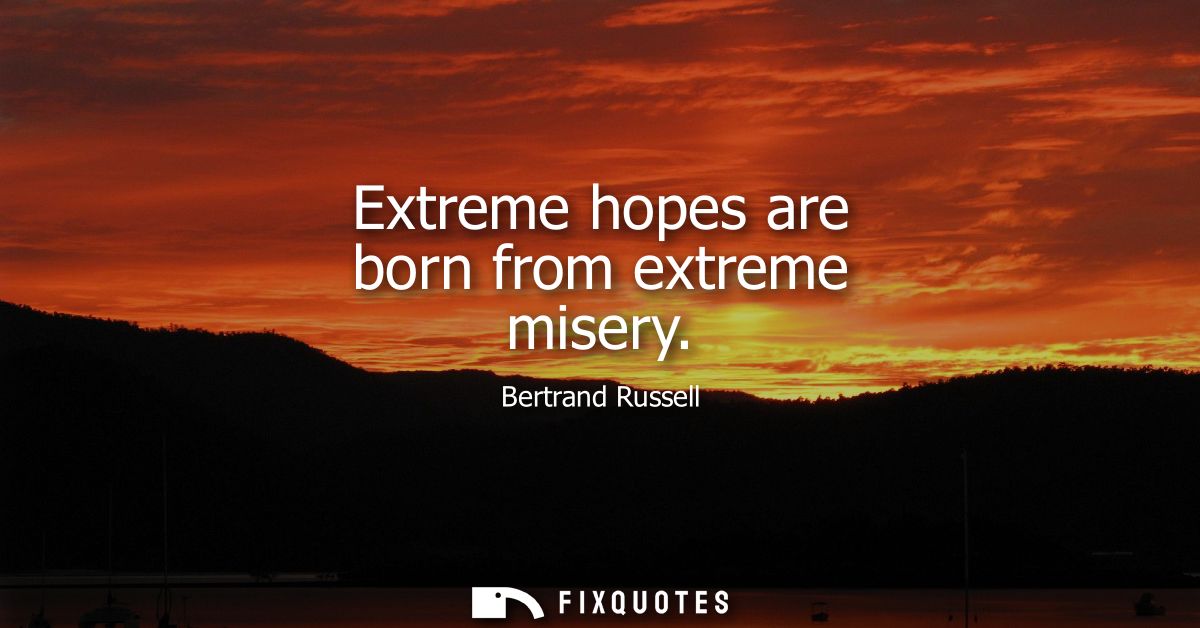
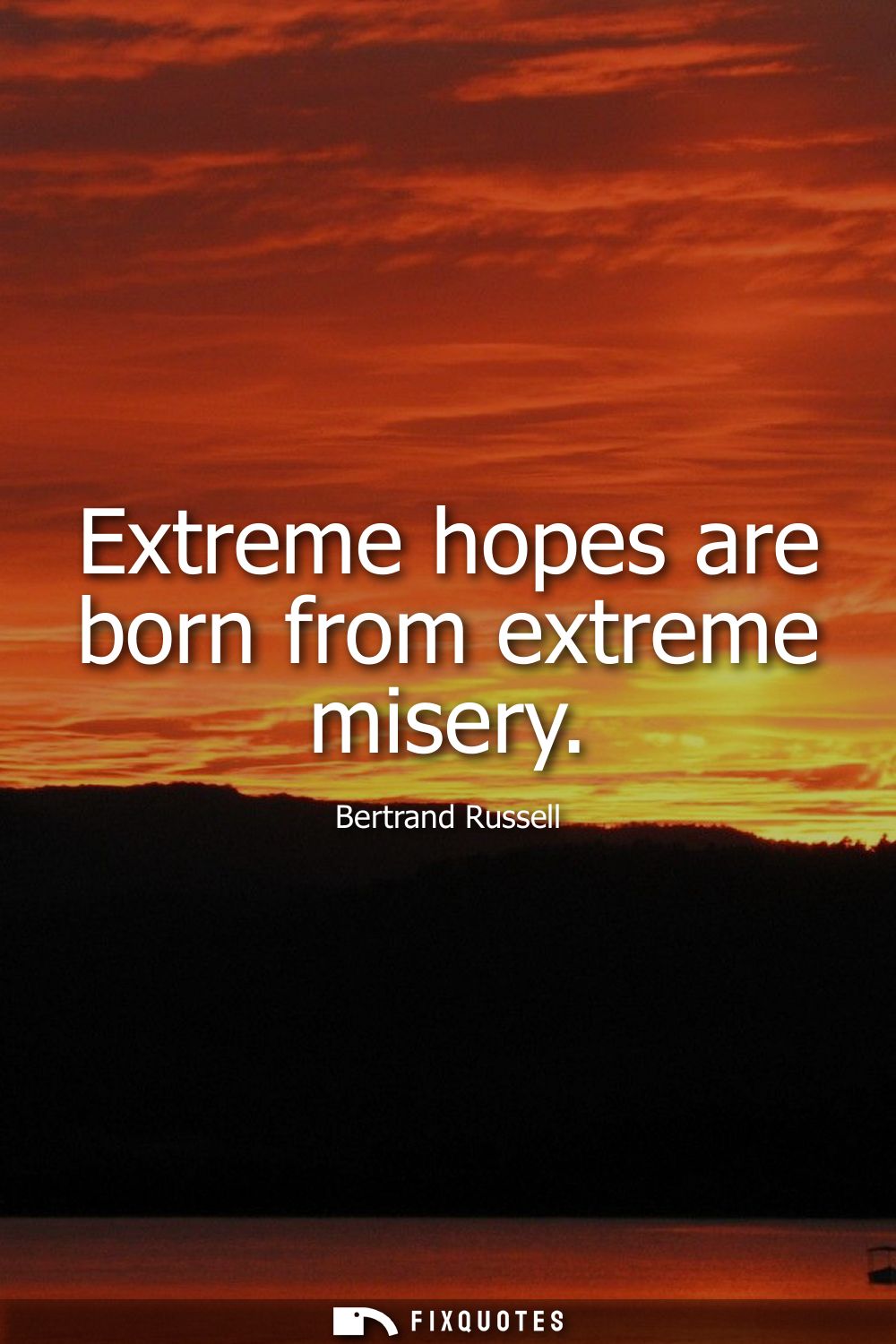
"Extreme hopes are born from extreme misery"
About this Quote
Russell’s line is a cool-headed autopsy of a hot emotion: hope. He refuses to treat it as a noble substance floating above circumstances. Instead, he pins it to pressure, to the way a mind behaves when ordinary expectations have been burned away. “Extreme” does double duty here. It’s not just intensity; it’s distortion. When life becomes unlivable, the imagination stops negotiating with reality and starts bargaining with fate.
The subtext is almost clinical, and a little accusatory. Extreme hope isn’t presented as wisdom or courage; it’s a symptom. In Russell’s worldview, shaped by a lifelong suspicion of comforting illusions, desperation becomes a factory for miracles. People don’t leap toward utopian promises because they’re naive; they do it because incremental solutions feel like insults when you’re starving, bombed out, trapped, or socially erased. Misery radicalizes the scale of what seems plausible, and that makes populations vulnerable to prophets, demagogues, and messianic ideologies offering total salvation.
Context matters: Russell lived through the mechanized slaughter of World War I, the rise of totalitarian movements, the Depression, and the shadow of nuclear annihilation. In the 20th century, “hope” wasn’t just personal uplift; it was political fuel, the kind that could power emancipation or catastrophe. The sentence works because it’s unsentimental: it acknowledges hope’s necessity while warning that its most fervent forms can be less a beacon than a flare fired from a sinking ship.
The subtext is almost clinical, and a little accusatory. Extreme hope isn’t presented as wisdom or courage; it’s a symptom. In Russell’s worldview, shaped by a lifelong suspicion of comforting illusions, desperation becomes a factory for miracles. People don’t leap toward utopian promises because they’re naive; they do it because incremental solutions feel like insults when you’re starving, bombed out, trapped, or socially erased. Misery radicalizes the scale of what seems plausible, and that makes populations vulnerable to prophets, demagogues, and messianic ideologies offering total salvation.
Context matters: Russell lived through the mechanized slaughter of World War I, the rise of totalitarian movements, the Depression, and the shadow of nuclear annihilation. In the 20th century, “hope” wasn’t just personal uplift; it was political fuel, the kind that could power emancipation or catastrophe. The sentence works because it’s unsentimental: it acknowledges hope’s necessity while warning that its most fervent forms can be less a beacon than a flare fired from a sinking ship.
Quote Details
| Topic | Hope |
|---|---|
| Source | Help us find the source |
| Cite |
Citation Formats
APA Style (7th ed.)
Russell, Bertrand. (2026, January 15). Extreme hopes are born from extreme misery. FixQuotes. https://fixquotes.com/quotes/extreme-hopes-are-born-from-extreme-misery-4914/
Chicago Style
Russell, Bertrand. "Extreme hopes are born from extreme misery." FixQuotes. January 15, 2026. https://fixquotes.com/quotes/extreme-hopes-are-born-from-extreme-misery-4914/.
MLA Style (9th ed.)
"Extreme hopes are born from extreme misery." FixQuotes, 15 Jan. 2026, https://fixquotes.com/quotes/extreme-hopes-are-born-from-extreme-misery-4914/. Accessed 30 Mar. 2026.
More Quotes by Bertrand
Add to List