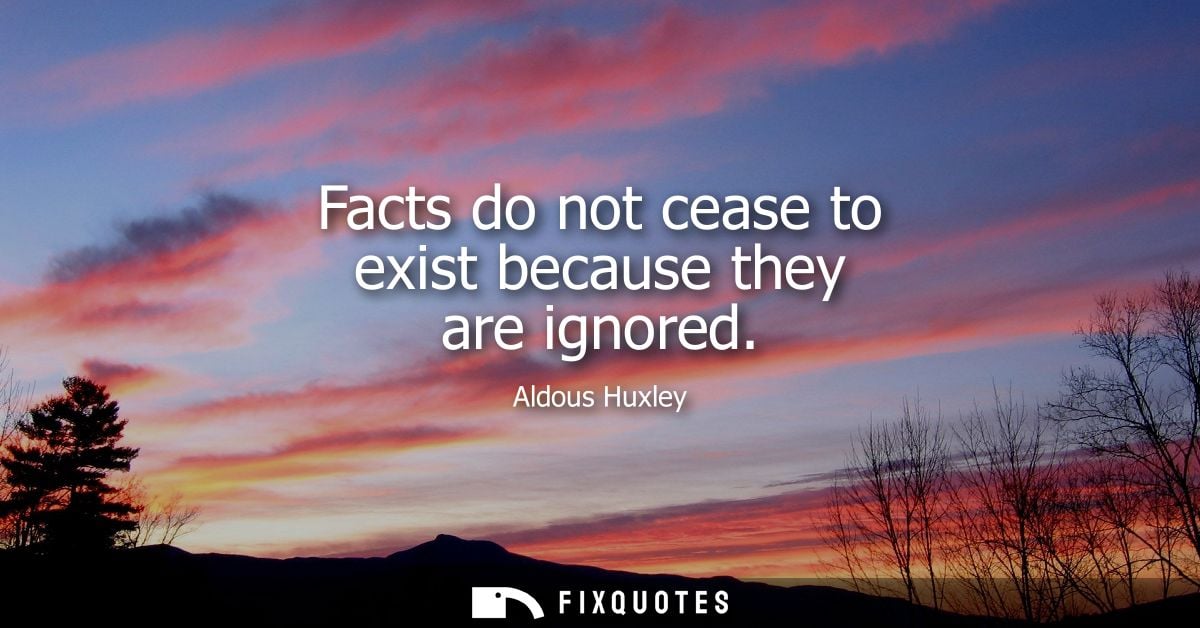
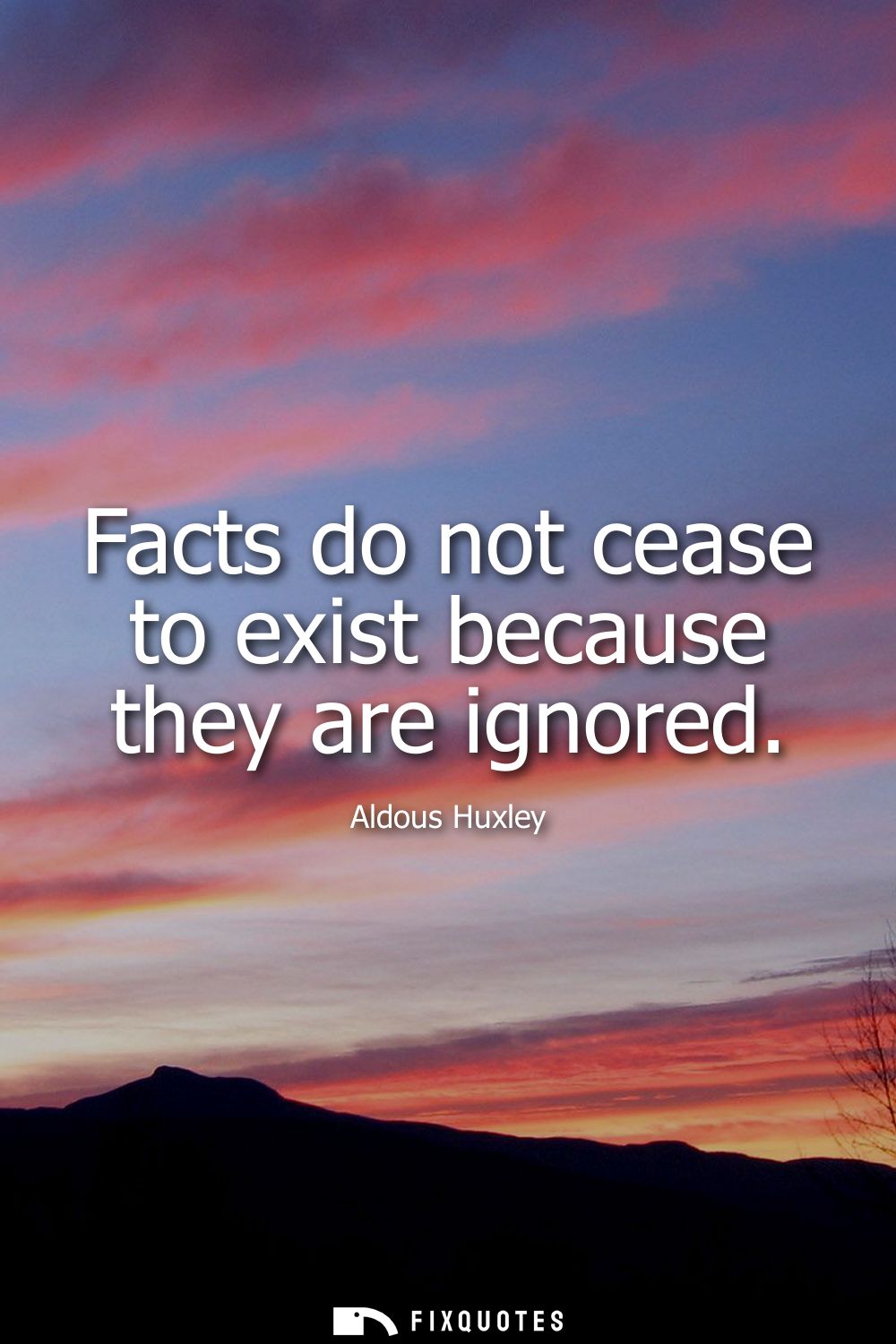
"Facts do not cease to exist because they are ignored"
About this Quote
Huxley’s line lands with the calm menace of a thermometer: it doesn’t argue, it registers. “Facts do not cease to exist because they are ignored” is less a plea for reason than a warning about the costs of pretending. The phrasing is almost childishly simple, which is the point. It strips away the comforting myth that reality is negotiable if you just look away hard enough. Denial isn’t an alternative worldview; it’s a short-term tactic that accrues interest.
The intent is aimed at a very modern pathology Huxley saw early: societies learning to manage discomfort not by confronting it, but by anesthetizing it. In his fiction and essays, the danger isn’t ignorance alone; it’s willful ignorance made convenient by institutions, entertainment, and ideology. “Ignored” is the key verb. It implies choice, not confusion. This is not about lacking information; it’s about refusing it because the facts are politically inconvenient, emotionally costly, or socially destabilizing.
Subtextually, the quote takes a swipe at the idea that consensus creates truth. You can vote to ignore a statistic, suppress a report, or build a whole identity around disbelief, but the thing you’re dodging remains active in the world, quietly shaping outcomes. Huxley’s cynicism is disciplined: he doesn’t romanticize “truth” as moral purity. He treats it as physical consequence.
In context, written by a novelist obsessed with propaganda, conditioning, and the soft machinery of control, the line reads like a rebuttal to both totalitarian spectacle and everyday self-deception. It’s the sentence you’d want taped to the edge of any screen.
The intent is aimed at a very modern pathology Huxley saw early: societies learning to manage discomfort not by confronting it, but by anesthetizing it. In his fiction and essays, the danger isn’t ignorance alone; it’s willful ignorance made convenient by institutions, entertainment, and ideology. “Ignored” is the key verb. It implies choice, not confusion. This is not about lacking information; it’s about refusing it because the facts are politically inconvenient, emotionally costly, or socially destabilizing.
Subtextually, the quote takes a swipe at the idea that consensus creates truth. You can vote to ignore a statistic, suppress a report, or build a whole identity around disbelief, but the thing you’re dodging remains active in the world, quietly shaping outcomes. Huxley’s cynicism is disciplined: he doesn’t romanticize “truth” as moral purity. He treats it as physical consequence.
In context, written by a novelist obsessed with propaganda, conditioning, and the soft machinery of control, the line reads like a rebuttal to both totalitarian spectacle and everyday self-deception. It’s the sentence you’d want taped to the edge of any screen.
Quote Details
| Topic | Truth |
|---|---|
| Source | Later attribution: The Truth About Lies (Aja Raden, 2021) modern compilationISBN: 9781250272034 · ID: edLtDwAAQBAJ
Evidence:
... Aldous Huxley said , " facts do not cease to exist because they are ignored . " And that's a valid point - there's still the hardest fact in the world : the fact that diamonds are not rare . The fact is , the prices are artificially ... |
| Cite |
Citation Formats
APA Style (7th ed.)
Huxley, Aldous. (2026, March 2). Facts do not cease to exist because they are ignored. FixQuotes. https://fixquotes.com/quotes/facts-do-not-cease-to-exist-because-they-are-3104/
Chicago Style
Huxley, Aldous. "Facts do not cease to exist because they are ignored." FixQuotes. March 2, 2026. https://fixquotes.com/quotes/facts-do-not-cease-to-exist-because-they-are-3104/.
MLA Style (9th ed.)
"Facts do not cease to exist because they are ignored." FixQuotes, 2 Mar. 2026, https://fixquotes.com/quotes/facts-do-not-cease-to-exist-because-they-are-3104/. Accessed 5 Mar. 2026.
More Quotes by Aldous
Add to List