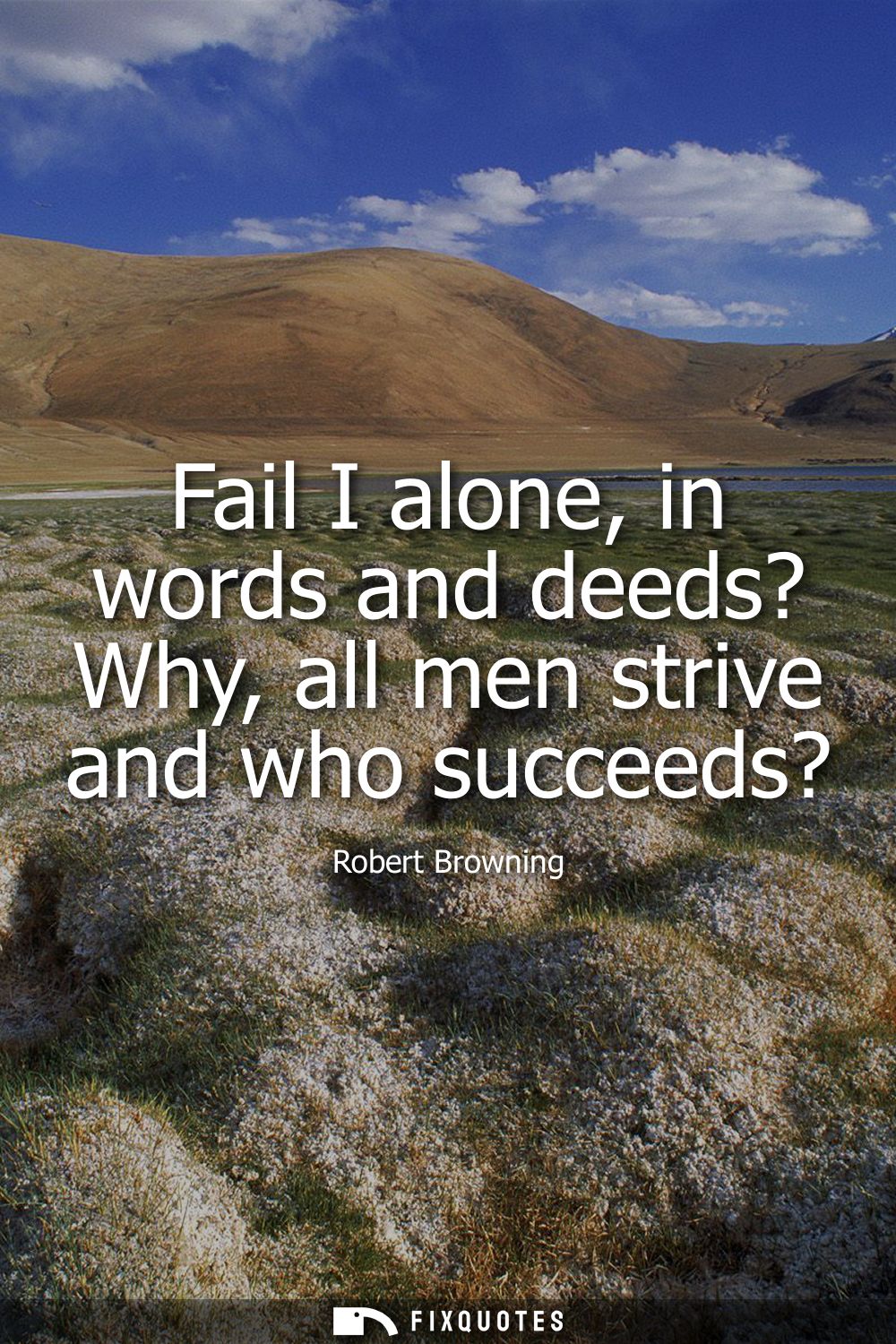
"Fail I alone, in words and deeds? Why, all men strive and who succeeds?"
About this Quote
Self-reproach collapses into a shrug of democratic fatalism. Browning’s speaker starts with the sting of singular failure - “Fail I alone” carries that paranoid throb that your missteps are uniquely humiliating, uniquely on display. Then the line pivots, almost impatiently: “Why” doesn’t soothe so much as snap the frame wider. The question isn’t whether the speaker failed, but whether success is even a stable category in a world where “all men strive” and achievement is the exception, not the rule.
What makes the couplet work is its argumentative choreography. “Words and deeds” is a deliberately total inventory: thought made public, intention made real. If the speaker can’t be absolved in one realm, maybe he can’t be absolved at all - unless the premise of personal exceptionalism is itself the problem. Browning counters the ego’s melodrama with a bruising, almost egalitarian realism: striving is universal; succeeding is scarce. The consolation isn’t that you’ll win next time. It’s that failure is the default condition of ambition.
Placed in a Victorian context that fetishized moral effort and public achievement, the lines read as both confession and critique. They puncture the era’s performance of earnest striving, hinting that the social narrative of merit - work hard, rise up - is partly theater. Browning, master of dramatic monologue, lets a voice expose its own coping mechanism: turn private shame into a general law, not to escape responsibility, but to survive the crush of it.
What makes the couplet work is its argumentative choreography. “Words and deeds” is a deliberately total inventory: thought made public, intention made real. If the speaker can’t be absolved in one realm, maybe he can’t be absolved at all - unless the premise of personal exceptionalism is itself the problem. Browning counters the ego’s melodrama with a bruising, almost egalitarian realism: striving is universal; succeeding is scarce. The consolation isn’t that you’ll win next time. It’s that failure is the default condition of ambition.
Placed in a Victorian context that fetishized moral effort and public achievement, the lines read as both confession and critique. They puncture the era’s performance of earnest striving, hinting that the social narrative of merit - work hard, rise up - is partly theater. Browning, master of dramatic monologue, lets a voice expose its own coping mechanism: turn private shame into a general law, not to escape responsibility, but to survive the crush of it.
Quote Details
| Topic | Failure |
|---|---|
| Source | Help us find the source |
| Cite |
Citation Formats
APA Style (7th ed.)
Browning, Robert. (2026, January 18). Fail I alone, in words and deeds? Why, all men strive and who succeeds? FixQuotes. https://fixquotes.com/quotes/fail-i-alone-in-words-and-deeds-why-all-men-15183/
Chicago Style
Browning, Robert. "Fail I alone, in words and deeds? Why, all men strive and who succeeds?" FixQuotes. January 18, 2026. https://fixquotes.com/quotes/fail-i-alone-in-words-and-deeds-why-all-men-15183/.
MLA Style (9th ed.)
"Fail I alone, in words and deeds? Why, all men strive and who succeeds?" FixQuotes, 18 Jan. 2026, https://fixquotes.com/quotes/fail-i-alone-in-words-and-deeds-why-all-men-15183/. Accessed 21 Mar. 2026.
More Quotes by Robert
Add to List