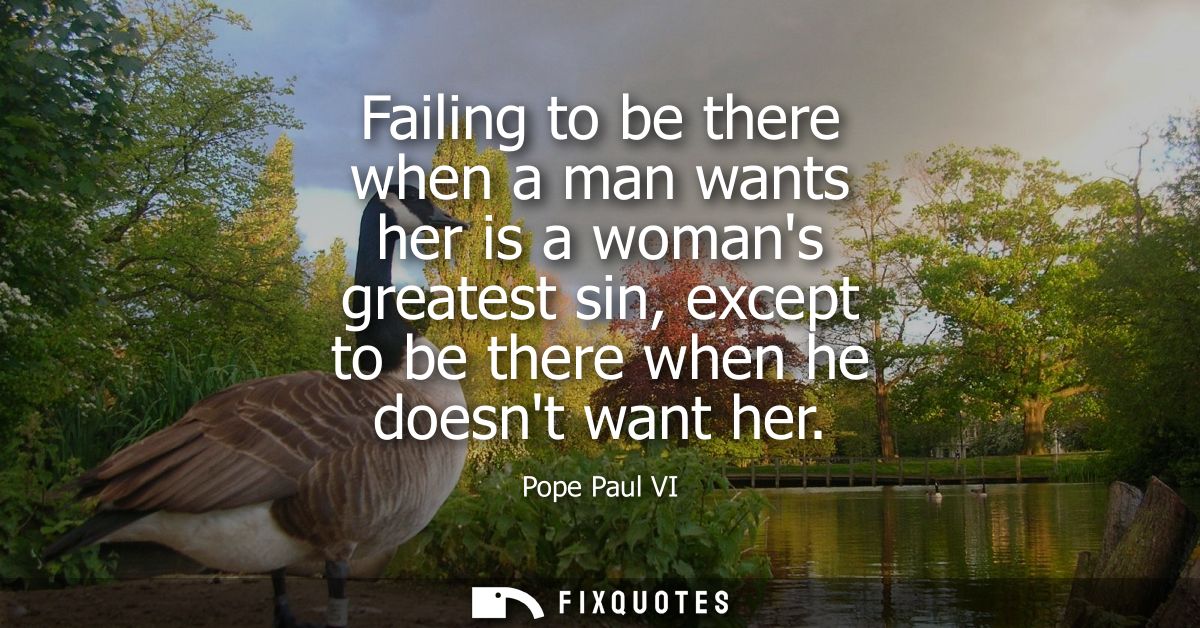
"Failing to be there when a man wants her is a woman's greatest sin, except to be there when he doesn't want her"
About this Quote
The sentence is built like a trap. The first clause sets the terms of judgment (“a woman’s greatest sin”) and frames female autonomy as dereliction of duty: if he wants her and she is absent, she has failed. The second clause flips it into a no-win scenario: if he doesn’t want her and she appears, she becomes intrusive, pathetic, even contaminating. The rhetoric pretends to offer balance, but the symmetry is the point: it reduces a woman’s moral standing to her ability to correctly anticipate male desire and time her presence accordingly. Her interior life, consent, and desire are irrelevant; she’s a responsive instrument.
The subtext is less about sexuality than about control. “Sin” does theological heavy lifting, smuggling a social expectation into the language of eternal consequence. In the era of Vatican II and the Church’s anxious engagement with modernity, this kind of formulation helps explain why Catholic teaching on marriage and sexuality often read as discipline masquerading as compassion: female virtue equals availability, but only on male terms. The wit is incidental; the worldview is the headline.
Quote Details
| Topic | Romantic |
|---|---|
| Source | Help us find the source |
| Cite |
Citation Formats
APA Style (7th ed.)
VI, Pope Paul. (2026, January 15). Failing to be there when a man wants her is a woman's greatest sin, except to be there when he doesn't want her. FixQuotes. https://fixquotes.com/quotes/failing-to-be-there-when-a-man-wants-her-is-a-159509/
Chicago Style
VI, Pope Paul. "Failing to be there when a man wants her is a woman's greatest sin, except to be there when he doesn't want her." FixQuotes. January 15, 2026. https://fixquotes.com/quotes/failing-to-be-there-when-a-man-wants-her-is-a-159509/.
MLA Style (9th ed.)
"Failing to be there when a man wants her is a woman's greatest sin, except to be there when he doesn't want her." FixQuotes, 15 Jan. 2026, https://fixquotes.com/quotes/failing-to-be-there-when-a-man-wants-her-is-a-159509/. Accessed 16 Feb. 2026.