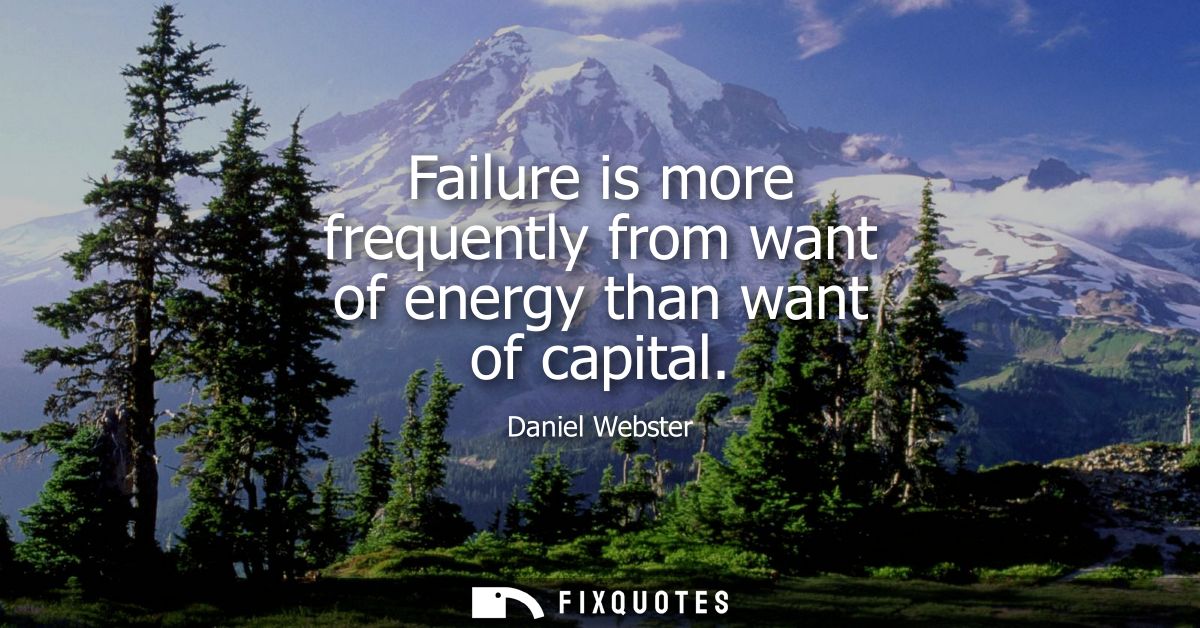
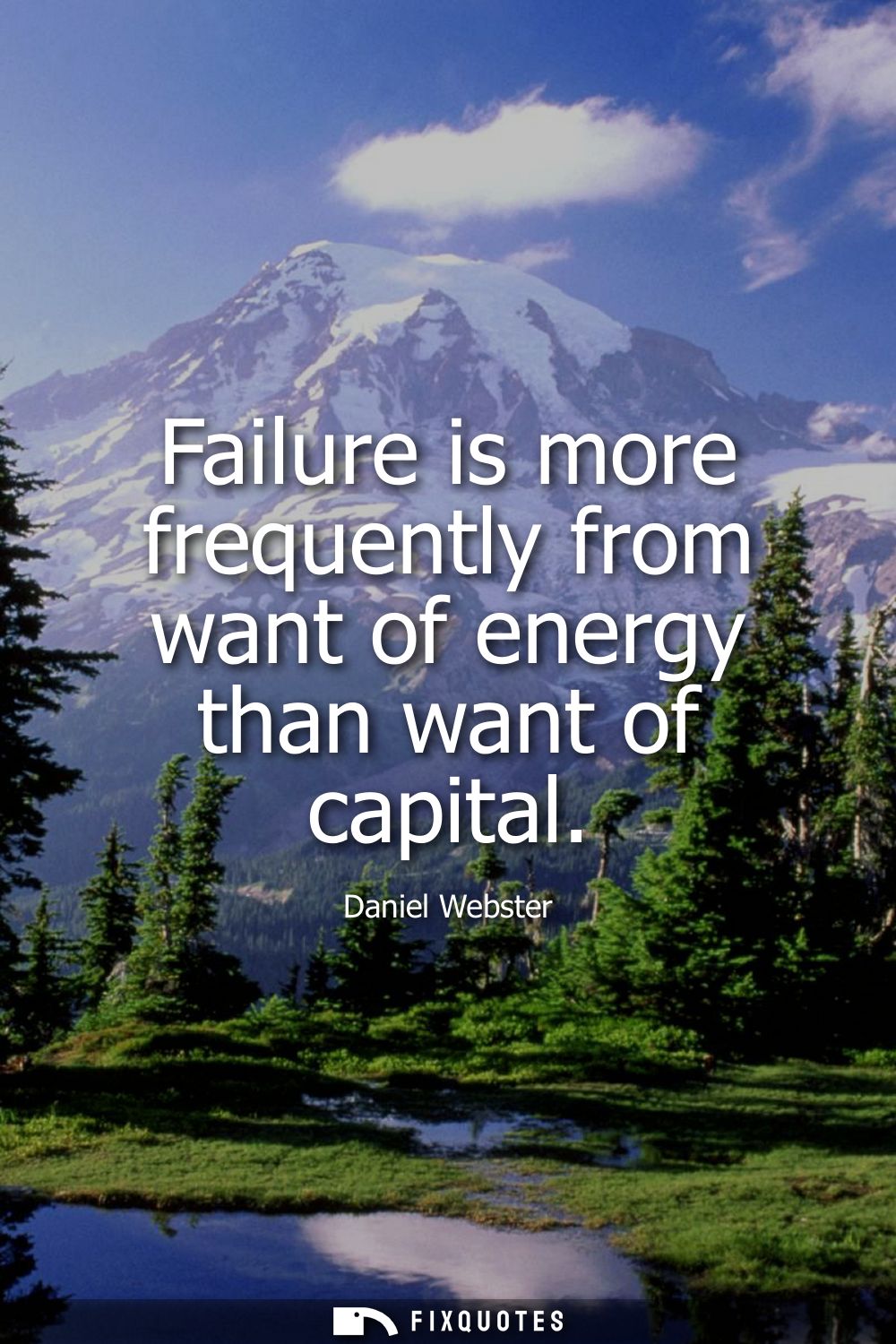
"Failure is more frequently from want of energy than want of capital"
About this Quote
Webster’s line lands like a brisk rebuke in the era’s favorite dialect: self-reliance, not excuses. “Capital” here isn’t just money; it’s the alibi people reach for when a project stalls. By flipping the expected culprit, he’s doing political rhetoric at street level, translating national ambition into personal discipline. The sentence has the tidy, courtroom logic of a statesman who spent his life arguing that outcomes have causes, and causes can be chosen.
The subtext is sharper than it first appears. Webster isn’t denying that material conditions matter in a young republic still building banks, canals, and industry. He’s insisting that energy - drive, organization, persistence, the willingness to risk reputation and comfort - is the multiplier that makes capital useful. Money sitting still is dead weight; energy turns it into motion. That emphasis flatters the striver and chastises the complacent, which is exactly what a public figure wants when selling big projects and civic confidence.
Context matters: the early-to-mid 19th century was a period of infrastructure booms, speculative bubbles, and expanding markets. Americans argued constantly about credit, investment, and the moral hazards of debt. Webster, a nationalist and booster of economic development, threads the needle: he nods to the importance of capital while moralizing its limits. The line legitimizes ambition without sounding like a banker’s sermon. It’s a call to treat “lack of funds” less as fate than as a test of will, a rhetorical move that turns economic struggle into a character question - and makes the speaker the judge.
The subtext is sharper than it first appears. Webster isn’t denying that material conditions matter in a young republic still building banks, canals, and industry. He’s insisting that energy - drive, organization, persistence, the willingness to risk reputation and comfort - is the multiplier that makes capital useful. Money sitting still is dead weight; energy turns it into motion. That emphasis flatters the striver and chastises the complacent, which is exactly what a public figure wants when selling big projects and civic confidence.
Context matters: the early-to-mid 19th century was a period of infrastructure booms, speculative bubbles, and expanding markets. Americans argued constantly about credit, investment, and the moral hazards of debt. Webster, a nationalist and booster of economic development, threads the needle: he nods to the importance of capital while moralizing its limits. The line legitimizes ambition without sounding like a banker’s sermon. It’s a call to treat “lack of funds” less as fate than as a test of will, a rhetorical move that turns economic struggle into a character question - and makes the speaker the judge.
Quote Details
| Topic | Work Ethic |
|---|---|
| Source | Help us find the source |
| Cite |
Citation Formats
APA Style (7th ed.)
Webster, Daniel. (2026, January 18). Failure is more frequently from want of energy than want of capital. FixQuotes. https://fixquotes.com/quotes/failure-is-more-frequently-from-want-of-energy-15513/
Chicago Style
Webster, Daniel. "Failure is more frequently from want of energy than want of capital." FixQuotes. January 18, 2026. https://fixquotes.com/quotes/failure-is-more-frequently-from-want-of-energy-15513/.
MLA Style (9th ed.)
"Failure is more frequently from want of energy than want of capital." FixQuotes, 18 Jan. 2026, https://fixquotes.com/quotes/failure-is-more-frequently-from-want-of-energy-15513/. Accessed 15 Mar. 2026.
More Quotes by Daniel
Add to List