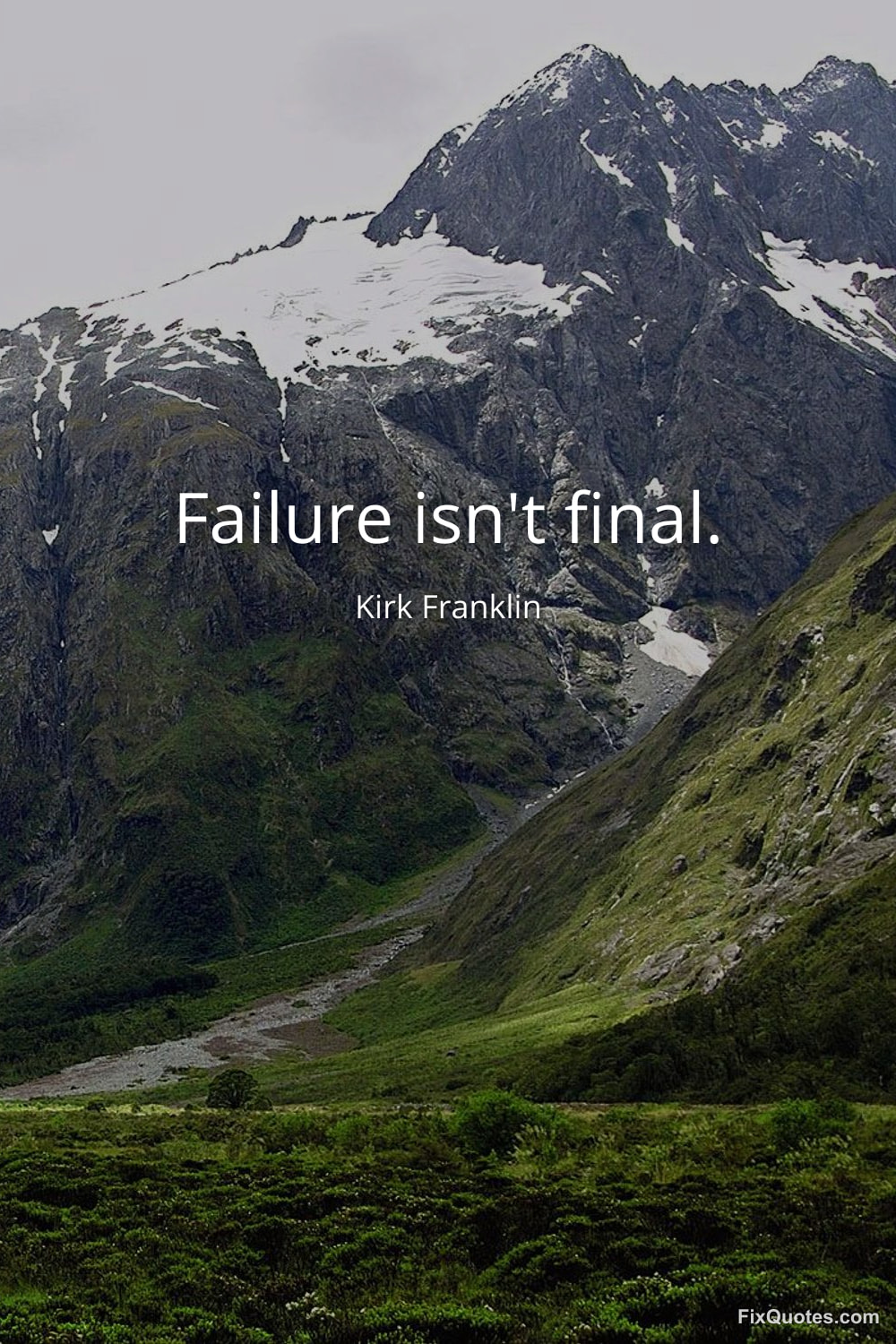
"Failure isn't final"
About this Quote
In four blunt words, Kirk Franklin turns a verdict into a comma. "Failure isn't final" lands like a gospel riff: simple, repeatable, built to be shouted back when the room gets quiet. Franklin's whole brand of faith-forward, hip-hop-adjacent uplift depends on that kind of compression. He doesn't offer a strategy or a timeline; he attacks the story we tell ourselves when we mess up, the one that tries to seal a single moment into an identity.
The intent is pastoral but street-level. Franklin isn't talking to an abstract "you"; he's talking to people who know what it is to be counted out, judged, relapsed on, laughed at. The line sidesteps the sugary "everything happens for a reason" lane and instead insists on continuation. The power comes from the negation: it doesn't promise you won't fail, it refuses the idea that failure gets the last word.
Subtextually, it's also a rebuke to respectability politics and the perfectionism that can haunt both church culture and celebrity culture. Franklin has lived in public with both praise and scrutiny; the quote reads like armor against the shame machine, including the version that operates inside religious spaces. "Final" is a loaded word in a tradition obsessed with judgment and redemption. By denying finality, he makes room for grace without having to sermonize.
Context matters: Franklin emerged when gospel was crossing into mainstream platforms, where success is measured in charts and branding. The line quietly separates spiritual worth from public metrics, arguing that your worst moment is not your closing credits.
The intent is pastoral but street-level. Franklin isn't talking to an abstract "you"; he's talking to people who know what it is to be counted out, judged, relapsed on, laughed at. The line sidesteps the sugary "everything happens for a reason" lane and instead insists on continuation. The power comes from the negation: it doesn't promise you won't fail, it refuses the idea that failure gets the last word.
Subtextually, it's also a rebuke to respectability politics and the perfectionism that can haunt both church culture and celebrity culture. Franklin has lived in public with both praise and scrutiny; the quote reads like armor against the shame machine, including the version that operates inside religious spaces. "Final" is a loaded word in a tradition obsessed with judgment and redemption. By denying finality, he makes room for grace without having to sermonize.
Context matters: Franklin emerged when gospel was crossing into mainstream platforms, where success is measured in charts and branding. The line quietly separates spiritual worth from public metrics, arguing that your worst moment is not your closing credits.
Quote Details
| Topic | Failure |
|---|---|
| Source | Kirk Franklin, social media post (Instagram/Twitter-style motivational posts; specific post date not provided here) |
| Cite |
Citation Formats
APA Style (7th ed.)
Franklin, Kirk. (2026, February 16). Failure isn't final. FixQuotes. https://fixquotes.com/quotes/failure-isnt-final-184831/
Chicago Style
Franklin, Kirk. "Failure isn't final." FixQuotes. February 16, 2026. https://fixquotes.com/quotes/failure-isnt-final-184831/.
MLA Style (9th ed.)
"Failure isn't final." FixQuotes, 16 Feb. 2026, https://fixquotes.com/quotes/failure-isnt-final-184831/. Accessed 25 Mar. 2026.
More Quotes by Kirk
Add to List