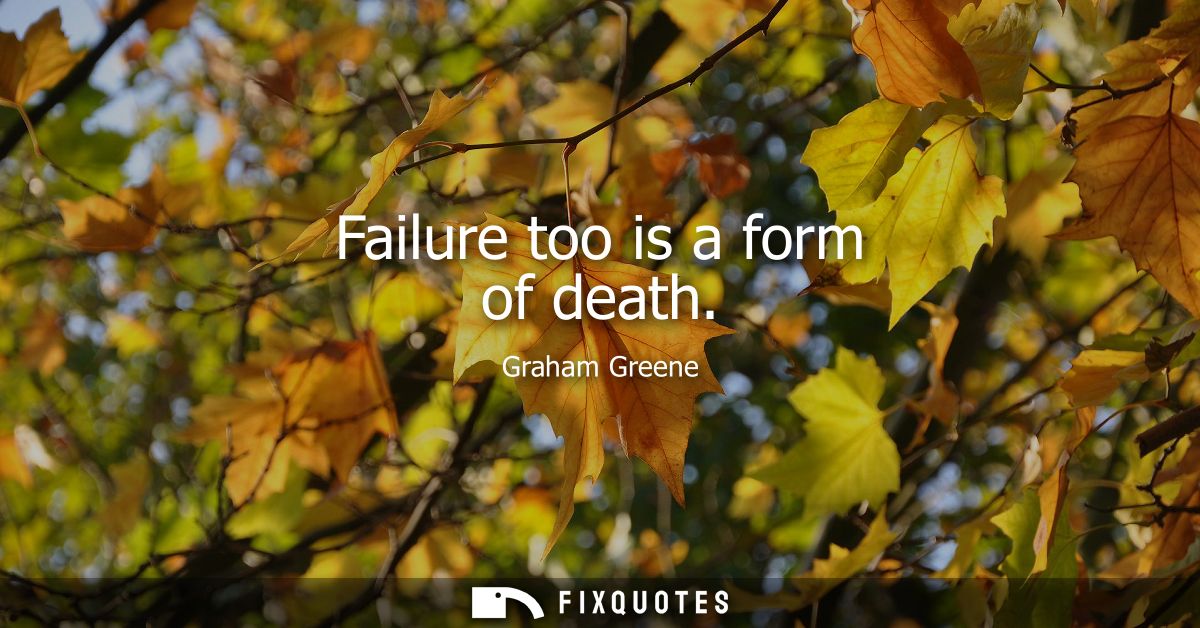
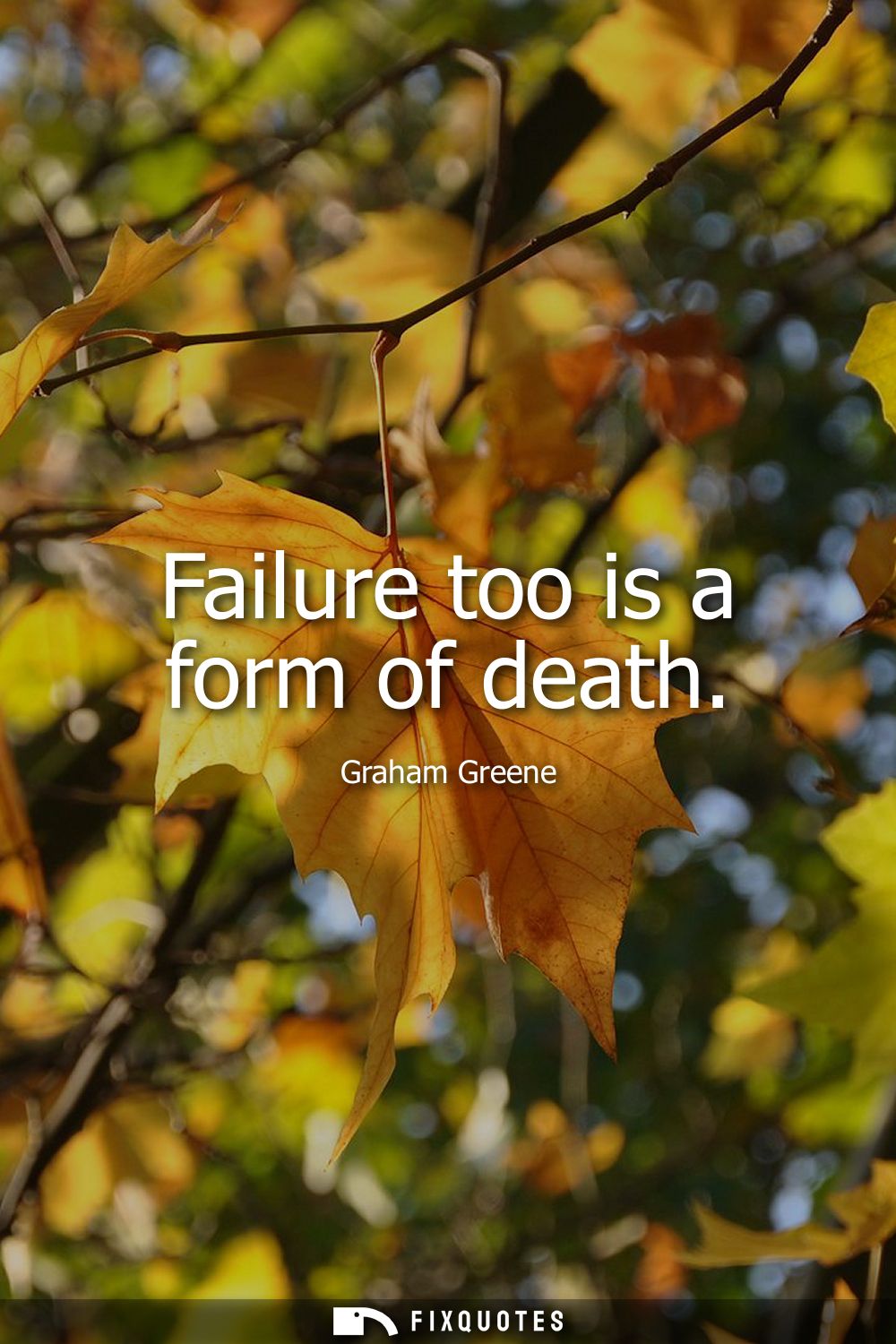
"Failure too is a form of death"
About this Quote
Greene’s line doesn’t romanticize failure as a “lesson.” It treats it as an extinction event: not the end of a body, but the collapse of a self. That’s the sting. “Too” is doing quiet, brutal work here, yoking failure to death as an adjacent category, an extra casualty we pretend isn’t terminal because it doesn’t come with a funeral.
The intent is less motivational than diagnostic. Greene is pointing to the way modern life converts performance into identity: you don’t just lose a job, a marriage, a vocation, a faith; you lose your standing in the story you tell about who you are. Failure is death in miniature because it kills continuity. It severs the thread that lets you believe tomorrow will still be “you,” just improved.
The subtext is distinctly Greene: the Catholic-tinged moral drama without the comfort of easy absolution. His characters often move through espionage, adultery, compromised ideals - lives where the decisive blow isn’t always a bullet but a private recognition of cowardice or betrayal. In that world, “failure” isn’t a résumé setback; it’s spiritual foreclosure, the moment you learn your best intentions weren’t enough to keep you decent.
Context matters: Greene wrote in a century of big systems and big disillusionments - war, ideology, bureaucratic power. In such a climate, failure can feel not merely personal but historical, as if the age itself is grading you. The line works because it refuses consolation. It names what we usually soften: that some defeats don’t teach; they erase.
The intent is less motivational than diagnostic. Greene is pointing to the way modern life converts performance into identity: you don’t just lose a job, a marriage, a vocation, a faith; you lose your standing in the story you tell about who you are. Failure is death in miniature because it kills continuity. It severs the thread that lets you believe tomorrow will still be “you,” just improved.
The subtext is distinctly Greene: the Catholic-tinged moral drama without the comfort of easy absolution. His characters often move through espionage, adultery, compromised ideals - lives where the decisive blow isn’t always a bullet but a private recognition of cowardice or betrayal. In that world, “failure” isn’t a résumé setback; it’s spiritual foreclosure, the moment you learn your best intentions weren’t enough to keep you decent.
Context matters: Greene wrote in a century of big systems and big disillusionments - war, ideology, bureaucratic power. In such a climate, failure can feel not merely personal but historical, as if the age itself is grading you. The line works because it refuses consolation. It names what we usually soften: that some defeats don’t teach; they erase.
Quote Details
| Topic | Failure |
|---|---|
| Source | Help us find the source |
| Cite |
Citation Formats
APA Style (7th ed.)
Greene, Graham. (2026, January 16). Failure too is a form of death. FixQuotes. https://fixquotes.com/quotes/failure-too-is-a-form-of-death-93242/
Chicago Style
Greene, Graham. "Failure too is a form of death." FixQuotes. January 16, 2026. https://fixquotes.com/quotes/failure-too-is-a-form-of-death-93242/.
MLA Style (9th ed.)
"Failure too is a form of death." FixQuotes, 16 Jan. 2026, https://fixquotes.com/quotes/failure-too-is-a-form-of-death-93242/. Accessed 14 Feb. 2026.
More Quotes by Graham
Add to List