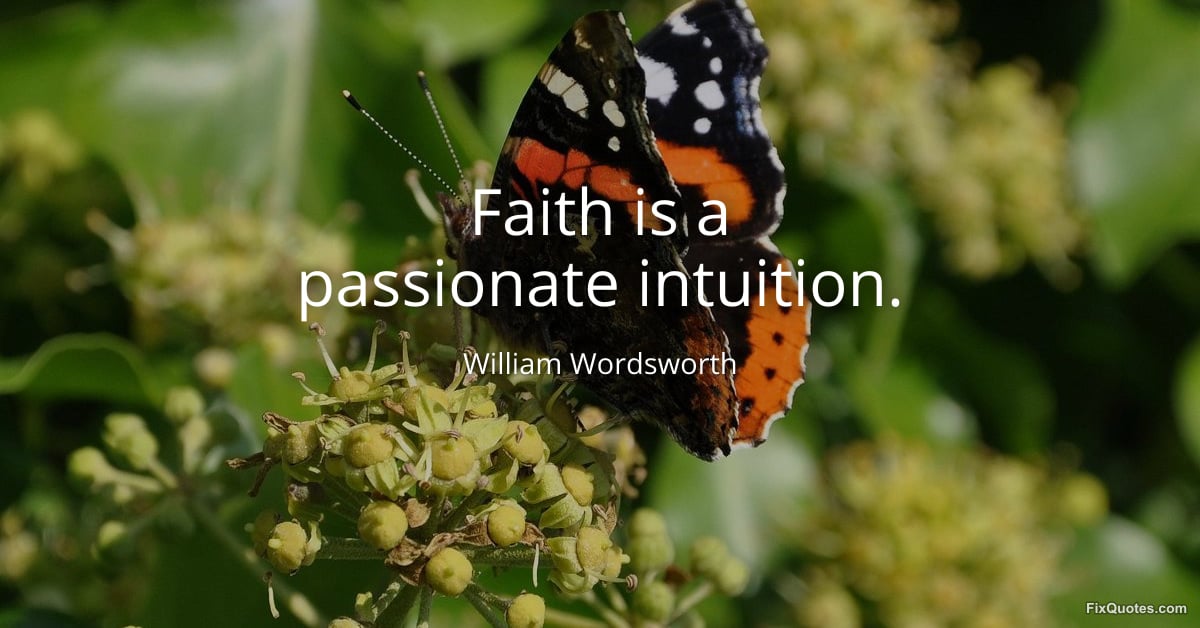
"Faith is a passionate intuition"
About this Quote
Wordsworth drags faith out of the pulpit and into the bloodstream. Calling it a "passionate intuition" is a deliberate rebuke to the Enlightenment habit of treating belief like a theorem: prove it, diagram it, submit it for peer review. He doesn’t even grant faith the dignity of calm certainty. Passion implies heat, risk, bodily commitment; intuition implies knowledge that arrives before argument, like weather. Put together, they make faith less a conclusion than a capacity - an inner instrument that detects meaning when logic runs out of signal.
The subtext is classic Romantic insurgency. Wordsworth is writing in the wake of revolution, industrial acceleration, and the creeping sense that modern life can measure everything except what makes it worth living. "Intuition" nods to the mind’s private, immediate apprehension of the world, the kind he locates in childhood perception, in nature, in quiet attention. "Passionate" insists that this apprehension isn’t optional decoration; it’s motive force. Faith, in this framing, is the emotional engine that allows the self to trust experience - to believe that the sublime isn’t just a trick of optics, that moral feeling isn’t merely social conditioning.
It works because it’s both modest and radical. Wordsworth avoids doctrinal claims, which would narrow the idea to one creed. Instead, he defines faith as a mode of perception, available to anyone willing to take their own responsiveness seriously. That’s a poet’s move: shifting authority from institutions to the felt encounter, and making belief sound like attention turned all the way up.
The subtext is classic Romantic insurgency. Wordsworth is writing in the wake of revolution, industrial acceleration, and the creeping sense that modern life can measure everything except what makes it worth living. "Intuition" nods to the mind’s private, immediate apprehension of the world, the kind he locates in childhood perception, in nature, in quiet attention. "Passionate" insists that this apprehension isn’t optional decoration; it’s motive force. Faith, in this framing, is the emotional engine that allows the self to trust experience - to believe that the sublime isn’t just a trick of optics, that moral feeling isn’t merely social conditioning.
It works because it’s both modest and radical. Wordsworth avoids doctrinal claims, which would narrow the idea to one creed. Instead, he defines faith as a mode of perception, available to anyone willing to take their own responsiveness seriously. That’s a poet’s move: shifting authority from institutions to the felt encounter, and making belief sound like attention turned all the way up.
Quote Details
| Topic | Faith |
|---|---|
| Source | Help us find the source |
| Cite |
Citation Formats
APA Style (7th ed.)
Wordsworth, William. (2026, January 15). Faith is a passionate intuition. FixQuotes. https://fixquotes.com/quotes/faith-is-a-passionate-intuition-3430/
Chicago Style
Wordsworth, William. "Faith is a passionate intuition." FixQuotes. January 15, 2026. https://fixquotes.com/quotes/faith-is-a-passionate-intuition-3430/.
MLA Style (9th ed.)
"Faith is a passionate intuition." FixQuotes, 15 Jan. 2026, https://fixquotes.com/quotes/faith-is-a-passionate-intuition-3430/. Accessed 2 Apr. 2026.
More Quotes by William
Add to List