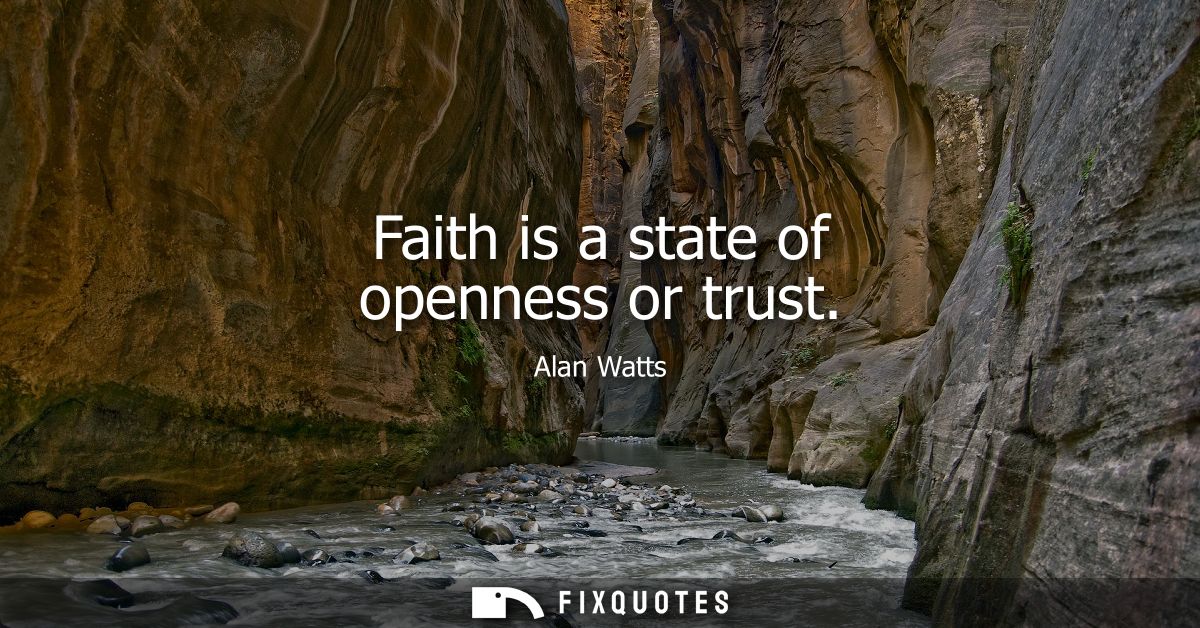
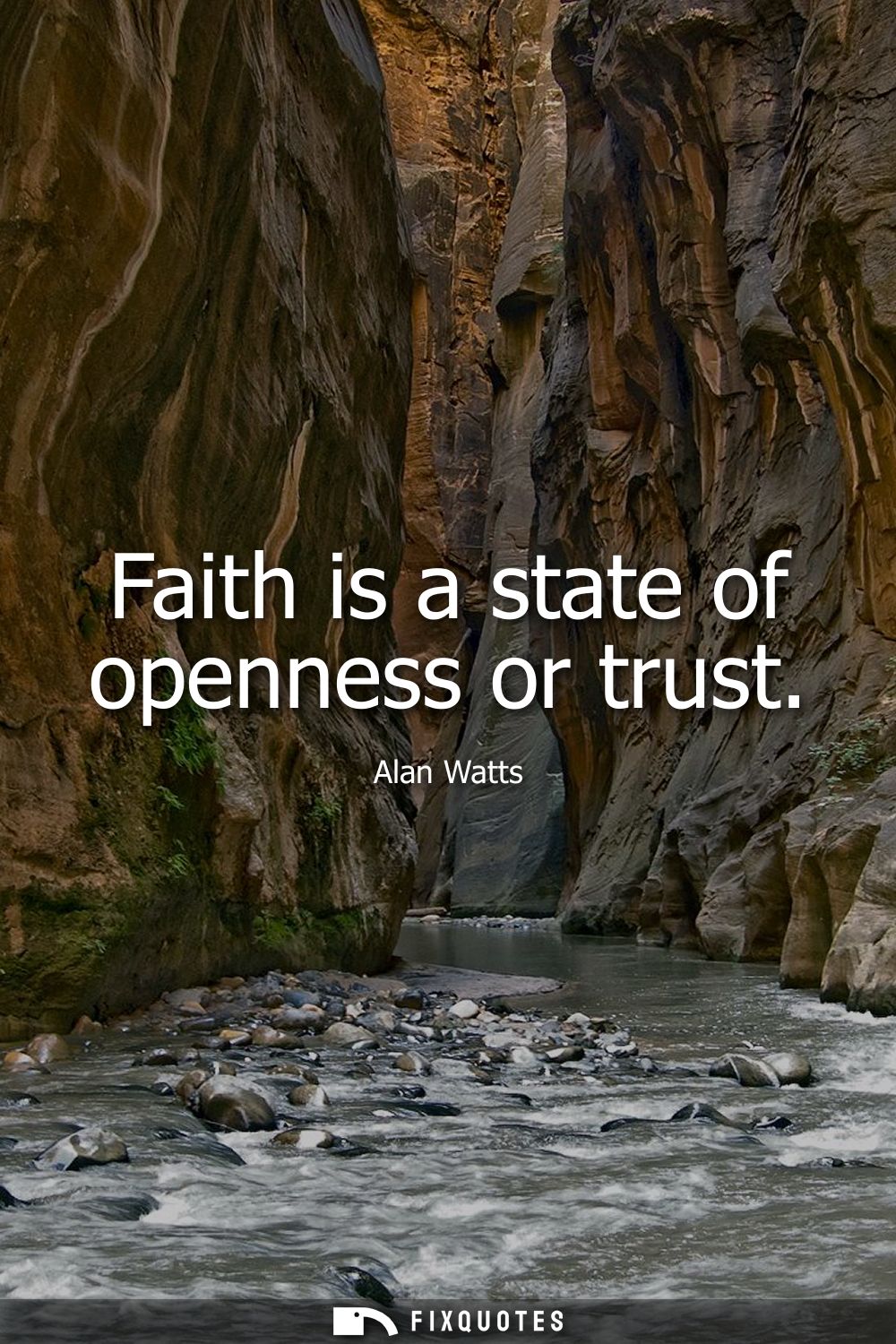
"Faith is a state of openness or trust"
About this Quote
Watts doesn’t treat faith as a mental trophy you win by believing the right things; he treats it as a posture, almost a bodily stance toward reality. Calling it “a state of openness or trust” quietly strips faith of its usual muscular certainty. No clenched jaw, no doctrinal scoreboard. The intent is corrective: to rescue faith from the brittle, defensive kind of “belief” that needs constant reinforcement because it’s terrified of ambiguity.
The subtext is even sharper. Openness implies vulnerability, which means faith isn’t the opposite of doubt so much as the opposite of control. Watts is nudging the reader away from the Western habit of managing life through concepts, plans, and identities - as if the mind can negotiate a contract with existence. Trust, in his framing, isn’t naive optimism; it’s an earned willingness to stop treating uncertainty as an emergency.
Context matters because Watts built his public philosophy in the mid-century West, translating Zen and Taoist ideas for audiences shaped by Christian moral seriousness and modern secular anxiety. In Zen terms, the “state” he points to resembles beginner’s mind: receptive, unarmored, attentive. In cultural terms, it’s a critique of a society that confuses information with wisdom and certainty with safety.
Why it works is its quiet provocation: redefining faith as an experience rather than a proposition. That move makes faith available to skeptics and believers alike - not as a ticket to being right, but as a way of living that can tolerate the world as it is, unfinished and uncontrollable.
The subtext is even sharper. Openness implies vulnerability, which means faith isn’t the opposite of doubt so much as the opposite of control. Watts is nudging the reader away from the Western habit of managing life through concepts, plans, and identities - as if the mind can negotiate a contract with existence. Trust, in his framing, isn’t naive optimism; it’s an earned willingness to stop treating uncertainty as an emergency.
Context matters because Watts built his public philosophy in the mid-century West, translating Zen and Taoist ideas for audiences shaped by Christian moral seriousness and modern secular anxiety. In Zen terms, the “state” he points to resembles beginner’s mind: receptive, unarmored, attentive. In cultural terms, it’s a critique of a society that confuses information with wisdom and certainty with safety.
Why it works is its quiet provocation: redefining faith as an experience rather than a proposition. That move makes faith available to skeptics and believers alike - not as a ticket to being right, but as a way of living that can tolerate the world as it is, unfinished and uncontrollable.
Quote Details
| Topic | Faith |
|---|---|
| Source | Help us find the source |
| Cite |
Citation Formats
APA Style (7th ed.)
Watts, Alan. (2026, January 17). Faith is a state of openness or trust. FixQuotes. https://fixquotes.com/quotes/faith-is-a-state-of-openness-or-trust-29576/
Chicago Style
Watts, Alan. "Faith is a state of openness or trust." FixQuotes. January 17, 2026. https://fixquotes.com/quotes/faith-is-a-state-of-openness-or-trust-29576/.
MLA Style (9th ed.)
"Faith is a state of openness or trust." FixQuotes, 17 Jan. 2026, https://fixquotes.com/quotes/faith-is-a-state-of-openness-or-trust-29576/. Accessed 12 Feb. 2026.
More Quotes by Alan
Add to List