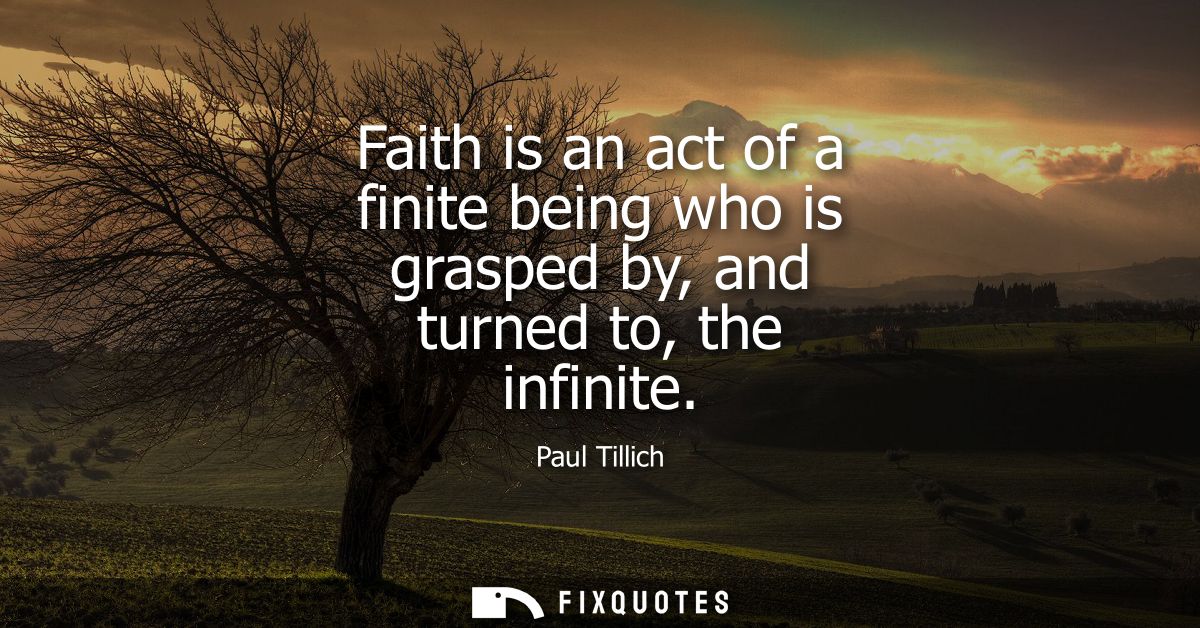
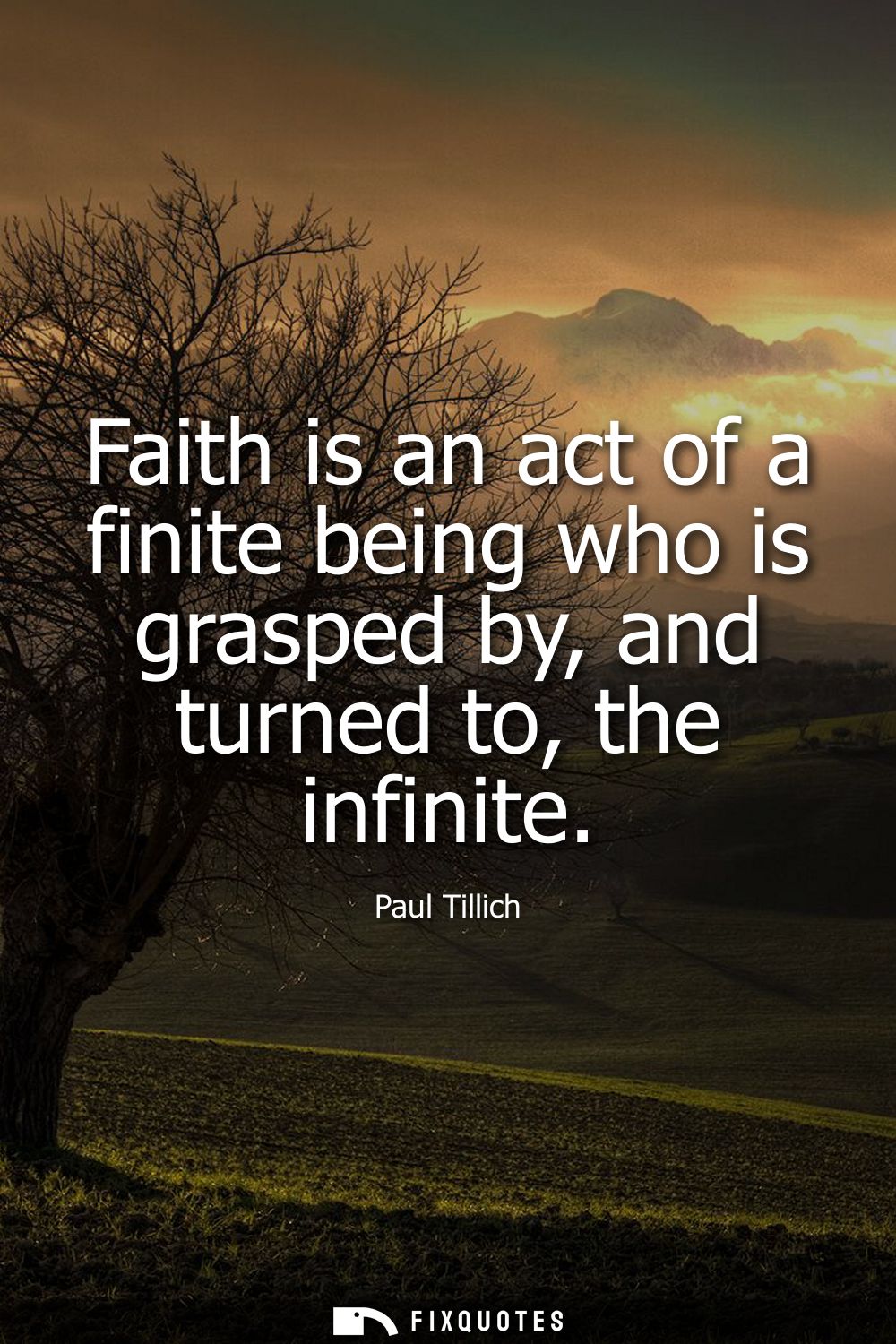
"Faith is an act of a finite being who is grasped by, and turned to, the infinite"
About this Quote
The subtext is anti-sentimental and anti-transactional. Tillich is refusing the cozy modern idea that faith is mainly reassurance or moral good behavior. He’s also refusing the fundamentalist framing of faith as intellectual assent to propositions. “Turned to” suggests conversion as direction, not dogma: a change in what you center your life around. Finite beings can’t climb their way to the infinite; the infinite bends toward them, and the result is a re-aiming.
Context matters. Writing in the shadow of world wars, mass politics, and the collapse of old certainties, Tillich treats anxiety as the baseline condition of modernity. His answer isn’t escapist confidence but “ultimate concern”: the courage to commit amid uncertainty, because what calls you is larger than your ego, your nation, your era. The line works because it dignifies human limits while insisting that limits aren’t the last word.
Quote Details
| Topic | Faith |
|---|---|
| Source | Help us find the source |
| Cite |
Citation Formats
APA Style (7th ed.)
Tillich, Paul. (2026, January 18). Faith is an act of a finite being who is grasped by, and turned to, the infinite. FixQuotes. https://fixquotes.com/quotes/faith-is-an-act-of-a-finite-being-who-is-grasped-22966/
Chicago Style
Tillich, Paul. "Faith is an act of a finite being who is grasped by, and turned to, the infinite." FixQuotes. January 18, 2026. https://fixquotes.com/quotes/faith-is-an-act-of-a-finite-being-who-is-grasped-22966/.
MLA Style (9th ed.)
"Faith is an act of a finite being who is grasped by, and turned to, the infinite." FixQuotes, 18 Jan. 2026, https://fixquotes.com/quotes/faith-is-an-act-of-a-finite-being-who-is-grasped-22966/. Accessed 28 Mar. 2026.