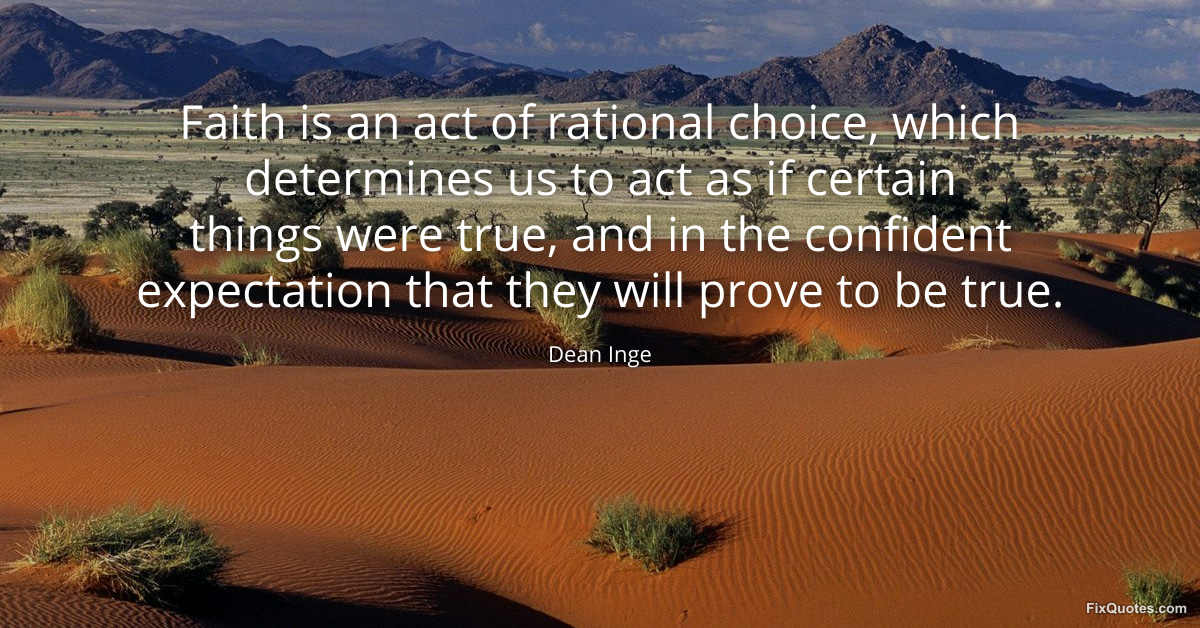
"Faith is an act of rational choice, which determines us to act as if certain things were true, and in the confident expectation that they will prove to be true"
About this Quote
The phrasing “act as if” is doing the heavy lifting. It admits that faith begins without proof, even without full confidence, and yet insists that behavior comes first. That’s pragmatic psychology before it’s a self-help slogan: live a commitment and you create the conditions in which its truth can become legible. Inge ties belief to futurity, to the wager that the world will meet you halfway. “Confident expectation” isn’t blind; it’s cultivated, a discipline of attention that treats certain goods (meaning, moral order, God) as real enough to organize a life around.
The subtext is a defense against modern skepticism and the early 20th-century prestige of scientific verification. Inge, an Anglican thinker shaped by an age of upheaval and disillusionment, reframes faith as a rational response to incomplete information rather than a refusal of evidence. It’s also a quiet rebuke to passive religiosity: if you want faith to “prove” itself, you don’t wait for lightning. You commit, act, and accept that proof may look less like a lab result and more like a life steadily clarified by the choice to trust.
Quote Details
| Topic | Faith |
|---|---|
| Source | Help us find the source |
| Cite |
Citation Formats
APA Style (7th ed.)
Inge, Dean. (2026, January 17). Faith is an act of rational choice, which determines us to act as if certain things were true, and in the confident expectation that they will prove to be true. FixQuotes. https://fixquotes.com/quotes/faith-is-an-act-of-rational-choice-which-52166/
Chicago Style
Inge, Dean. "Faith is an act of rational choice, which determines us to act as if certain things were true, and in the confident expectation that they will prove to be true." FixQuotes. January 17, 2026. https://fixquotes.com/quotes/faith-is-an-act-of-rational-choice-which-52166/.
MLA Style (9th ed.)
"Faith is an act of rational choice, which determines us to act as if certain things were true, and in the confident expectation that they will prove to be true." FixQuotes, 17 Jan. 2026, https://fixquotes.com/quotes/faith-is-an-act-of-rational-choice-which-52166/. Accessed 30 Mar. 2026.