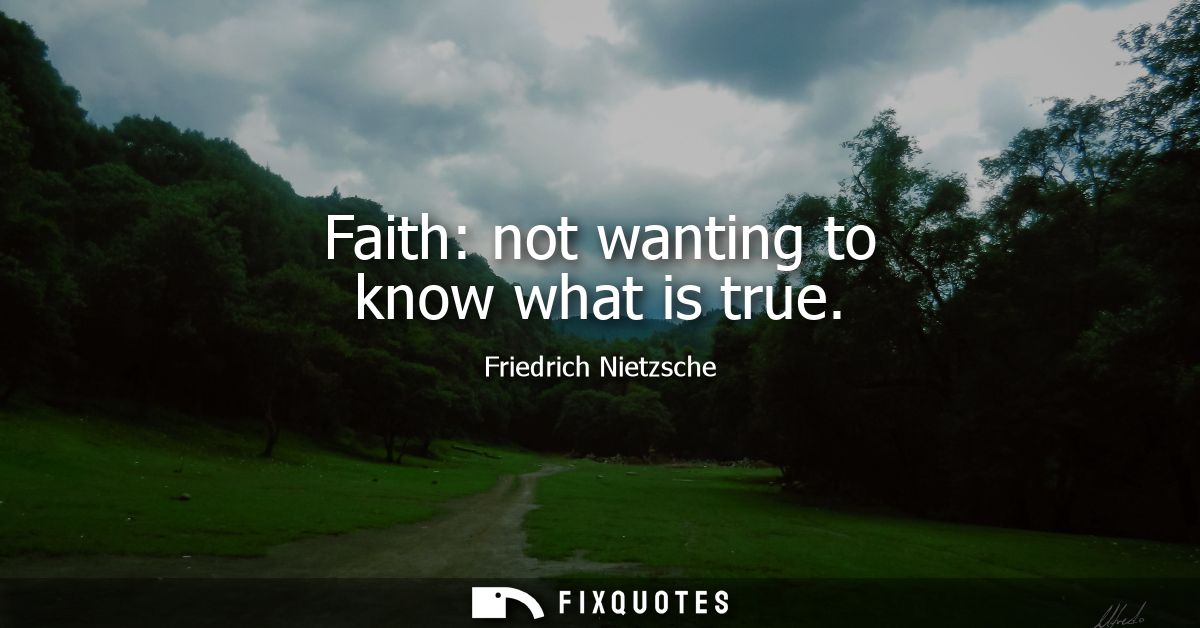
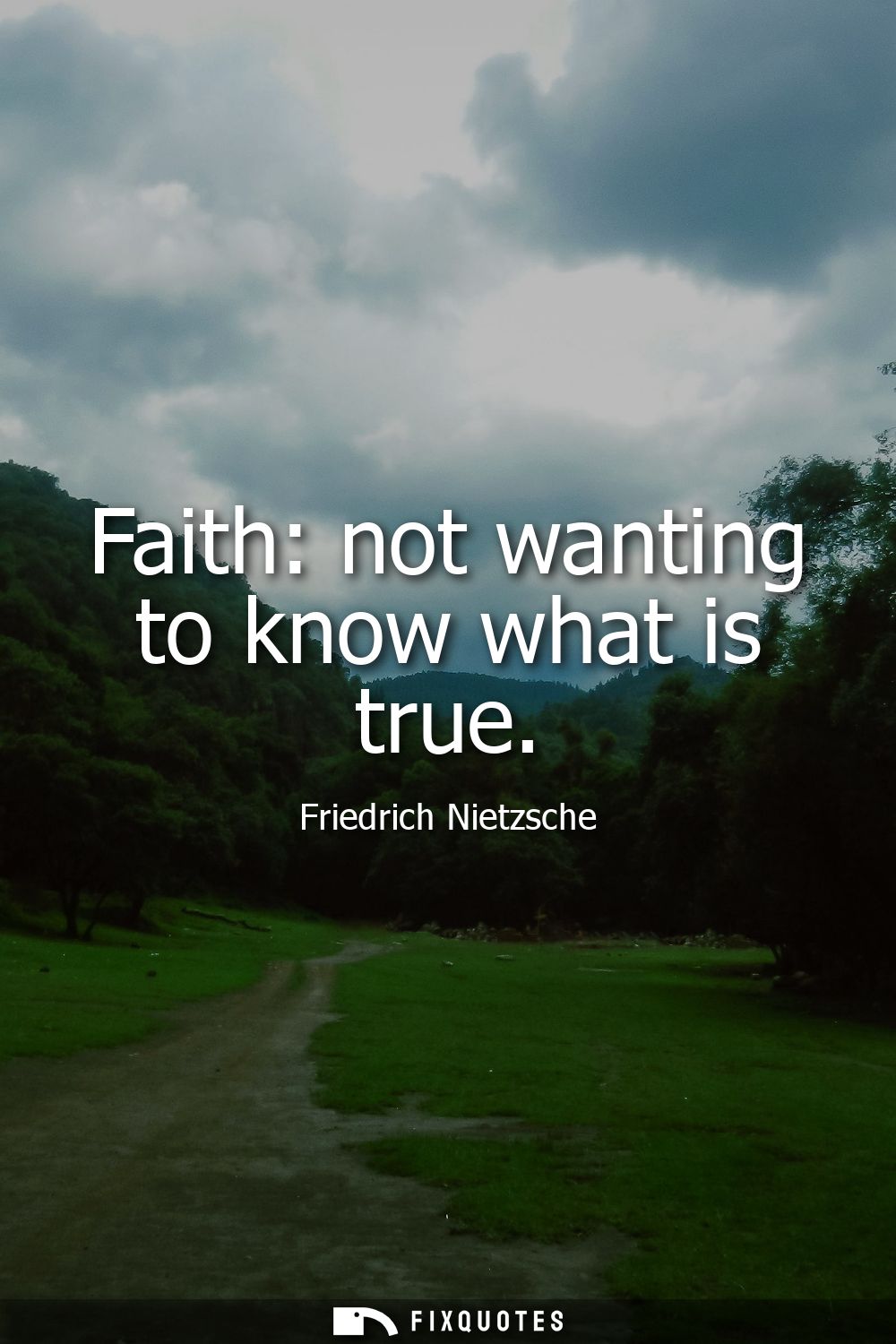
"Faith: not wanting to know what is true"
About this Quote
Nietzsche’s line is a scalpel: it cuts past faith as comfort and treats it as strategy. “Not wanting to know what is true” doesn’t accuse believers of being too dumb to grasp reality; it accuses them of preferring a protective story to the risk of reality itself. The target is willful innocence, the choice to keep the lights low because bright light reveals uncomfortable furniture: contingency, suffering without purpose, morality without cosmic backing.
The brilliance is in the phrasing. He doesn’t define faith as “believing without evidence” (a classroom cliché). He defines it as a desire, a posture of the will. That’s the Nietzschean move: epistemology becomes psychology. Belief isn’t a neutral conclusion you arrive at; it’s a lifestyle you maintain. Faith, in this framing, is less a bridge to truth than an insurance policy against it.
Context matters. Nietzsche is writing in a Europe where Christianity still supplies the moral grammar of everyday life, even as modern science and historical criticism are eroding its claims. His broader project after proclaiming “God is dead” isn’t simple atheism; it’s diagnosis: what happens to meaning, to ethics, to human energy when the old metaphysical landlord has moved out. “Faith” becomes the name for refusing that vacancy, clinging to a ready-made order to avoid the anxiety - and freedom - of building one.
The subtext is unforgiving: faith isn’t merely mistaken; it’s a kind of resentment toward life’s ambiguity. For Nietzsche, the demand for certainty can be a moral failure, not because doubt is virtuous, but because reality is.
The brilliance is in the phrasing. He doesn’t define faith as “believing without evidence” (a classroom cliché). He defines it as a desire, a posture of the will. That’s the Nietzschean move: epistemology becomes psychology. Belief isn’t a neutral conclusion you arrive at; it’s a lifestyle you maintain. Faith, in this framing, is less a bridge to truth than an insurance policy against it.
Context matters. Nietzsche is writing in a Europe where Christianity still supplies the moral grammar of everyday life, even as modern science and historical criticism are eroding its claims. His broader project after proclaiming “God is dead” isn’t simple atheism; it’s diagnosis: what happens to meaning, to ethics, to human energy when the old metaphysical landlord has moved out. “Faith” becomes the name for refusing that vacancy, clinging to a ready-made order to avoid the anxiety - and freedom - of building one.
The subtext is unforgiving: faith isn’t merely mistaken; it’s a kind of resentment toward life’s ambiguity. For Nietzsche, the demand for certainty can be a moral failure, not because doubt is virtuous, but because reality is.
Quote Details
| Topic | Faith |
|---|---|
| Source | Verified source: Der Antichrist (Friedrich Nietzsche, 1895)
Evidence: "Faith" means the will to avoid knowing what is true. (Kapitel 52). This line appears in §/Chapter 52 of Nietzsche’s Der Antichrist. The commonly-circulated wording “Faith: not wanting to know what is true” is a shortened/paraphrased form; the primary-text wording (in the widely used English translation hosted at the linked source) is “Faith means the will to avoid knowing what is true.” In German, it is commonly given as: "»Glaube« heißt Nicht-wissen-wollen, was wahr ist." Other candidates (1) The Challenge of Evolution (Paul R. Myrant, 2009) compilation87.5% ... Friedrich Nietzsche said , " Faith : not wanting to know what is true.xi " Richard Dawkins claimed : Faith is the... |
| Cite |
Citation Formats
APA Style (7th ed.)
Nietzsche, Friedrich. (2026, February 19). Faith: not wanting to know what is true. FixQuotes. https://fixquotes.com/quotes/faith-not-wanting-to-know-what-is-true-172642/
Chicago Style
Nietzsche, Friedrich. "Faith: not wanting to know what is true." FixQuotes. February 19, 2026. https://fixquotes.com/quotes/faith-not-wanting-to-know-what-is-true-172642/.
MLA Style (9th ed.)
"Faith: not wanting to know what is true." FixQuotes, 19 Feb. 2026, https://fixquotes.com/quotes/faith-not-wanting-to-know-what-is-true-172642/. Accessed 19 Mar. 2026.
More Quotes by Friedrich
Add to List