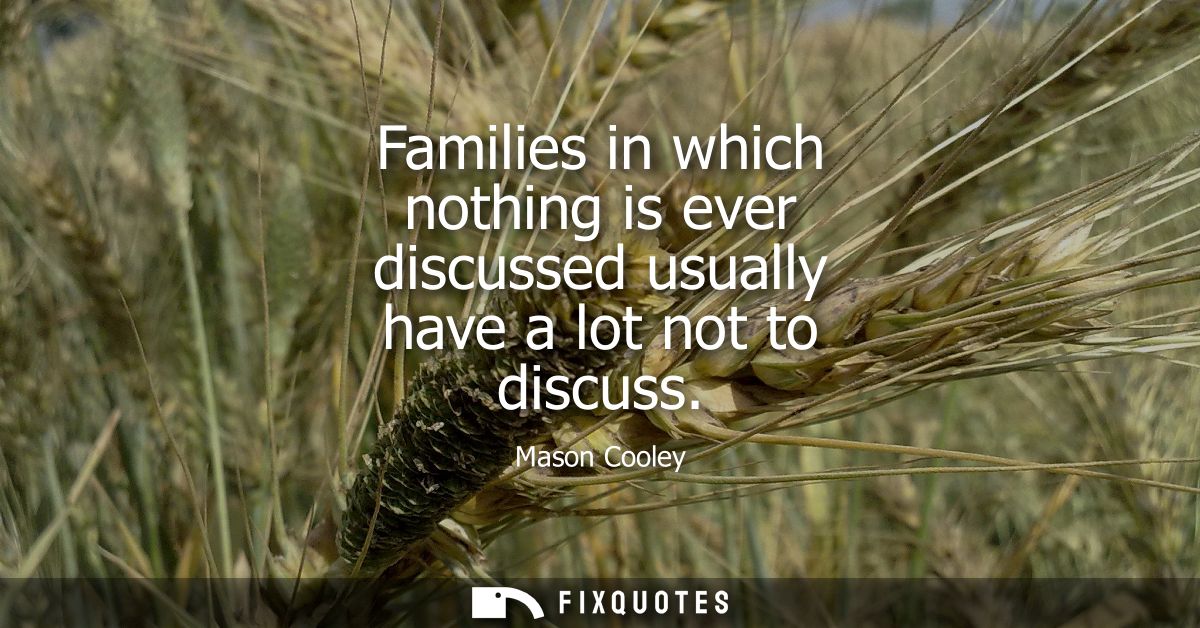
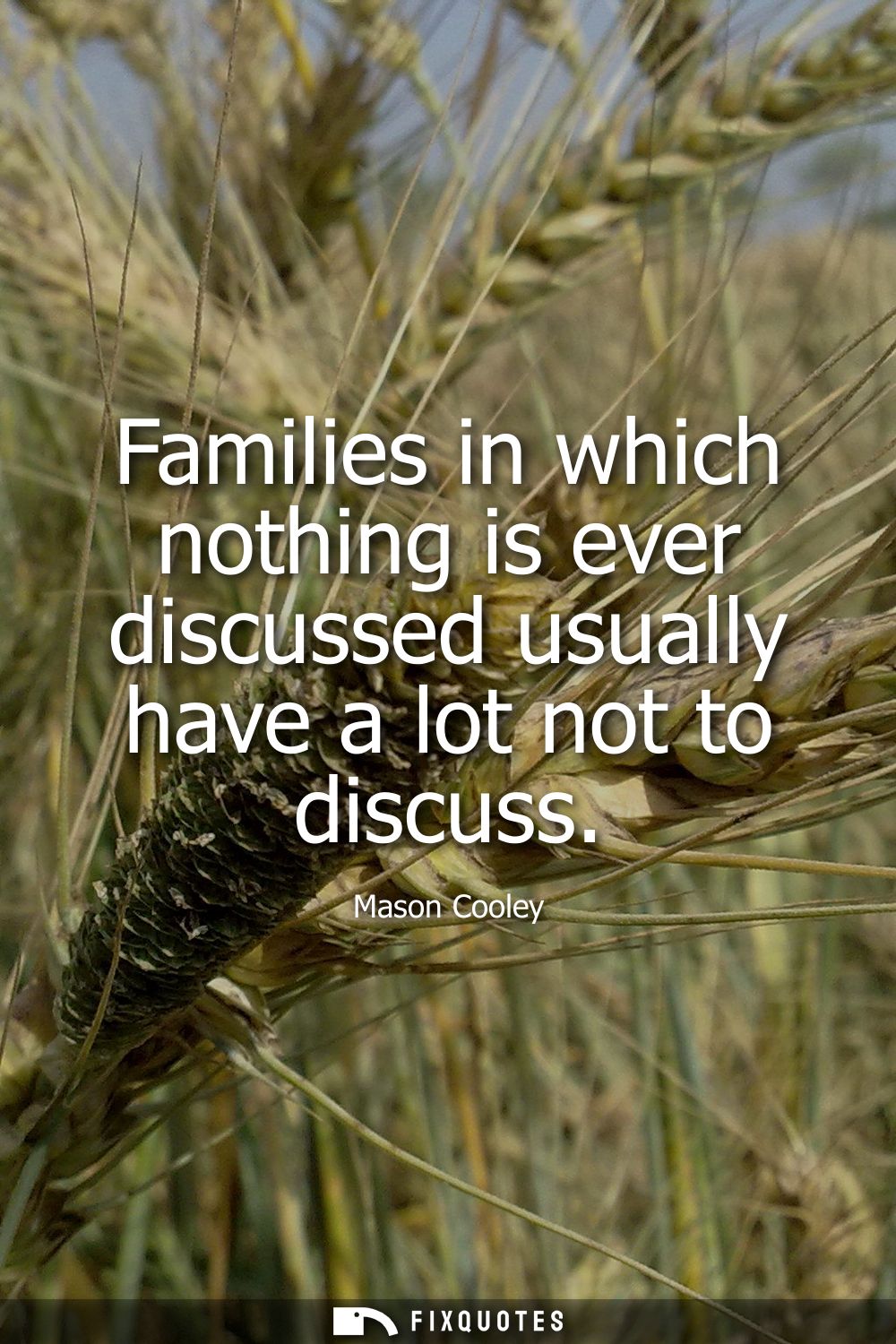
"Families in which nothing is ever discussed usually have a lot not to discuss"
About this Quote
The wit hinges on that sly repetition: “discussed” becomes “to discuss,” shifting from behavior to inventory. What’s unsaid isn’t empty; it’s stocked. The joke works because it mimics the logic families use to justify avoidance: if we don’t bring it up, it doesn’t exist. Cooley’s line punctures that magical thinking with one clean reversal.
The subtext is about power. Silence is rarely neutral; it’s enforced. Someone benefits when certain topics stay off the table: money, addiction, sexuality, resentment, politics, grief. “Usually” is doing important work here, too. He isn’t writing a sentimental universal; he’s describing a pattern of repression that feels familiar precisely because it’s so socially rewarded.
Contextually, Cooley’s aphorisms sit in a late-20th-century moment when public life was getting more confessional (therapy-speak, memoir culture) while many private lives remained rigidly performative. The line reads like a note from the edge of the living room: the calm is staged, and everyone knows it.
Quote Details
| Topic | Family |
|---|---|
| Source | Help us find the source |
| Cite |
Citation Formats
APA Style (7th ed.)
Cooley, Mason. (2026, January 16). Families in which nothing is ever discussed usually have a lot not to discuss. FixQuotes. https://fixquotes.com/quotes/families-in-which-nothing-is-ever-discussed-93709/
Chicago Style
Cooley, Mason. "Families in which nothing is ever discussed usually have a lot not to discuss." FixQuotes. January 16, 2026. https://fixquotes.com/quotes/families-in-which-nothing-is-ever-discussed-93709/.
MLA Style (9th ed.)
"Families in which nothing is ever discussed usually have a lot not to discuss." FixQuotes, 16 Jan. 2026, https://fixquotes.com/quotes/families-in-which-nothing-is-ever-discussed-93709/. Accessed 23 Mar. 2026.