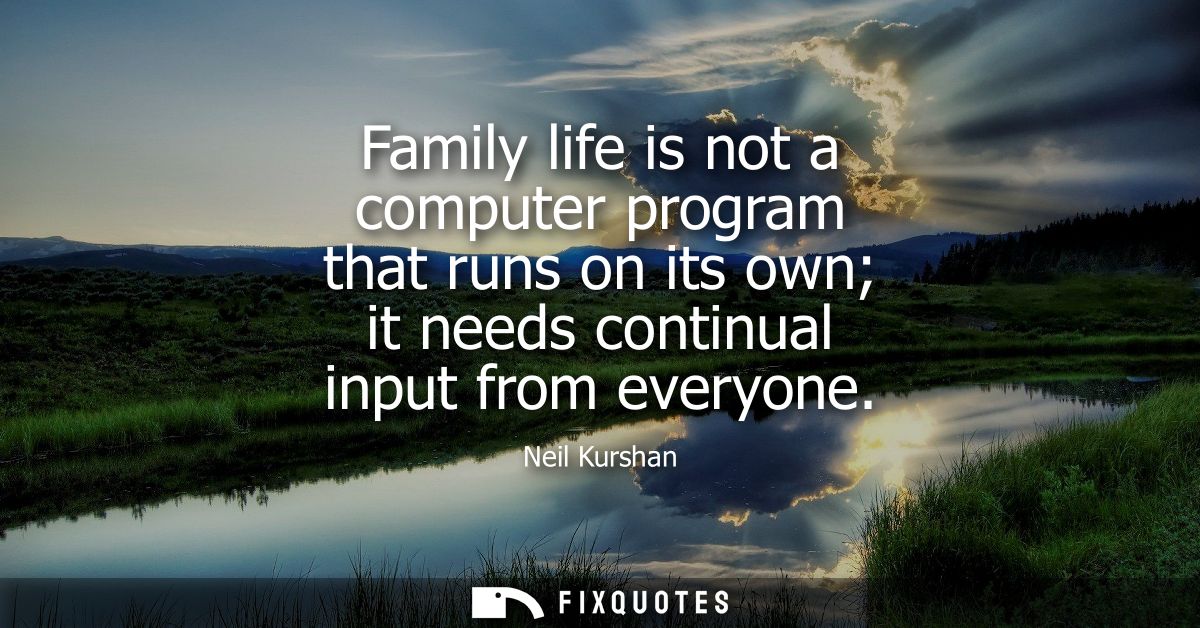
"Family life is not a computer program that runs on its own; it needs continual input from everyone"
About this Quote
The phrase “continual input” does double duty. On the surface it’s practical: attention, time, money, patience, chores, emotional labor. Underneath, it’s a reminder that neglect isn’t neutral. In technology, no input just means the program keeps running; in families, no input becomes a message, a slow withdrawal that everyone still feels. The line also smuggles in a democratic ethic: “from everyone.” Not just the parent as manager, not one spouse as the household’s default operator, not the eldest child as the backup adult. It pushes against the cultural habit of assigning maintenance to one person and then treating the family’s stability as a natural resource.
Contextually, it reads like a response to a world of calendars, parenting hacks, and productivity culture: tools that can help, but also tempt us into thinking coordination is the same as care. Kurshan’s intent is corrective, almost managerial in tone, but the subtext is emotional: families don’t “run.” They’re rebuilt, in small choices, every day.
Quote Details
| Topic | Family |
|---|---|
| Source | Help us find the source |
| Cite |
Citation Formats
APA Style (7th ed.)
Kurshan, Neil. (2026, January 16). Family life is not a computer program that runs on its own; it needs continual input from everyone. FixQuotes. https://fixquotes.com/quotes/family-life-is-not-a-computer-program-that-runs-127957/
Chicago Style
Kurshan, Neil. "Family life is not a computer program that runs on its own; it needs continual input from everyone." FixQuotes. January 16, 2026. https://fixquotes.com/quotes/family-life-is-not-a-computer-program-that-runs-127957/.
MLA Style (9th ed.)
"Family life is not a computer program that runs on its own; it needs continual input from everyone." FixQuotes, 16 Jan. 2026, https://fixquotes.com/quotes/family-life-is-not-a-computer-program-that-runs-127957/. Accessed 14 Mar. 2026.