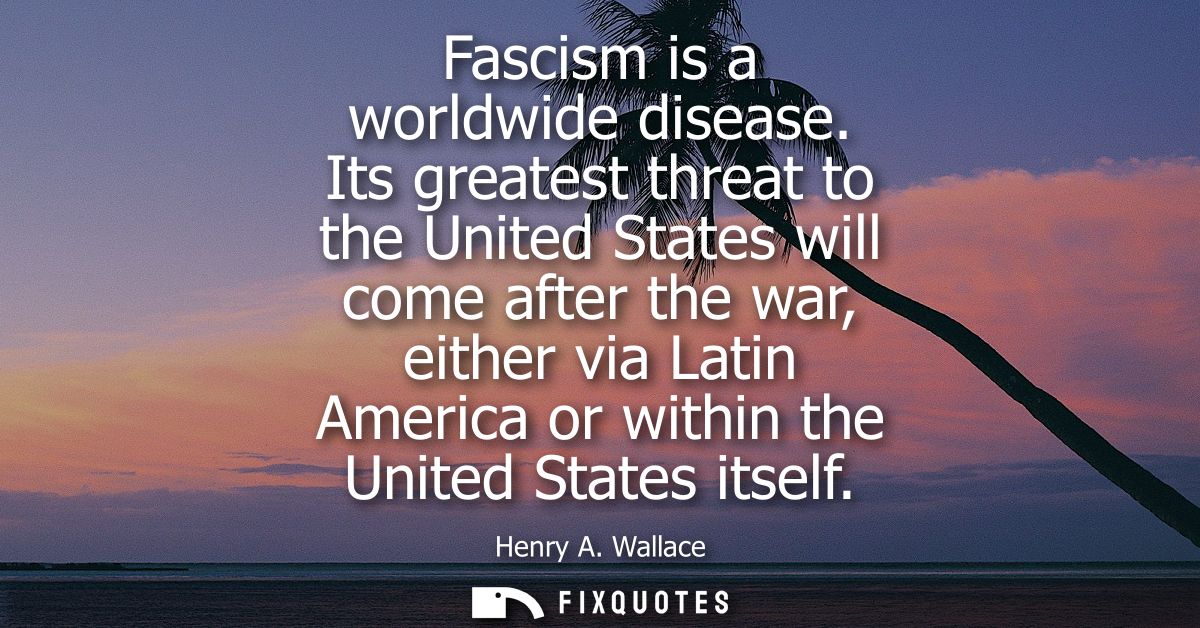
"Fascism is a worldwide disease. Its greatest threat to the United States will come after the war, either via Latin America or within the United States itself"
About this Quote
The most pointed move is the timing: “after the war.” In 1944-45, the American public was primed to see victory as closure. Wallace argues the opposite: victory is when the real test begins, because democracies relax and power brokers reorganize. He’s also pushing against a familiar U.S. habit of externalizing evil. By naming Latin America, he’s nodding to the region’s strongmen, oligarchic alliances, and the ways U.S. business and security priorities could tolerate, even incubate, authoritarian regimes as “stability.” The subtext is uncomfortable: fascism can wear a friendly uniform if it protects investments and fights the “right” enemies.
Then comes the sharper blade: “within the United States itself.” Wallace is warning that fascism doesn’t need an invasion; it can arrive through domestic demagogues, corporate capture, racial terror, and the laundering of authoritarian ideas through patriotism. For a sitting vice president, this isn’t abstract alarmism. It’s a rebuke to complacency - and a forecast of a postwar politics where anti-fascism abroad could coexist with illiberalism at home.
Quote Details
| Topic | War |
|---|---|
| Source | Help us find the source |
| Cite |
Citation Formats
APA Style (7th ed.)
Wallace, Henry A. (2026, January 18). Fascism is a worldwide disease. Its greatest threat to the United States will come after the war, either via Latin America or within the United States itself. FixQuotes. https://fixquotes.com/quotes/fascism-is-a-worldwide-disease-its-greatest-20360/
Chicago Style
Wallace, Henry A. "Fascism is a worldwide disease. Its greatest threat to the United States will come after the war, either via Latin America or within the United States itself." FixQuotes. January 18, 2026. https://fixquotes.com/quotes/fascism-is-a-worldwide-disease-its-greatest-20360/.
MLA Style (9th ed.)
"Fascism is a worldwide disease. Its greatest threat to the United States will come after the war, either via Latin America or within the United States itself." FixQuotes, 18 Jan. 2026, https://fixquotes.com/quotes/fascism-is-a-worldwide-disease-its-greatest-20360/. Accessed 13 Mar. 2026.