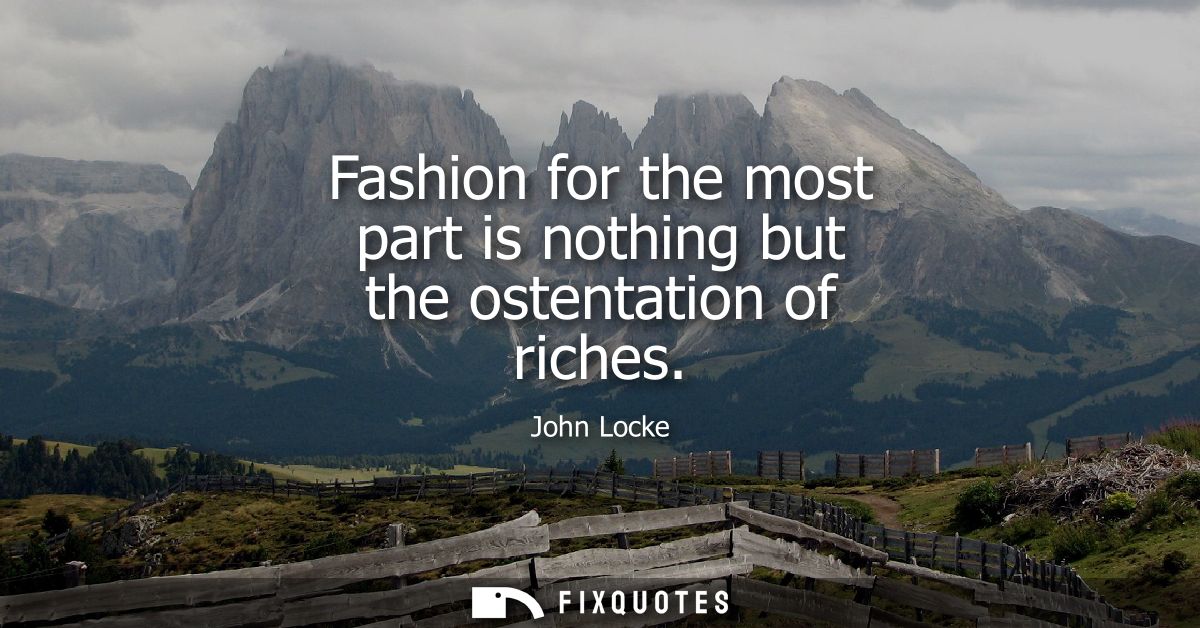
"Fashion for the most part is nothing but the ostentation of riches"
About this Quote
Locke doesn’t bother pretending fashion is a harmless playground of taste. He treats it as a social technology: a way for wealth to announce itself when direct bragging would be gauche or politically risky. “For the most part” is doing quiet but crucial work here. He leaves room for craft, comfort, or personal delight, while insisting the dominant function of fashion is display - a wearable receipt for economic power.
The subtext is classic Locke: suspicion of inherited hierarchy and impatience with the tricks that keep it looking natural. Clothing becomes a soft form of coercion. If status can be read at a glance, people self-sort, defer, imitate, and envy without anyone giving an order. That’s ostentation not as personality, but as infrastructure: it trains the eye to recognize rank, and it normalizes inequality as mere “style.”
Context matters. Locke is writing in a world where sumptuary laws had long tried (and failed) to regulate what different classes could wear, precisely because dress threatened to blur social boundaries. Early modern consumer culture was expanding; overseas trade was pumping new goods into England; the emerging bourgeoisie could buy the look of gentility. Locke’s jab lands on that anxiety: when wealth starts moving, fashion becomes the fastest language for reasserting who’s “above” whom.
It also reads like an early critique of what we now call conspicuous consumption. Not anti-beauty, but anti-mystification: if you’re going to worship a hierarchy, don’t pretend it’s art.
The subtext is classic Locke: suspicion of inherited hierarchy and impatience with the tricks that keep it looking natural. Clothing becomes a soft form of coercion. If status can be read at a glance, people self-sort, defer, imitate, and envy without anyone giving an order. That’s ostentation not as personality, but as infrastructure: it trains the eye to recognize rank, and it normalizes inequality as mere “style.”
Context matters. Locke is writing in a world where sumptuary laws had long tried (and failed) to regulate what different classes could wear, precisely because dress threatened to blur social boundaries. Early modern consumer culture was expanding; overseas trade was pumping new goods into England; the emerging bourgeoisie could buy the look of gentility. Locke’s jab lands on that anxiety: when wealth starts moving, fashion becomes the fastest language for reasserting who’s “above” whom.
It also reads like an early critique of what we now call conspicuous consumption. Not anti-beauty, but anti-mystification: if you’re going to worship a hierarchy, don’t pretend it’s art.
Quote Details
| Topic | Wealth |
|---|---|
| Source | Help us find the source |
More Quotes by John
Add to List